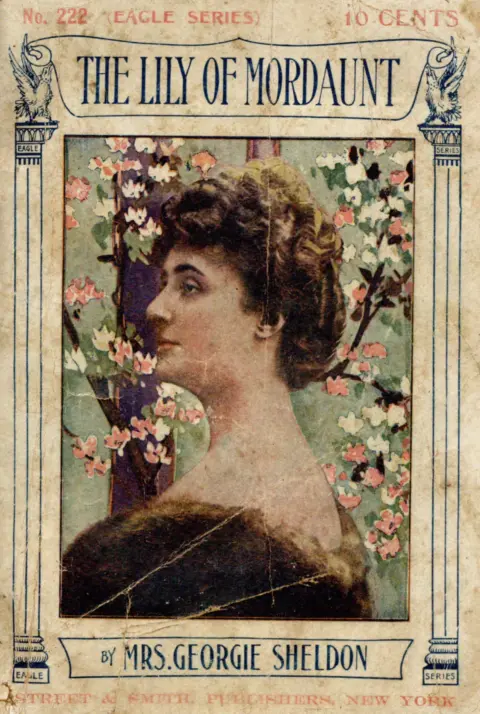
The lily of Mordaunt
Georgie, Mrs. Sheldon
THE CLASSIC COLLECTION · 1879
"Brownie's Triumph" by Mrs. Georgie Sheldon is a fiction novel written in the late 19th century. The story centers around the character of Brownie Douglas, a young heiress whose life takes a dramatic turn after the death of her wealthy aunt, leaving her without the fortune she expected. The novel explores themes of resilience, societal expectations, and the journey of a young woman as she confronts the realities of life in a world that suddenly feels far less secure. The opening of "Brownie's Triumph" introduces readers to a lively scene set during the World’s Centennial Exposition in Philadelphia. Brownie Douglas, a petite and spirited young woman, has just encountered her elegant friend Aspasia Huntington, who is struggling with her extravagant attire. The narrative unfolds with comedic moments involving a clumsy countryman, showcasing the contrast between the two young ladies. As the girls navigate through the exposition, they attract the attention of two young men, setting the stage for potential romantic developments amidst Brownie's transition from wealth to self-sufficiency after her aunt's passing. This initial glimpse of both frivolity and deeper themes offers a captivating start to Brownie’s journey.
Introduction adapted from the source catalogue; source summaries may be automatically generated.
Free to read · English · 100,316 words · No account needed
MAKE TIME FOR A GOOD BOOK
On by default. Untick to stop anonymous reading totals. Each page counts after 10 seconds in view. How this works.
Anonymous counting is on unless you have switched it off.
“I have none,” and the sad, sweet eyes filled with tears.
“Humph! That’s bad for a pretty face like yours. What do you do for a
living?”
“Teach.”
“Teach what?”
“Almost anything, except the higher classics.”
“Ah! indeed! and only nineteen! Perhaps you are one of those reduced gentlewomen, who go out governessing, and pretend to know everything!” snapped the old woman, with a sneer.
Probably she had been taken in some time during her life by some such person as she described, which accounted for her scorn.
“No, madam; I pretend to nothing. I have a good education, therefore teach for a living, and am only a poor girl without home or friends.”
Brownie’s cheeks were very red now, but her dignity would have done credit to the highest lady in the land.
The strange woman chuckled audibly, nodded her head two or three times, as if much amused, and then went on with her catechising:
“Do you read French?”
“Yes, madam,” replied the young girl, inwardly resenting the woman’s brusque manner, yet feeling bound to reverence her gray head.
“And German.”
“Yes, madam.”
“Can you play the piano, and sing?”
“I can.”
“Have you an engagement now?”
“No, madam.”
“Are you desirous of obtaining a situation?”
“I am.”
“Can you produce the ‘best of references?’”
This question was also accompanied by a sneer.
“I cannot, madam. I have only my qualifications and my own word to recommend me,” Brownie answered, with a good deal of spirit.
Again the old woman chuckled, and distorted her neck to look at her, in a way which made Brownie fear she would dislocate it.
“Where were you last?” she demanded.
Evidently the old lady possessed authority in the house, or she would not have assumed this manner toward her. She was very richly dressed, too, and despite her deformity, had the appearance of nobility about her.
Brownie tried to hide her indignation at being so persistently questioned, for she had been kindly treated, having received every care and kindness, although as yet she was unconscious how much of it was due her present tormentor.
“I taught in an American family,” she at last replied.
“Ah! Came over with them, didn’t you? And you are an American, too, aren’t you?” she asked, with a searching look.
Brownie nodded her head wearily; she was becoming very nervous.
“What was the name of the family, and what did they dismiss you for?”
This was going a little too far, and assuming too much.
Your reading position is saved on this browser. Take it to another device with a library code. Reading pages adapt to text, rather than matching a printed edition.
Georgie, Mrs. Sheldon
Georgie, Mrs. Sheldon
Georgie, Mrs. Sheldon
Georgie, Mrs. Sheldon
BEHIND THE BOOK
This eBook is for the use of anyone anywhere in the United States and most other parts of the world at no cost and with almost no restrictions whatsoever. You may copy it, give it away or re-use it under the terms of the Project Gutenberg License included with this eBook or online at www.gutenberg.org. If you are not located in the United States, you will have to check the laws of the country where you are located before using this eBook. Read the source licence.
The original source file, including credits and licence, is retained by this library. Request an original-format copy at no charge. Please include the book title and Project Gutenberg identifier #71118.
KEEP YOUR CURIOSITY GOING
Coulson Kernahan

Maurice Baring
Frances Wright
Cécile Tormay

Frederic Jesup Stimson

W. H. P. (William Henry Pope) Jarvis