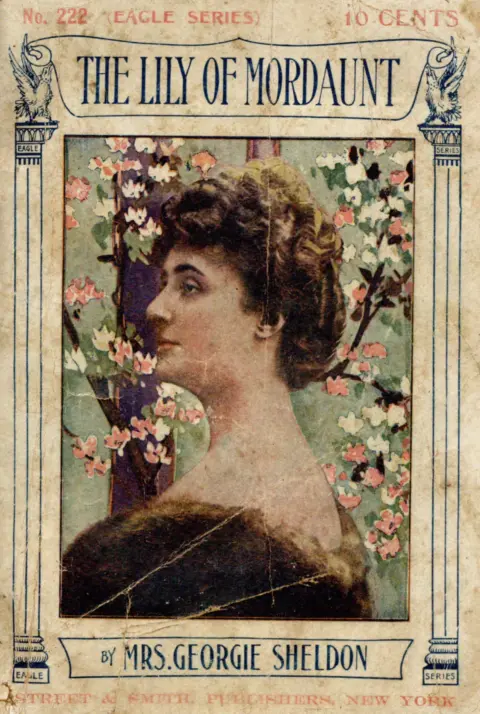
The lily of Mordaunt
Georgie, Mrs. Sheldon
THE CLASSIC COLLECTION · 1879
"Brownie's Triumph" by Mrs. Georgie Sheldon is a fiction novel written in the late 19th century. The story centers around the character of Brownie Douglas, a young heiress whose life takes a dramatic turn after the death of her wealthy aunt, leaving her without the fortune she expected. The novel explores themes of resilience, societal expectations, and the journey of a young woman as she confronts the realities of life in a world that suddenly feels far less secure. The opening of "Brownie's Triumph" introduces readers to a lively scene set during the World’s Centennial Exposition in Philadelphia. Brownie Douglas, a petite and spirited young woman, has just encountered her elegant friend Aspasia Huntington, who is struggling with her extravagant attire. The narrative unfolds with comedic moments involving a clumsy countryman, showcasing the contrast between the two young ladies. As the girls navigate through the exposition, they attract the attention of two young men, setting the stage for potential romantic developments amidst Brownie's transition from wealth to self-sufficiency after her aunt's passing. This initial glimpse of both frivolity and deeper themes offers a captivating start to Brownie’s journey.
Introduction adapted from the source catalogue; source summaries may be automatically generated.
Free to read · English · 100,316 words · No account needed
MAKE TIME FOR A GOOD BOOK
On by default. Untick to stop anonymous reading totals. Each page counts after 10 seconds in view. How this works.
Anonymous counting is on unless you have switched it off.
When she found that her father had departed without taking them with him, she was delighted, and appropriated them without a scruple, and, as time wore away, she began to look upon them as almost belonging to her.
It must be confessed that she stood a little bit in awe of her high-born
lover.
It did not take her long to discover that he was actuated only by the
loftiest sentiments.
His manner was as courteous to a servant or an inferior as to an equal, and he never stopped to consider the position of any one when granting a favor.
The beggar or the peer was befriended with equal kindness.
Open and frank himself, he could not tolerate deception or hypocrisy in any one, and a deliberate wrong incurred his deepest displeasure.
Of course, the haughty and selfish girl could feel no sympathy with any such sentiments so foreign to her own nature, but having once learned Sir Charles’s idiosyncracies, and being extremely anxious to share his coronet and plethoric purse, she exerted herself to the utmost to blind his eyes, and, to all outward appearance, she became a most earnest advocate of all his philanthropic schemes, much to his satisfaction, and the secret contempt and amusement of Viola and Alma, who neglected no opportunity when alone with their sister to torment her about it.
One evening Sir Charles invited her to walk over a portion of the estate with him, and unfolded to her his plans for beautifying it, and of improving the condition and comfort of his tenantry.
She strove to listen attentively, and appear interested in it all, but it was hard work, and although she was exceedingly kind and gracious to all whom she met, and won for herself high encomiums for her sweetness among his people, yet her heart was not in it, and she was immensely relieved when they turned their steps homeward.
On their way they had to pass the villa before described.
Just before reaching it, Sir Charles had called her attention to a
lovely view.
They stood silent for several minutes enjoying it, when suddenly a few rich chords, struck upon a fine-toned piano, saluted their ears, and then a voice of ravishing sweetness and power burst forth into joyous song.
Isabel started at the sound as if a wasp had stung her.
“Who is that?” she demanded, her face flushing with a sudden thought and
fear.
“It comes from yonder villa. Did it startle you?” asked Sir Charles, regarding her disturbed manner with some surprise.
“A little—it was so quiet before.”
“I think it very fine,” he replied, stopping to listen again to the
clear, beautiful tones.
Your reading position is saved on this browser. Take it to another device with a library code. Reading pages adapt to text, rather than matching a printed edition.
Georgie, Mrs. Sheldon
Georgie, Mrs. Sheldon
Georgie, Mrs. Sheldon
Georgie, Mrs. Sheldon
BEHIND THE BOOK
This eBook is for the use of anyone anywhere in the United States and most other parts of the world at no cost and with almost no restrictions whatsoever. You may copy it, give it away or re-use it under the terms of the Project Gutenberg License included with this eBook or online at www.gutenberg.org. If you are not located in the United States, you will have to check the laws of the country where you are located before using this eBook. Read the source licence.
The original source file, including credits and licence, is retained by this library. Request an original-format copy at no charge. Please include the book title and Project Gutenberg identifier #71118.
KEEP YOUR CURIOSITY GOING
Coulson Kernahan

Maurice Baring
Frances Wright
Cécile Tormay

Frederic Jesup Stimson

W. H. P. (William Henry Pope) Jarvis