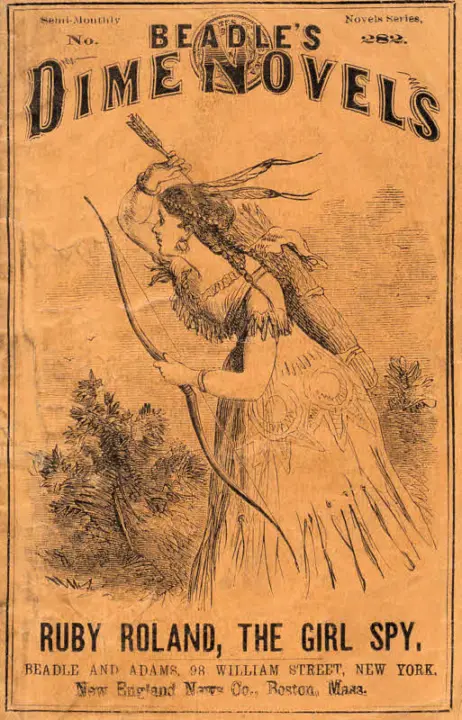
Ruby Roland, the Girl Spy; or, Simon Kenton’s Protege
Frederick Whittaker
THE CLASSIC COLLECTION · 1884
"Black Nick, the Hermit of the Hills; or, The Expiated Crime" by Frederick Whittaker is a historical novel written in the late 19th century. Set against the backdrop of the American Revolutionary War, the story involves themes of survival, espionage, and supernatural elements. The central characters include Indian warriors, a mysterious white man connected to Burgoyne's army, and the enigmatic figure of Black Nick, who embodies the supernatural aspect lurking in the wilderness. The opening of the novel introduces readers to a group of Indian warriors preparing to meet a British emissary in the midst of a twilight setting filled with portentous signs of an approaching storm. This atmosphere of tension and anticipation is compounded by the arrival of a messenger, who bears urgent news about a looming attack. Just as the plot thickens, the bizarre figure of Black Nick appears, disrupting the warrior's camp with a demoniacal presence that evokes both terror and awe. This blurs the lines between reality and myth, setting up a gripping narrative steeped in historical conflict and haunting intrigue as the characters navigate the dangers that surround them.
Introduction adapted from the source catalogue; source summaries may be automatically generated.
Free to read · English · 31,911 words · No account needed
MAKE TIME FOR A GOOD BOOK
On by default. Untick to stop anonymous reading totals. Each page counts after 10 seconds in view. How this works.
Anonymous counting is on unless you have switched it off.
The girl looked at him in amazement. She could not see that the accomplished man of the world was but taking advantage of a lucky accident, to feel his way into her confidence, by a mingling of truth and falsehood in his manner.
“Then who are you that knows me so well?” she asked, artlessly. “I never thought human creature would come nigh our cottage, and you say it is famous.”
“For my name,” said the hussar, smiling, “you may call me Captain Schuyler, if you will. If you would like a shorter name and a pleasanter one, call me Adrian.”
“Adrian is a pretty name,” said the girl, smiling with the frank, fearless innocence that distinguished her every action. “Adrian and Diana are both beautiful.”
“Diana is beautiful,” said the hussar, meaningly; “how beautiful no one
knows but me.”
Diana looked up at him inquiringly. Then something seemed to inform her of his meaning, for she flushed hotly and drew herself up with sudden haughtiness, asking:
“What brought you here? Do you not know that it is death to intrude on this mountain? Even the wild Indian shuns it.”
“I have heard that a demon haunts it,” said the hussar, boldly; “but I never dreamed that it wore such a shape as yours.”
At the bold words of the intruder Diana turned pale, and looked apprehensively around her, saying in low tones:
“Do not mention him, foolish Adrian. He will seize you and plunge you into a fiery pit if he hears you. Away, while you have time, or you may repent it. Any moment he may be here.”
“In that case I should like to see him,” said Schuyler, coolly. “I don’t believe in demons, Diana. Your demon is a man, and I am curious to see him. I rode over here expressly to do that.”
“You rode over here to dare the mountain demon?” asked the girl, in a faint tone, as if wonder-stricken. “Man, are you mad? I tell you he has killed every creature that has passed this way for years, and he will kill you, if he finds you.”
The captain of hussars laughed carelessly, and threw up the flap of one of his holsters, from whence he produced a long pistol of elegant finish, and double-barreled.
“That, for his demoniac majesty,” he said, holding up the weapon, “and let him beware how he crosses my path. I have--”
He was interrupted by a suspicious growl from one of the hounds, who had been couched on the grass in seeming contentment since the conference had become peaceful.
Your reading position is saved on this browser. Take it to another device with a library code. Reading pages adapt to text, rather than matching a printed edition.
Frederick Whittaker
BEHIND THE BOOK
This eBook is for the use of anyone anywhere in the United States and most other parts of the world at no cost and with almost no restrictions whatsoever. You may copy it, give it away or re-use it under the terms of the Project Gutenberg License included with this eBook or online at www.gutenberg.org. If you are not located in the United States, you will have to check the laws of the country where you are located before using this eBook. Read the source licence.
The original source file, including credits and licence, is retained by this library. Request an original-format copy at no charge. Please include the book title and Project Gutenberg identifier #69323.
KEEP YOUR CURIOSITY GOING
Cécile Tormay

Moritz Busch
Coulson Kernahan
John L. Ransom

Maurice Baring
Frances Wright