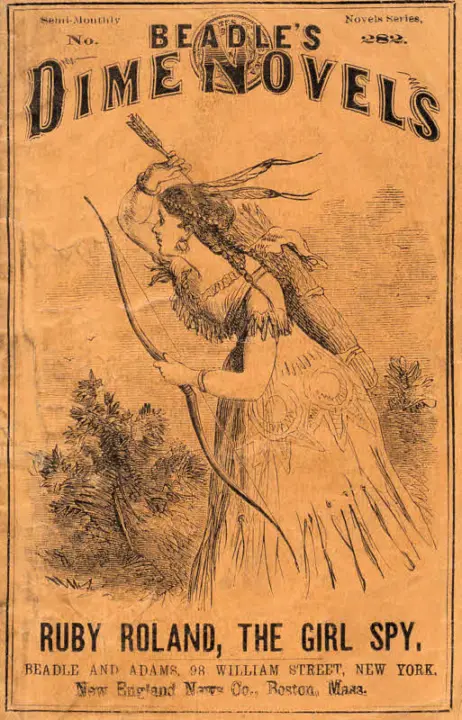
Ruby Roland, the Girl Spy; or, Simon Kenton’s Protege
Frederick Whittaker
THE CLASSIC COLLECTION · 1884
"Black Nick, the Hermit of the Hills; or, The Expiated Crime" by Frederick Whittaker is a historical novel written in the late 19th century. Set against the backdrop of the American Revolutionary War, the story involves themes of survival, espionage, and supernatural elements. The central characters include Indian warriors, a mysterious white man connected to Burgoyne's army, and the enigmatic figure of Black Nick, who embodies the supernatural aspect lurking in the wilderness. The opening of the novel introduces readers to a group of Indian warriors preparing to meet a British emissary in the midst of a twilight setting filled with portentous signs of an approaching storm. This atmosphere of tension and anticipation is compounded by the arrival of a messenger, who bears urgent news about a looming attack. Just as the plot thickens, the bizarre figure of Black Nick appears, disrupting the warrior's camp with a demoniacal presence that evokes both terror and awe. This blurs the lines between reality and myth, setting up a gripping narrative steeped in historical conflict and haunting intrigue as the characters navigate the dangers that surround them.
Introduction adapted from the source catalogue; source summaries may be automatically generated.
Free to read · English · 31,911 words · No account needed
MAKE TIME FOR A GOOD BOOK
On by default. Untick to stop anonymous reading totals. Each page counts after 10 seconds in view. How this works.
Anonymous counting is on unless you have switched it off.
Without a moment’s hesitation the colonel left the rampart, and hastened down to the sallyport spoken of by the other. This was a low heavy door on the inner side of the ditch, approached by an underground passage, and protected by the fire of two faces of the fort, and the colonel emerged from this, finding himself confronted by a figure of great hight, but thin and attenuated as a specter. This figure was wrapped in a long, flowing cloak, and its face was hidden by a broad, shadowy hat.
Under any circumstances, it is probable that Gansevoort would have felt some distrust of the other, but as it was, he was too eager to hear the news to be particular about how it came.
“The news, quick, man, what is it?” he whispered. “Good or bad?”
“Good,” answered the stranger, in the same low tone. “Read this letter.”
As he spoke, he extended both arms, the shadowy cloak hanging from them, so as to conceal what passed from the view of any lurking besieger. Gansevoort then noticed, for the first time, that the other bore, at his belt, a small dark-lantern. He eagerly grasped the letter which the stranger extended to him, and beheld the well-known bold clerkly hand of General Schuyler. Quickly he ran it over.
[2]“STILLWATER, August 15th, 1777.
“DEAR COLONEL: A body of troops left this place yesterday, and others are following to raise the siege of Fort Schuyler. Everybody here believes you will defend it to the last, and I strictly enjoin you so to do. General Burgoyne is at Fort Edward--our army at Stillwater--great reinforcements coming from the eastward, and we trust all will be well and the enemy repulsed.
“Yours faithfully,
“PH. SCHUYLER.
“COLONEL GANSEVOORT,
“Com’d’g Post at Fort Schuyler,
“By Capt. Erastus Benedict, A. D. C.”
For a moment Gansevoort’s feelings overcome him. The revulsion from anxiety to hope was so great that he nearly choked, in his efforts to suppress emotion. Then he turned to the tall stranger, seized his hand and shook it earnestly.
“God in heaven bless you, captain,” he said, with trembling voice. “You have saved a soldier from disgrace, and America from destruction. We were nearly spent. Defend it to the last? Ay Captain Benedict, I will do it now with tenfold the vigor I did. God bless the General for his confidence in me, and all the brave fellows with him.”
The stranger’s hand, long, cold, and bony, lay passively in the grasp of the colonel, till the latter had finished. Then he said, quietly:
“You mistake. I am not Captain Benedict. He is dead.”
Your reading position is saved on this browser. Take it to another device with a library code. Reading pages adapt to text, rather than matching a printed edition.
Frederick Whittaker
BEHIND THE BOOK
This eBook is for the use of anyone anywhere in the United States and most other parts of the world at no cost and with almost no restrictions whatsoever. You may copy it, give it away or re-use it under the terms of the Project Gutenberg License included with this eBook or online at www.gutenberg.org. If you are not located in the United States, you will have to check the laws of the country where you are located before using this eBook. Read the source licence.
The original source file, including credits and licence, is retained by this library. Request an original-format copy at no charge. Please include the book title and Project Gutenberg identifier #69323.
KEEP YOUR CURIOSITY GOING
Cécile Tormay

Moritz Busch
Coulson Kernahan
John L. Ransom

Maurice Baring
Frances Wright