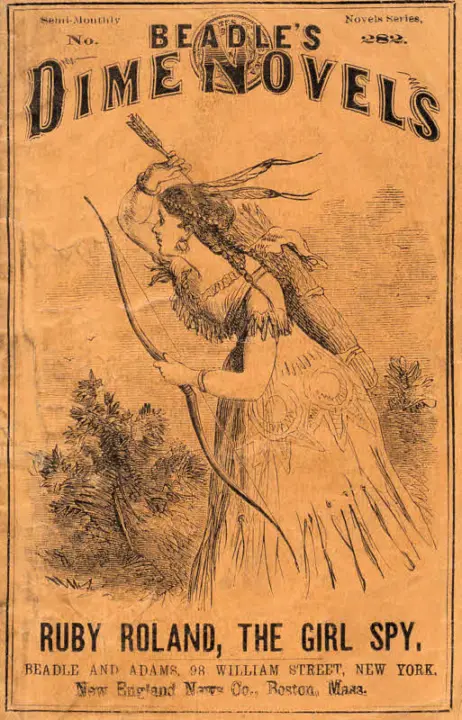
Ruby Roland, the Girl Spy; or, Simon Kenton’s Protege
Frederick Whittaker
THE CLASSIC COLLECTION · 1884
"Black Nick, the Hermit of the Hills; or, The Expiated Crime" by Frederick Whittaker is a historical novel written in the late 19th century. Set against the backdrop of the American Revolutionary War, the story involves themes of survival, espionage, and supernatural elements. The central characters include Indian warriors, a mysterious white man connected to Burgoyne's army, and the enigmatic figure of Black Nick, who embodies the supernatural aspect lurking in the wilderness. The opening of the novel introduces readers to a group of Indian warriors preparing to meet a British emissary in the midst of a twilight setting filled with portentous signs of an approaching storm. This atmosphere of tension and anticipation is compounded by the arrival of a messenger, who bears urgent news about a looming attack. Just as the plot thickens, the bizarre figure of Black Nick appears, disrupting the warrior's camp with a demoniacal presence that evokes both terror and awe. This blurs the lines between reality and myth, setting up a gripping narrative steeped in historical conflict and haunting intrigue as the characters navigate the dangers that surround them.
Introduction adapted from the source catalogue; source summaries may be automatically generated.
Free to read · English · 31,911 words · No account needed
MAKE TIME FOR A GOOD BOOK
On by default. Untick to stop anonymous reading totals. Each page counts after 10 seconds in view. How this works.
Anonymous counting is on unless you have switched it off.
“Halt!” he suddenly shouted. “Face about, lads! We’ve gone far enough. Now, follow me, and charge!”
A moment later, with the fair Diana at his side, the ex-hussar was bearing down on the Indians at full speed, followed by his rangers. Schuyler’s men all carried broadswords, in the use of which they were somewhat clumsy, it is true, but strong arms made up the deficiency.
The sudden change of demeanor on the part of the horsemen produced a result highly favorable to them. The Indians, who always have a dread of dragoons, fired a harmless, scattering volley, and were then left with empty pieces while the patriots charged home.
“Now we have them,” cried Adrian, exultingly. “Ride over them, lads, and then on to our own camp. If a man gets wounded, I’m mistaken.”
The example of their leader stimulated the men to greater courage, and they uttered a hearty cheer as they drove on. The rain beat in their faces, and the wind whistled past as they went, but the enemy were just as much in the rain, and the Americans knew that the fire would damp the powder of their foes.
It took but a minute to decide the question. At the full gallop the whole party of the rangers neared the enemy, and far in front rode Adrian Schuyler, closely followed by Diana.
The few horsemen who were with the Indians seemed to be officers, for they were seen dashing up and down the line, encouraging the wavering savages to stand. Adrian noticed one tall, powerful figure among them, which he recognized as the Tory, Butler, and he bent his course toward that part of the line, knowing that if he could overthrow the bold leader, the followers would probably be demoralized.
A moment later, he charged against the partisan, who met him, wielding
a long broadsword.
Adrian was a splendid swordsman, and equally good horseman, and his steed was perfectly trained, no slight advantage in a single combat, mounted. His antagonist, however, proved to be equally matched. In hight and weight he was far superior to Adrian, and his blows came like those of sledgehammers, while his big horse obeyed the rein easily.
But the hussar didn’t wait long to fight. There were too many enemies near him. His men had already dashed through the line, and were past him on their way to Stark’s forces, when his antagonist suddenly, without any visible cause, turned pale, dropped his sword-hand, and wrenched his horse back several paces, while he glared over his enemy’s shoulder, as if at some frightful vision.
Your reading position is saved on this browser. Take it to another device with a library code. Reading pages adapt to text, rather than matching a printed edition.
Frederick Whittaker
BEHIND THE BOOK
This eBook is for the use of anyone anywhere in the United States and most other parts of the world at no cost and with almost no restrictions whatsoever. You may copy it, give it away or re-use it under the terms of the Project Gutenberg License included with this eBook or online at www.gutenberg.org. If you are not located in the United States, you will have to check the laws of the country where you are located before using this eBook. Read the source licence.
The original source file, including credits and licence, is retained by this library. Request an original-format copy at no charge. Please include the book title and Project Gutenberg identifier #69323.
KEEP YOUR CURIOSITY GOING
Cécile Tormay

Moritz Busch
Coulson Kernahan
John L. Ransom

Maurice Baring
Frances Wright