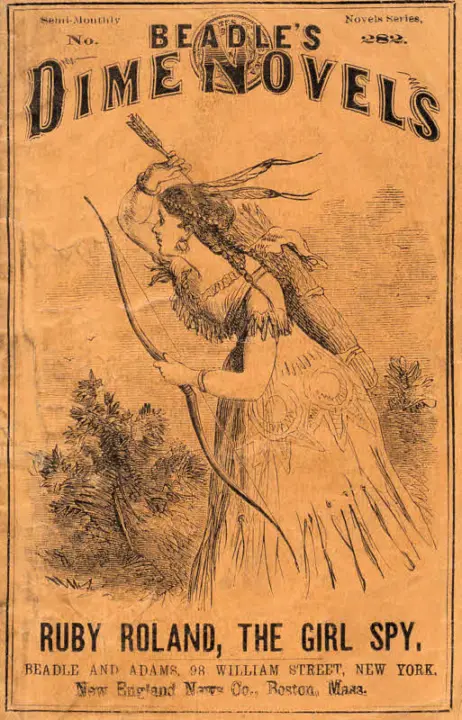
Ruby Roland, the Girl Spy; or, Simon Kenton’s Protege
Frederick Whittaker
THE CLASSIC COLLECTION · 1884
"Black Nick, the Hermit of the Hills; or, The Expiated Crime" by Frederick Whittaker is a historical novel written in the late 19th century. Set against the backdrop of the American Revolutionary War, the story involves themes of survival, espionage, and supernatural elements. The central characters include Indian warriors, a mysterious white man connected to Burgoyne's army, and the enigmatic figure of Black Nick, who embodies the supernatural aspect lurking in the wilderness. The opening of the novel introduces readers to a group of Indian warriors preparing to meet a British emissary in the midst of a twilight setting filled with portentous signs of an approaching storm. This atmosphere of tension and anticipation is compounded by the arrival of a messenger, who bears urgent news about a looming attack. Just as the plot thickens, the bizarre figure of Black Nick appears, disrupting the warrior's camp with a demoniacal presence that evokes both terror and awe. This blurs the lines between reality and myth, setting up a gripping narrative steeped in historical conflict and haunting intrigue as the characters navigate the dangers that surround them.
Introduction adapted from the source catalogue; source summaries may be automatically generated.
Free to read · English · 31,911 words · No account needed
MAKE TIME FOR A GOOD BOOK
On by default. Untick to stop anonymous reading totals. Each page counts after 10 seconds in view. How this works.
Anonymous counting is on unless you have switched it off.
“Thar they be, Cap,” said the scout, in a low tone, pointing to his left front, “they’re gone into camp, as slick as molasses, and their Dutch sentry ain’t got no eyes, I guess, for he’s a-blinkin’ this way, jest like an owl on a fine day, and hain’t seen me.”
Schuyler, sheltering himself behind the other, and bowing his head, so as to hide his tall cap, slipped off his horse and leveled a telescope over the croup of the scout’s steady animal. A bluish line of smoke, clearly visible against the cold gray background of mist and rain, pointed out the position of the camp of Baum and his Hessians, detached from the army of Burgoyne, to seize the stores at Bennington.
They lay in a square, compact mass, in a bend of the little rivulet, called the Wollonsac, which covered their position. A green grove, at the borders of the stream, furnished them with some shelter from the rain, for otherwise they were compelled to trust to huts of straw.
A brown line of fresh earth, covering the whole front of their position, showed that their commander was a cautious man, who knew the value of intrenchments.
“There they are, sure enough, Kerr,” said Schuyler, as he shut up his glass; “but I don’t see any Indians.”
“I’d admire to see the reptyles,” said Kerr, spitefully, “sneaking round when our boys are here, Cap. No, no, thur ain’t one of ’em left near us, since the Mountain Devil’s up and arter ’em.”
“The Mountain Devil! Who’s that?” asked Adrian, surprised. It was the first time he had heard allusions from others to the singular being that had effected his own release from his late captors.
“Wal, Cap, that’s hard to say,” responded the scout. “Some say he’s a real devil, some say he’s only a feller that’s got a spite against the Injins. All I know is, that he’s been round lately, and skeered every one on ’em out of the country. Folks say he’s b’en dodgin’ round Burgoyne’s men, playin’ the same games, and that thur leavin’ for hum.”
“Has he been seen near our quarters?” asked the hussar.
“Nary time, Cap. He may be a devil, but if so, he’s a mighty friendly one fur our side. He don’t only kill Injins and Tories, and leaves our folks alone. We hain’t so much as seen him, though prisoners tells mighty tough stories about him, how he’s got horns and huffs, and sends fire out of his mouth, and sich like.”
Your reading position is saved on this browser. Take it to another device with a library code. Reading pages adapt to text, rather than matching a printed edition.
Frederick Whittaker
BEHIND THE BOOK
This eBook is for the use of anyone anywhere in the United States and most other parts of the world at no cost and with almost no restrictions whatsoever. You may copy it, give it away or re-use it under the terms of the Project Gutenberg License included with this eBook or online at www.gutenberg.org. If you are not located in the United States, you will have to check the laws of the country where you are located before using this eBook. Read the source licence.
The original source file, including credits and licence, is retained by this library. Request an original-format copy at no charge. Please include the book title and Project Gutenberg identifier #69323.
KEEP YOUR CURIOSITY GOING
Cécile Tormay

Moritz Busch
Coulson Kernahan
John L. Ransom

Maurice Baring
Frances Wright