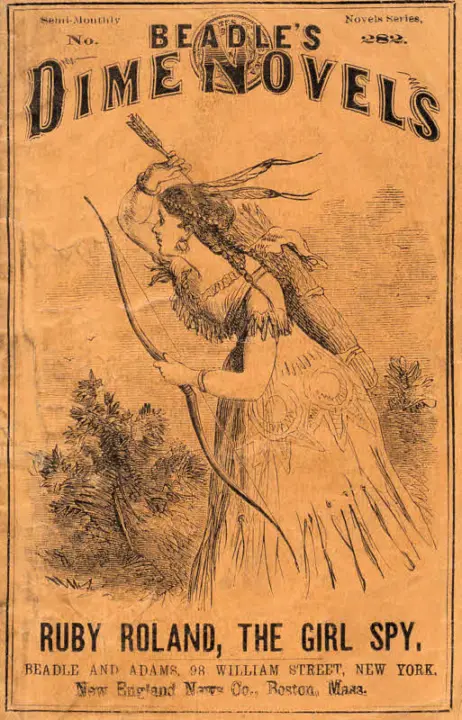
Ruby Roland, the Girl Spy; or, Simon Kenton’s Protege
Frederick Whittaker
THE CLASSIC COLLECTION · 1884
"Black Nick, the Hermit of the Hills; or, The Expiated Crime" by Frederick Whittaker is a historical novel written in the late 19th century. Set against the backdrop of the American Revolutionary War, the story involves themes of survival, espionage, and supernatural elements. The central characters include Indian warriors, a mysterious white man connected to Burgoyne's army, and the enigmatic figure of Black Nick, who embodies the supernatural aspect lurking in the wilderness. The opening of the novel introduces readers to a group of Indian warriors preparing to meet a British emissary in the midst of a twilight setting filled with portentous signs of an approaching storm. This atmosphere of tension and anticipation is compounded by the arrival of a messenger, who bears urgent news about a looming attack. Just as the plot thickens, the bizarre figure of Black Nick appears, disrupting the warrior's camp with a demoniacal presence that evokes both terror and awe. This blurs the lines between reality and myth, setting up a gripping narrative steeped in historical conflict and haunting intrigue as the characters navigate the dangers that surround them.
Introduction adapted from the source catalogue; source summaries may be automatically generated.
Free to read · English · 31,911 words · No account needed
MAKE TIME FOR A GOOD BOOK
On by default. Untick to stop anonymous reading totals. Each page counts after 10 seconds in view. How this works.
Anonymous counting is on unless you have switched it off.
“And still you dare stay here,” said the girl, in a tone of wonder. “Oh, sir, if you value your life, let me entreat you to fly. The road to Derryfield is straight and easy.”
“And yet you stay here,” said the hussar, meaningly. “Why should I fear what you do not?”
“Oh, sir, that is different. I am--I can not tell you what. But I
entreat you to fly.”
“Madam,” said Schuyler, gravely, “I should be glad to do so, for my duty calls me away. But I have no horse, and the woods are full of enemies. If I go on foot, the chances are that I never get there.”
“What then? You can not stay here--you say you saw him--what is to be done? You must go back whence you came.”
“I can not do it,” said Schuyler. “The scouts of Burgoyne’s army are between me and home. I must get to Derryfield, if I have to steal a horse.”
Diana wrung her hands in agony.
“Man, man, I tell you he will kill you if you stay here. You must go
away.”
“I have a choice of deaths, then,” said the hussar, coolly. “I am safe from the Indians, on this mountain, and as for the demon, if he kills me, he will serve his enemies. On my mission to Derryfield depends the whole future of a campaign.”
As he spoke, the sound of another horn, deep, hoarse and bellowing, echoed from the top of the hill, and the girl turned deadly pale, ejaculating:
“It is too late! He is here! You are lost!”
In spite of his general courage and coolness, an involuntary thrill of terror gathered over the heart of Adrian Schuyler, as he listened to the mysterious sounds of the phantom horn. It echoed from hill to hill in deep reverberations, and when it died away, left him with an indescribable sense of awe.
At the same moment, as if the mysterious demon had waited to sound his horn till the aspects of nature were in harmony with diabolical influences, a sudden shadow swept over the sun, and Adrian, looking up, beheld a deep thundercloud, hitherto hidden behind the mountains, swallow up the sun, and rush across the sky with wonderful swiftness, while a powerful gust of wind shook and bowed the trees on the mountain-side in a groaning chorus.
He turned to Diana, and behold, she was gone! He just caught a glimpse of her white deer-skin tunic vanishing in the upper woods on the mountain-side, whence the sound of the horn had come, and he realized that it had been a summons.
Your reading position is saved on this browser. Take it to another device with a library code. Reading pages adapt to text, rather than matching a printed edition.
Frederick Whittaker
BEHIND THE BOOK
This eBook is for the use of anyone anywhere in the United States and most other parts of the world at no cost and with almost no restrictions whatsoever. You may copy it, give it away or re-use it under the terms of the Project Gutenberg License included with this eBook or online at www.gutenberg.org. If you are not located in the United States, you will have to check the laws of the country where you are located before using this eBook. Read the source licence.
The original source file, including credits and licence, is retained by this library. Request an original-format copy at no charge. Please include the book title and Project Gutenberg identifier #69323.
KEEP YOUR CURIOSITY GOING
Cécile Tormay

Moritz Busch
Coulson Kernahan
John L. Ransom

Maurice Baring
Frances Wright