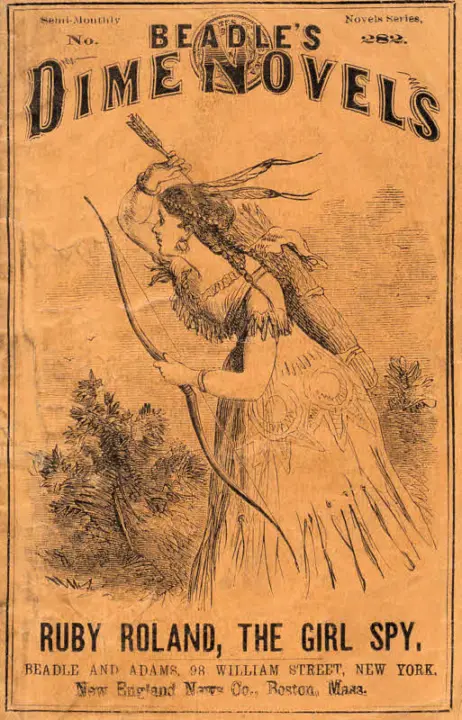
Ruby Roland, the Girl Spy; or, Simon Kenton’s Protege
Frederick Whittaker
THE CLASSIC COLLECTION · 1884
"Black Nick, the Hermit of the Hills; or, The Expiated Crime" by Frederick Whittaker is a historical novel written in the late 19th century. Set against the backdrop of the American Revolutionary War, the story involves themes of survival, espionage, and supernatural elements. The central characters include Indian warriors, a mysterious white man connected to Burgoyne's army, and the enigmatic figure of Black Nick, who embodies the supernatural aspect lurking in the wilderness. The opening of the novel introduces readers to a group of Indian warriors preparing to meet a British emissary in the midst of a twilight setting filled with portentous signs of an approaching storm. This atmosphere of tension and anticipation is compounded by the arrival of a messenger, who bears urgent news about a looming attack. Just as the plot thickens, the bizarre figure of Black Nick appears, disrupting the warrior's camp with a demoniacal presence that evokes both terror and awe. This blurs the lines between reality and myth, setting up a gripping narrative steeped in historical conflict and haunting intrigue as the characters navigate the dangers that surround them.
Introduction adapted from the source catalogue; source summaries may be automatically generated.
Free to read · English · 31,911 words · No account needed
MAKE TIME FOR A GOOD BOOK
On by default. Untick to stop anonymous reading totals. Each page counts after 10 seconds in view. How this works.
Anonymous counting is on unless you have switched it off.
The recluse cast his rifle into the hollow of his arm, and struck across the valley to a point where he could intersect the road in its many curves at a much nearer point. He was a little curious to see who the advancing dragoon might be.
There was still plenty of light, although the sun was fast nearing the mountain tops, and the long strides of the Mountain Hermit took him across the stretch of woods that barred him from the road in a very short time.
As he neared it, the sound of horse-hoofs and the clatter of a saber-scabbard were plainly audible, skirting the mountain-side beyond.
At the point which the recluse had reached, the road came round a spur, over the dividing ridge, and dived into the valley beyond. Waiting a few moments, till the sound of hoofs was close by, the Mountain Hermit stalked boldly into the road, just as the young hussar captain dashed around the corner.
At the sight of the stranger’s figure, Adrian Schuyler abruptly halted, throwing his horse on its haunches close to the other, while the sharp click of his pistol-lock enforced the stern command, “Halt!”
The stranger quietly turned, and faced the hussar with a sullen frown,
asking:
“Who are you to halt a peaceable farmer? I’ve as much right as you, and more, in this place.”
“Perhaps so,” said the hussar, coolly: “but in war-time we of the light cavalry take liberties that we support with our weapons. Who are you?”
“A peaceable farmer, as I said before,” answered the other, with a sullen scowl. “Who are you?”
“An officer on duty, my man, who doesn’t care to be trifled with. There are too many Indians and spies loose in these mountains for me to trust strangers. If you’re a peaceable farmer, you’re as sulky a looking one as I have seen. How far is it to Derryfield?”
“Four miles,” said the sullen stranger, gruffly. Then he turned away as if the colloquy was terminated, but the hussar was not going to let him off so easy.
“Halt!” he again cried, in his sharp tones, covering the other with his pistol. “Move another step, and it’s your last.”
The stranger obeyed the order with his usual sullen air, but the hussar’s voice showed that he was in earnest.
“Look here, Mr. Officer,” began the stranger, in a tone of injury, “I don’t see what you have against me to treat me in this way. Let me alone, or by the Lord, we’ll see if my rifle ain’t as good as your pistol.”
Your reading position is saved on this browser. Take it to another device with a library code. Reading pages adapt to text, rather than matching a printed edition.
Frederick Whittaker
BEHIND THE BOOK
This eBook is for the use of anyone anywhere in the United States and most other parts of the world at no cost and with almost no restrictions whatsoever. You may copy it, give it away or re-use it under the terms of the Project Gutenberg License included with this eBook or online at www.gutenberg.org. If you are not located in the United States, you will have to check the laws of the country where you are located before using this eBook. Read the source licence.
The original source file, including credits and licence, is retained by this library. Request an original-format copy at no charge. Please include the book title and Project Gutenberg identifier #69323.
KEEP YOUR CURIOSITY GOING
Cécile Tormay

Moritz Busch
Coulson Kernahan
John L. Ransom

Maurice Baring
Frances Wright