THE CLASSIC COLLECTION✦An outlaw’s diary: the CommuneCLASSIC FREE BOOKS
An outlaw’s diary: the Commune
Cécile Tormay
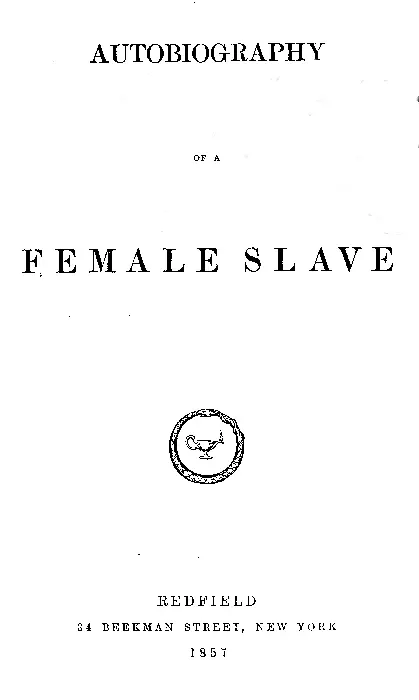
THE CLASSIC COLLECTION · 1857
"Autobiography of a Female Slave" by Martha Griffith Browne is a historical account written in the mid-19th century. This compelling narrative offers readers a firsthand perspective of the life of a female slave in the Southern United States, exploring her personal struggles, family ties, and experiences of both cruelty and kindness. The author provides an intimate portrayal of the protagonist's journey, encapsulating the harsh realities of slavery while highlighting the deep emotional bonds that shape her existence. The opening of this autobiography introduces us to the narrator, a young female slave born on a Kentucky farm, detailing her early life, her family's dynamics, and her yearning for education amidst the oppressive backdrop of slavery. As her master falls ill and subsequently passes away, the narrator faces the terrifying prospect of being sold away from her mother, which unveils the traumatic realities of the slave trade. The emotional turmoil felt by both the mother and daughter during this separation takes center stage, illustrating the heart-wrenching impact of slavery on familial relationships. Through vivid descriptions of love, loss, and the hope for a brighter future, the opening sets the tone for a deeply moving exploration of resilience and the quest for freedom.
Introduction adapted from the source catalogue; source summaries may be automatically generated.
Free to read · English · 135,160 words · No account needed
MAKE TIME FOR A GOOD BOOK
On by default. Untick to stop anonymous reading totals. Each page counts after 10 seconds in view. How this works.
Anonymous counting is on unless you have switched it off.
"Oh, that's what the most of 'em says. It 'pears so quare ter me for a Masser to sell good sarvants; but I guess you'll soon git a home; fur you is 'bout the likeliest yaller gal I ever seed. Now, thim rale black 'uns hardly ever goes off here. We has to send 'em down river, or let 'em go at a mighty low price."
"How often do you have sales?"
"Oh, we don't have 'em at all. That's we don't have public 'uns. We sells 'em privately like; but we buys up more; and when we gits a large number, we ships 'em down de river."
Wishing to cut short his garrulity, I asked him to show me the room
where I was to stay.
"In here, wid de rest of 'em," he said, as he opened the door of a large shed-room, where I found some ten or twelve negroes, women and men, ranged round on stools and chairs, all neatly dressed, some of them looking very happy, others with down-cast, sorrow-stricken countenances.
One bright, gold-colored man, with long, silky black hair, and raven eyes, full of subdued power, stood leaning his elbow against the mantel. His melancholy face and pensive attitude struck a responsive feeling, and I turned with a sisterly sentiment toward him.
I have always been of a taciturn disposition, shunning company; but this man impressed me so favorably, he seemed the very counterpart of myself, that I forgot my usual reserve, and, after a few moments' investigation of my companions, the faces of most of whom were unpleasant to me, I approached him and inquired--
"Have you been long here?"
"Only a few days," he answered, as he lifted his mournful eyes towards mine, and I could see from their misty light, that they were dimmed by tears.
"Are you sold?" I asked.
"Oh yes," and he shuddered terribly.
I did not venture to say more; but stood looking at him, when, suddenly
he turned to me, saying,
"I know that you are sold."
"Yes," I replied, with that strong sort of courage that characterized
me.
"You take it calmly," he said; "have you no friends?"
"You do not talk like one familiar with slavery, to speak of a slave's
having friends."
"True, true; but I have--oh, God!--a wife and children, and from them I was cruelly torn, and--and--and I saw my poor wife knocked flat upon the floor, and because I had the manhood to say that it was wrong, they tied me up and slashed me. All this is right, because my skin is darker than theirs."
What a fearful groan he gave, as he struck his breast violently.
Your reading position is saved on this browser. Take it to another device with a library code. Reading pages adapt to text, rather than matching a printed edition.
BEHIND THE BOOK
This eBook is for the use of anyone anywhere in the United States and most other parts of the world at no cost and with almost no restrictions whatsoever. You may copy it, give it away or re-use it under the terms of the Project Gutenberg License included with this eBook or online at www.gutenberg.org. If you are not located in the United States, you will have to check the laws of the country where you are located before using this eBook. Read the source licence.
The original source file, including credits and licence, is retained by this library. Request an original-format copy at no charge. Please include the book title and Project Gutenberg identifier #55813.
KEEP YOUR CURIOSITY GOING
Cécile Tormay

Moritz Busch
Coulson Kernahan
John L. Ransom

Maurice Baring
Frances Wright