THE CLASSIC COLLECTION✦An outlaw’s diary: the CommuneCLASSIC FREE BOOKS
An outlaw’s diary: the Commune
Cécile Tormay
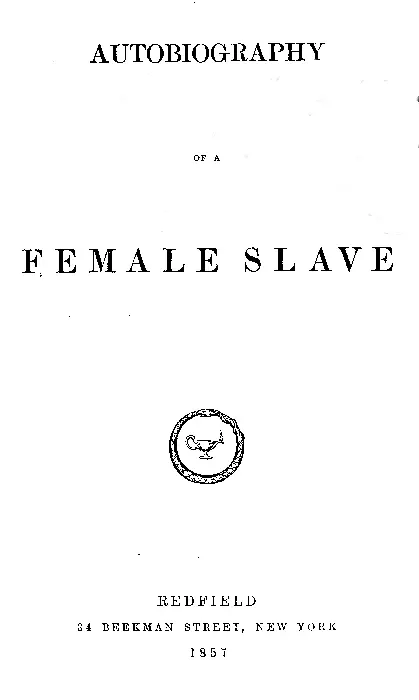
THE CLASSIC COLLECTION · 1857
"Autobiography of a Female Slave" by Martha Griffith Browne is a historical account written in the mid-19th century. This compelling narrative offers readers a firsthand perspective of the life of a female slave in the Southern United States, exploring her personal struggles, family ties, and experiences of both cruelty and kindness. The author provides an intimate portrayal of the protagonist's journey, encapsulating the harsh realities of slavery while highlighting the deep emotional bonds that shape her existence. The opening of this autobiography introduces us to the narrator, a young female slave born on a Kentucky farm, detailing her early life, her family's dynamics, and her yearning for education amidst the oppressive backdrop of slavery. As her master falls ill and subsequently passes away, the narrator faces the terrifying prospect of being sold away from her mother, which unveils the traumatic realities of the slave trade. The emotional turmoil felt by both the mother and daughter during this separation takes center stage, illustrating the heart-wrenching impact of slavery on familial relationships. Through vivid descriptions of love, loss, and the hope for a brighter future, the opening sets the tone for a deeply moving exploration of resilience and the quest for freedom.
Introduction adapted from the source catalogue; source summaries may be automatically generated.
Free to read · English · 135,160 words · No account needed
MAKE TIME FOR A GOOD BOOK
On by default. Untick to stop anonymous reading totals. Each page counts after 10 seconds in view. How this works.
Anonymous counting is on unless you have switched it off.
At breakfast, Miss Jane shook her head at Amy, saying,
"I'll settle accounts with you, presently."
I wondered if that tremulous form, that stood eyeing her in affright, did not soften her; but no, the "shaking culprit," as she styled Amy, was the very creature upon whom she desired to deal swift justice.
Pitiable was the sight in the kitchen, where Jake and Dan, great stout fellows, were making their breakfasts off of scraps of meat, old bones and corn-bread, whilst the aroma of coffee, broiled chicken, and egg-cakes was wafted to them from the house-table.
"I wish't I had somepin' more to eat," said Dan.
"You's never satisfy," replied Sally, the cook; "you gits jist as much as de balance, yit you makes de most complaints."
"No I doesn't."
"Yes, you does; don't he, Jake?"
"Why, to be sartain he does," said Jake, who of late had agreed to live with Sally as a wife. Of course no matrimonial rite was allowed, for Mr. Peterkin was consistent enough to say, that, as the law did not recognize the validity of negro marriages, he saw no use of the tomfoolery of a preacher in the case; and this is all reasonable enough.
"You allers takes Sal's part," said Dan, "now sense she has got to be your wife; you and her is allers colloged together agin' de rest ov us."
"Wal, haint I right for to 'tect my ole 'oman?"
"Now, ha, ha!" cried Nace, as he entered, "de idee ob yer 'tectin' a wife! I jist wisht Masser sell yer apart, den whar is yer 'tection ob one anoder?"
"Oh, dat am very different. Den I'd jist git me anoder ole 'oman, an' she'd git her anoder ole man."
"Sure an' I would," was Sally's reply; "hain't I done had five old men already, an' den if Jake be sole, I'de git somebody else."
"White folks don't do dat ar' way," interposed Dan, as he picked away at
a bone.
"In course dey don't. Why should dey?" put in Nace. "Ain't dey our Massers, and habn't dey dar own way in ebery ting?"
"I wisht I'd bin born white," added Dan.
"Ya, ya, dat is funny!"
"Do de free colored folks live like de whites?" asked Sally.
Your reading position is saved on this browser. Take it to another device with a library code. Reading pages adapt to text, rather than matching a printed edition.
BEHIND THE BOOK
This eBook is for the use of anyone anywhere in the United States and most other parts of the world at no cost and with almost no restrictions whatsoever. You may copy it, give it away or re-use it under the terms of the Project Gutenberg License included with this eBook or online at www.gutenberg.org. If you are not located in the United States, you will have to check the laws of the country where you are located before using this eBook. Read the source licence.
The original source file, including credits and licence, is retained by this library. Request an original-format copy at no charge. Please include the book title and Project Gutenberg identifier #55813.
KEEP YOUR CURIOSITY GOING
Cécile Tormay

Moritz Busch
Coulson Kernahan
John L. Ransom

Maurice Baring
Frances Wright