THE CLASSIC COLLECTION✦An outlaw’s diary: the CommuneCLASSIC FREE BOOKS
An outlaw’s diary: the Commune
Cécile Tormay
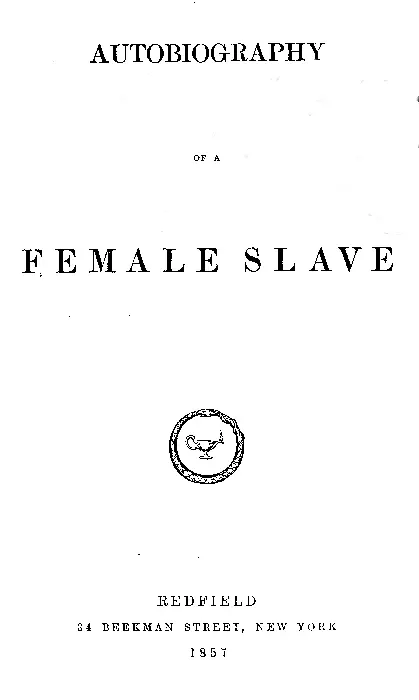
THE CLASSIC COLLECTION · 1857
"Autobiography of a Female Slave" by Martha Griffith Browne is a historical account written in the mid-19th century. This compelling narrative offers readers a firsthand perspective of the life of a female slave in the Southern United States, exploring her personal struggles, family ties, and experiences of both cruelty and kindness. The author provides an intimate portrayal of the protagonist's journey, encapsulating the harsh realities of slavery while highlighting the deep emotional bonds that shape her existence. The opening of this autobiography introduces us to the narrator, a young female slave born on a Kentucky farm, detailing her early life, her family's dynamics, and her yearning for education amidst the oppressive backdrop of slavery. As her master falls ill and subsequently passes away, the narrator faces the terrifying prospect of being sold away from her mother, which unveils the traumatic realities of the slave trade. The emotional turmoil felt by both the mother and daughter during this separation takes center stage, illustrating the heart-wrenching impact of slavery on familial relationships. Through vivid descriptions of love, loss, and the hope for a brighter future, the opening sets the tone for a deeply moving exploration of resilience and the quest for freedom.
Introduction adapted from the source catalogue; source summaries may be automatically generated.
Free to read · English · 135,160 words · No account needed
MAKE TIME FOR A GOOD BOOK
On by default. Untick to stop anonymous reading totals. Each page counts after 10 seconds in view. How this works.
Anonymous counting is on unless you have switched it off.
"Well, if you have a mind to, you may do it; but I haven't any time to
parley now, come on."
Henry pressed my hand affectionately, and I saw the tears roll in a stream down his bronzed cheeks. I did not trust myself to speak; I merely returned the pressure of his hand, and silently followed Master William.
Through the streets, up one and across another, we went, until suddenly we stopped in front of a two-story brick house with an iron fence in front. Covering a small portion of the front view of the main building, an office had been erected, a plain, uncarpeted room, from the door of which projected a sheet-iron sign, advertising to the passers-by, "negroes bought and sold here." We walked into this room, and upon the table found a small bell, which Mr. Summerville rang. In answer to this, a neatly-dressed negro boy appeared. To Master William's interrogatory, "Is Mr. Atkins in?" he answered, most obsequiously, that he was, and instantly withdrew. In a few moments the door opened, and a heavy man about five feet ten inches entered. He was of a most forbidding appearance; a tan-colored complexion, with very black hair and whiskers, and mean, watery, milky, diseased-looking eyes. He limped as he walked, one leg being shorter than the other, and carried a huge stick to assist his ambulations.
"Good morning, Mr. Atkins."
"Good morning, sir."
"Here is the girl we were speaking of yesterday."
"Well," replied the other, as he removed a lighted cigar from his mouth, "she is likely enough. Take off yer bonnet, girl, let me look at yer eyes. They are good; open your mouth--no decayed teeth--all sound; hold up your 'coat, legs are good, some marks on 'em--now the back--pretty much and badly scarred. Well, what's the damage?"
"Seven hundred, cash down. You can recommend her as a first-rate house
and lady's maid."
"What's your name, girl?"
"Ann," I replied.
"Ann, go within," he added, pointing to the door through which he had
entered.
I turned to Mr. Summerville, saying,
"Good-bye, Master William. I wish you well."
"Good-bye, Ann," and he extended his hand to me; "I hope Mr. Atkins will
get you a good home."
Dropping a courtesy and a tear, I passed through the door designated by Mr. Atkins, and stood within the pen. Here I was met by the mulatto who had answered the bell.
"Has you bin bought, Miss?"
"Yes, Mr. Atkins just bought me."
"Why did your Masser sell you?"
"I don't know."
Your reading position is saved on this browser. Take it to another device with a library code. Reading pages adapt to text, rather than matching a printed edition.
BEHIND THE BOOK
This eBook is for the use of anyone anywhere in the United States and most other parts of the world at no cost and with almost no restrictions whatsoever. You may copy it, give it away or re-use it under the terms of the Project Gutenberg License included with this eBook or online at www.gutenberg.org. If you are not located in the United States, you will have to check the laws of the country where you are located before using this eBook. Read the source licence.
The original source file, including credits and licence, is retained by this library. Request an original-format copy at no charge. Please include the book title and Project Gutenberg identifier #55813.
KEEP YOUR CURIOSITY GOING
Cécile Tormay

Moritz Busch
Coulson Kernahan
John L. Ransom

Maurice Baring
Frances Wright