THE CLASSIC COLLECTION✦An outlaw’s diary: the CommuneCLASSIC FREE BOOKS
An outlaw’s diary: the Commune
Cécile Tormay
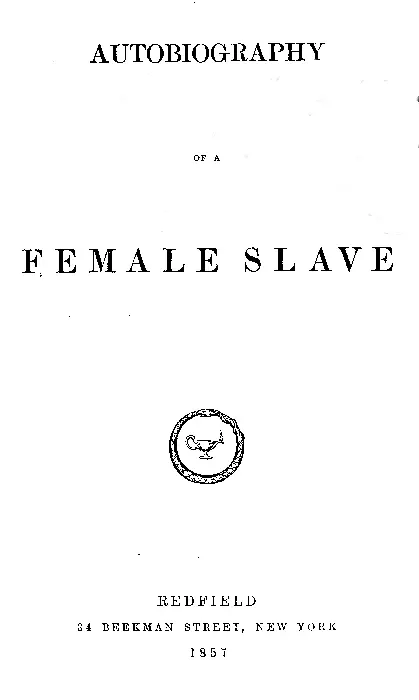
THE CLASSIC COLLECTION · 1857
"Autobiography of a Female Slave" by Martha Griffith Browne is a historical account written in the mid-19th century. This compelling narrative offers readers a firsthand perspective of the life of a female slave in the Southern United States, exploring her personal struggles, family ties, and experiences of both cruelty and kindness. The author provides an intimate portrayal of the protagonist's journey, encapsulating the harsh realities of slavery while highlighting the deep emotional bonds that shape her existence. The opening of this autobiography introduces us to the narrator, a young female slave born on a Kentucky farm, detailing her early life, her family's dynamics, and her yearning for education amidst the oppressive backdrop of slavery. As her master falls ill and subsequently passes away, the narrator faces the terrifying prospect of being sold away from her mother, which unveils the traumatic realities of the slave trade. The emotional turmoil felt by both the mother and daughter during this separation takes center stage, illustrating the heart-wrenching impact of slavery on familial relationships. Through vivid descriptions of love, loss, and the hope for a brighter future, the opening sets the tone for a deeply moving exploration of resilience and the quest for freedom.
Introduction adapted from the source catalogue; source summaries may be automatically generated.
Free to read · English · 135,160 words · No account needed
MAKE TIME FOR A GOOD BOOK
On by default. Untick to stop anonymous reading totals. Each page counts after 10 seconds in view. How this works.
Anonymous counting is on unless you have switched it off.
In Mr. Smith's family of servants was Emily, the cook, a sagacious woman, but totally without education, knowledge, or the peculiar ambition that leads to its acquisition. She was a bold, raw, unthinking spirit; and, from the fact that she had been kept closely confined to the house, never allowed any social pleasure, she resolved to be revenged, and unfortunately in her desire for "spite" (as she termed it), had sacrificed her character, and was the mother of two children, with unacknowledged fathers. Possessed of a violent temper, she would, at periods, rave like a mad-woman; and only the severest lashing could bring her into subjection. She was my particular terror. Her two children, half-bloods, were little, sick, weasly things that excited the compassion of all beholders, and though two years of age (twins), were, from some physical derangement, unable to walk.
There was also a man servant, Duke, who attended to odd ends of housework, and served in the capacity of decorated carriage-driver, and a girl, Elsy, a raw, green, country concern, good-natured and foolish, with a face as black as tar. They had hired her from a man in the country, and she being quite delighted with town and the off-cast finery of the ladies, was as happy as she could be--yet the mistakes she constantly made were truly amusing. She had formed quite an attachment for Duke, which he did not in the slightest degree return; yet, with none of the bashfulness of her sex, she confessed to the feeling, and declared that "Duke was very mean not to love her a little." This never failed to excite the derision of the more sprightly Emily.
"Well, you is a fool," she would exclaim, with an odd shake of the head.
"I loves him, and don't kere who knows it."
"Does he love you?" asked Emily.
"Well, he doesn't."
"Then I'd hate him," replied Emily, as, with a great force, she brought her rolling-pin down on the table.
"No, I wouldn't," answered the loving Elsy.
"You ain't worth shucks."
"Wish I was worth Duke."
"Hush, fool."
"You needn't git mad, kase I don't think as you does."
"I is mad bekase you is a fool."
"Who made me one?"
"You was born it, I guess."
"Then I aren't to blame fur it. Them that made me is."
Conversations like this were of frequent occurrence, and once, when I ventured to ask Elsy if she wouldn't like to learn to read, she laughed heartily, saying:
"Does you think I wants to run off?"
"Certainly not."
"Den why did you ax me if I wanted to larn to read?"
Your reading position is saved on this browser. Take it to another device with a library code. Reading pages adapt to text, rather than matching a printed edition.
BEHIND THE BOOK
This eBook is for the use of anyone anywhere in the United States and most other parts of the world at no cost and with almost no restrictions whatsoever. You may copy it, give it away or re-use it under the terms of the Project Gutenberg License included with this eBook or online at www.gutenberg.org. If you are not located in the United States, you will have to check the laws of the country where you are located before using this eBook. Read the source licence.
The original source file, including credits and licence, is retained by this library. Request an original-format copy at no charge. Please include the book title and Project Gutenberg identifier #55813.
KEEP YOUR CURIOSITY GOING
Cécile Tormay

Moritz Busch
Coulson Kernahan
John L. Ransom

Maurice Baring
Frances Wright