
Letters to a Friend, Written to Mrs. Ezra S. Carr, 1866-1879
John Muir
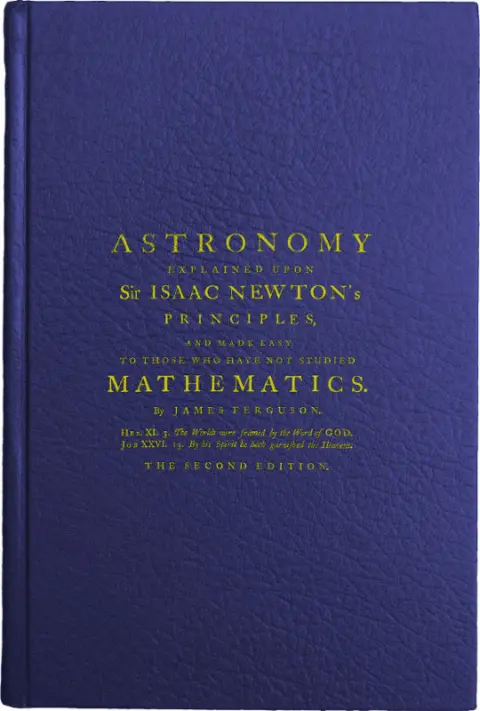
THE CLASSIC COLLECTION · 1756
"Astronomy Explained Upon Sir Isaac Newton's Principles" by James Ferguson is a scientific publication written in the mid-18th century. This work delves into the principles of astronomy as established by Isaac Newton, making complex astronomical concepts accessible to those who lack a mathematical background. The book covers the solar system's structure, the nature of celestial bodies, and various astronomical phenomena, emphasizing the scientific significance and beauty of the universe. The beginning of the book introduces astronomy as the most sublime and useful of sciences, detailing its impact on human understanding and the vastness of the universe. Ferguson aims to convey not only the mechanics of celestial movements but also the grandeur of the cosmos, evoking a sense of wonder about the relationship between humanity and the divine. He emphasizes the infinitude of stars and systems, setting the tone for an exploration of the solar system's structure and properties, which unfolds in subsequent chapters.
Introduction adapted from the source catalogue; source summaries may be automatically generated.
Free to read · English · 129,260 words · No account needed
MAKE TIME FOR A GOOD BOOK
On by default. Untick to stop anonymous reading totals. Each page counts after 10 seconds in view. How this works.
Anonymous counting is on unless you have switched it off.
Rays of Light, if not disturbed, move in straight lines, and hinder not one another’s motions, 168. Are refracted in passing through different mediums, 171.
Reflection of the Atmosphere causes the Twilight, 177.
Refraction of the Atmosphere bends the rays of light from straight
lines, and keeps the Sun and Moon longer in sight than they would
otherwise be, 178.
A surprising instance of this, 183.
Must be allowed for in taking the Altitudes of the celestial bodies,
ib.
Right Sphere, 131.
Satellites; the times of their revolutions round their primary Planets, 52, 73, 80. Their Orbits compared with each other, with the Orbits of the primary Planets, and with the Sun’s circumference, 271. What sort of Curves they describe, 272.
Saturn, with his Ring and Moon’s, their Phenomena, 78, 79, 82. The Sun’s light 1000 times as strong to him as the light of the Full Moon is to us, 85. The Phenomena of his Ring farther explained, 204.
Our blessed SAVIOUR, the darkness at his crucifixion supernatural,
352.
The prophetic year of his crucifixion found to agree with an
astronomical calculation, 432.
Seasons, different, illustrated by an easy experiment, 200;
by a figure, 202.
Shadow, what, 312.
Sidereal Time, what, 221; the number of Sidereal Days in a year exceeds the number of Solar Days by one, and why, 222. An easy method for regulating Clocks and Watches by it, 223.
Signs of the Zodiac, their names and characters, 91, 365. How they are numbered by Astronomers, 354.
Sines, line of, how to make, 369.
SMITH, (Rev. Dr.) his companion between Moon-light and Day-light, 85. His demonstration that light decreases as the square of the distance from the luminous body increases, 169. (Mr. GEORGE) his Dissertation on the Progress of a Solar Eclipse, 321-324.
Solar Astronomer, the judgment he might be supposed to make concerning the Planets and Stars, 135, 136.
Sphere, parallel, oblique, and right, 131.
It’s Circles, 198.
Spring and Neap Tides, 302.
Stars, their vast distance from the Earth, 3, 196.
Probably not all at the same distance, 4 Shine by their own light,
and are therefore Suns 7,
probably to other worlds, 8 A demonstration that they do not move
round the Earth, 111.
Have an apparent slow motion round the Poles of the Ecliptic, and
why, 251.
A catalogue of them, 399.
Cloudy, 402.
New, 403.
Some of them change their places, 404.
Starry Heavens have the same appearance from any part of the Solar
System, 132.
Your reading position is saved on this browser. Take it to another device with a library code. Reading pages adapt to text, rather than matching a printed edition.
BEHIND THE BOOK
This eBook is for the use of anyone anywhere in the United States and most other parts of the world at no cost and with almost no restrictions whatsoever. You may copy it, give it away or re-use it under the terms of the Project Gutenberg License included with this eBook or online at www.gutenberg.org. If you are not located in the United States, you will have to check the laws of the country where you are located before using this eBook. Read the source licence.
The original source file, including credits and licence, is retained by this library. Request an original-format copy at no charge. Please include the book title and Project Gutenberg identifier #60619.
KEEP YOUR CURIOSITY GOING
John Muir

Asa Gray
Asa Gray

Florence Nightingale
Elizabeth Robins Pennell
Denison Olmsted