
Letters to a Friend, Written to Mrs. Ezra S. Carr, 1866-1879
John Muir
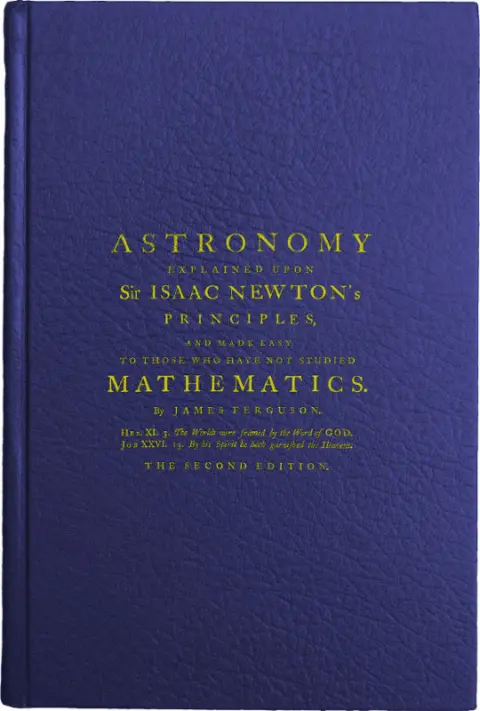
THE CLASSIC COLLECTION · 1756
"Astronomy Explained Upon Sir Isaac Newton's Principles" by James Ferguson is a scientific publication written in the mid-18th century. This work delves into the principles of astronomy as established by Isaac Newton, making complex astronomical concepts accessible to those who lack a mathematical background. The book covers the solar system's structure, the nature of celestial bodies, and various astronomical phenomena, emphasizing the scientific significance and beauty of the universe. The beginning of the book introduces astronomy as the most sublime and useful of sciences, detailing its impact on human understanding and the vastness of the universe. Ferguson aims to convey not only the mechanics of celestial movements but also the grandeur of the cosmos, evoking a sense of wonder about the relationship between humanity and the divine. He emphasizes the infinitude of stars and systems, setting the tone for an exploration of the solar system's structure and properties, which unfolds in subsequent chapters.
Introduction adapted from the source catalogue; source summaries may be automatically generated.
Free to read · English · 129,260 words · No account needed
MAKE TIME FOR A GOOD BOOK
On by default. Untick to stop anonymous reading totals. Each page counts after 10 seconds in view. How this works.
Anonymous counting is on unless you have switched it off.
SUN appears bigger than the Stars, and why, 4 Turns round his Axis, 18. His proportional breadth as seen from the different Planets, 87. Describes unequal arcs above and below the Horizon at different times, and why, 130. His Center the only place from which the true motions of the Planets could be seen, 135. Is for half a year together visible at each Pole in it’s turn, and as long in visible, 200, 294. Is nearer the Earth in Winter than in Summer, 205. Why his motion agrees so seldom with the motion of a well regulated Clock, 224-245. Would more than fill the Moon’s Orbit, 271. Proved to be much bigger than the Earth, and the Earth to be bigger than the Moon, 315. To calculate his true place, 360.
Systems, the Solar, 17-95;
the Ptolemean, 96;
the Tychonic, 97.
Table, of the Periods, Revolutions, Magnitudes, Distances, &c. of the Planets, facing § 99. Of the Air’s rarity, compression, and expansion at different heights, 174. Of refractions, 182. For converting time into motion, and the reverse, 220. For shewing how much of the celestial Equator passes over the Meridian in any part of a mean Solar Day; and how much the Stars accelerate upon the mean Solar time for a month, 221. Of the first part of the Equation of time, 229; of the second part, 241. Of the precession of the Equinox, 247. Of the length of Sidereal, Julian, and Tropical Years, 251. Of the Sun’s place and Anomaly, following 251. Of the Equation of natural Days, following 251 Of the Conjunctions of the hour and minute hands of a Watch, 264. Of the Curves described by the Satellites, 272. Of the difference of time in the Moon’s rising and setting on the parallel of London every day during her course round the Ecliptic, 277. Of Eclipses, 327. For calculating New and Full Moons and Eclipses, following 390. Of the Constellations and number of the Stars, 399. Of the Jewish, Egyptian, Arabic, and Grecian months, 415. For inserting the Golden Numbers right in the Calendar, 423. Of the times of all the New Moons for 76 years, 424. Of remarkable Æras or Events, 433. Of the Golden Number, Number of Direction, Dominical Letter and Days of the Months, following 433.
THALES’s Eclipse, 323.
THUCYDIDES’s Eclipse 324.
Tides, their Cause and Phenomena, 295-311.
Tide-Dial described, 441.
Trajectorium Lunare described, 440.
Tropics, 198.
Twilight, none in the Moon, 254.
Tychonic System absurd, 97.
Universe, the Work of Almighty Power, 5, 161.
Up and down, only relative terms, 122.
Upper or under side of the Earth no such thing, 123.
Your reading position is saved on this browser. Take it to another device with a library code. Reading pages adapt to text, rather than matching a printed edition.
BEHIND THE BOOK
This eBook is for the use of anyone anywhere in the United States and most other parts of the world at no cost and with almost no restrictions whatsoever. You may copy it, give it away or re-use it under the terms of the Project Gutenberg License included with this eBook or online at www.gutenberg.org. If you are not located in the United States, you will have to check the laws of the country where you are located before using this eBook. Read the source licence.
The original source file, including credits and licence, is retained by this library. Request an original-format copy at no charge. Please include the book title and Project Gutenberg identifier #60619.
KEEP YOUR CURIOSITY GOING
John Muir

Asa Gray
Asa Gray

Florence Nightingale
Elizabeth Robins Pennell
Denison Olmsted