
Letters to a Friend, Written to Mrs. Ezra S. Carr, 1866-1879
John Muir
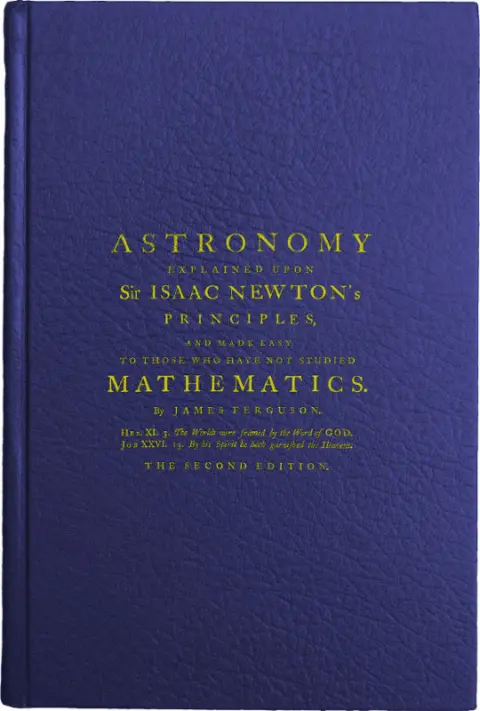
THE CLASSIC COLLECTION · 1756
"Astronomy Explained Upon Sir Isaac Newton's Principles" by James Ferguson is a scientific publication written in the mid-18th century. This work delves into the principles of astronomy as established by Isaac Newton, making complex astronomical concepts accessible to those who lack a mathematical background. The book covers the solar system's structure, the nature of celestial bodies, and various astronomical phenomena, emphasizing the scientific significance and beauty of the universe. The beginning of the book introduces astronomy as the most sublime and useful of sciences, detailing its impact on human understanding and the vastness of the universe. Ferguson aims to convey not only the mechanics of celestial movements but also the grandeur of the cosmos, evoking a sense of wonder about the relationship between humanity and the divine. He emphasizes the infinitude of stars and systems, setting the tone for an exploration of the solar system's structure and properties, which unfolds in subsequent chapters.
Introduction adapted from the source catalogue; source summaries may be automatically generated.
Free to read · English · 129,260 words · No account needed
MAKE TIME FOR A GOOD BOOK
On by default. Untick to stop anonymous reading totals. Each page counts after 10 seconds in view. How this works.
Anonymous counting is on unless you have switched it off.
Venus, her bulk, distance, period, length of days and nights, 26.
Shines not by her own light, ib.
Is our morning and evening Star, 28.
Her Axis, how situated, 29.
Her surprising Phenomena, 29-43.
The inclination of her Orbit, 45.
When she will be seen on the Sun, ib.
How it may probably be soon known if she has a Satellite, 46.
Appears in all the Shapes of the Moon, 23, 141.
An experiment to shew her phases and apparent motion, 141.
Vision, how caused, 167.
Weather, not hottest when the Sun is nearest to us, and why, 205.
Weight, the cause of it, 122.
World not eternal, 164.
Year, 407,
Great, 251,
Tropical, 408,
Sidereal, 400,
Lunar, 410,
Civil, 411,
Bissextile, ib.
Roman, 413,
Jewish, Egyptian, Arabic, and Grecian, 415,
how long it would be if the Sun moved round the Earth, 111.
Zodiac, what, 397.
How divided by the antients, 398.
Zones, what, 199.
DIRECTIONS to the BOOKBINDER.
The ORRERY PLATE is to front the Title Page.
PLATE I fronting Page 5 II 39 III 49 IV 73 V 81 VI 97 VII 125 VIII 147 IX 147 X 157 XI 179 XII 203 XIII 279
Footnotes
Footnote 1:
Dr. YOUNG’s Night Thoughts.
Footnote 2:
If a thread be tied loosely round two pins stuck in a table, and moderately stretched by the point of a black lead pencil carried round by an even motion and light pressure of the hand, an oval or ellipsis will be described; the two points where the pins are fixed being called the foci or focuses thereof. The Orbits of all the Planets are elliptical, and the Sun is placed in or near to one of the foci of each of them: and that in which he is placed, is called the lower focus.
Footnote 3:
Astronomers are not far from the truth, when they reckon the Sun’s center the lower focus of all the Planetary Orbits. Though strictly speaking, if we consider the focus of Mercury’s Orbit to be in the Sun’s center, the focus of Venus’s Orbit will be in the common center of gravity of the Sun and Mercury; the focus of the Earth’s Orbit in the common center of gravity of the Sun, Mercury, and Venus; the focus of the Orbit of Mars in the common center of gravity of the Sun, Mercury, Venus, and the Earth; and so of the rest. Yet, the focuses of the Orbits of all the Planets, except Saturn, will not be sensibly removed from the center of the Sun; nor will the focus of Saturn’s Orbit recede sensibly from the common center of gravity of the Sun and Jupiter.
Footnote 4:
As represented in Plate III. Fig. I. and described in § 138.
Footnote 5:
When he is between the Earth and the Sun in the nearer part of his
Orbit.
Footnote 6:
Your reading position is saved on this browser. Take it to another device with a library code. Reading pages adapt to text, rather than matching a printed edition.
BEHIND THE BOOK
This eBook is for the use of anyone anywhere in the United States and most other parts of the world at no cost and with almost no restrictions whatsoever. You may copy it, give it away or re-use it under the terms of the Project Gutenberg License included with this eBook or online at www.gutenberg.org. If you are not located in the United States, you will have to check the laws of the country where you are located before using this eBook. Read the source licence.
The original source file, including credits and licence, is retained by this library. Request an original-format copy at no charge. Please include the book title and Project Gutenberg identifier #60619.
KEEP YOUR CURIOSITY GOING
John Muir

Asa Gray
Asa Gray

Florence Nightingale
Elizabeth Robins Pennell
Denison Olmsted