
Letters to a Friend, Written to Mrs. Ezra S. Carr, 1866-1879
John Muir
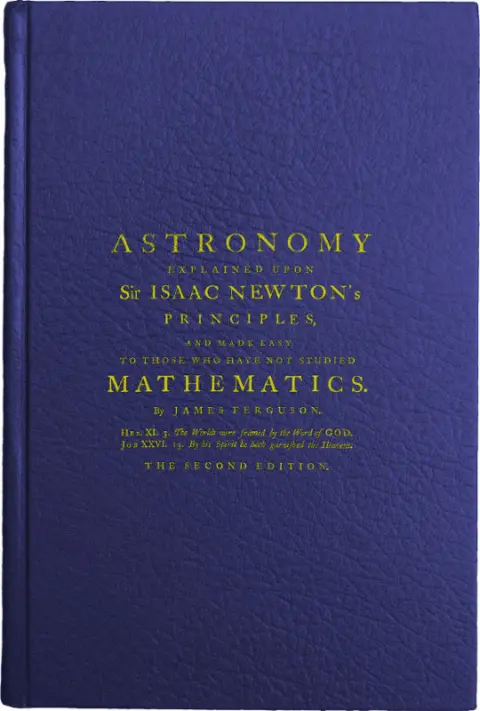
THE CLASSIC COLLECTION · 1756
"Astronomy Explained Upon Sir Isaac Newton's Principles" by James Ferguson is a scientific publication written in the mid-18th century. This work delves into the principles of astronomy as established by Isaac Newton, making complex astronomical concepts accessible to those who lack a mathematical background. The book covers the solar system's structure, the nature of celestial bodies, and various astronomical phenomena, emphasizing the scientific significance and beauty of the universe. The beginning of the book introduces astronomy as the most sublime and useful of sciences, detailing its impact on human understanding and the vastness of the universe. Ferguson aims to convey not only the mechanics of celestial movements but also the grandeur of the cosmos, evoking a sense of wonder about the relationship between humanity and the divine. He emphasizes the infinitude of stars and systems, setting the tone for an exploration of the solar system's structure and properties, which unfolds in subsequent chapters.
Introduction adapted from the source catalogue; source summaries may be automatically generated.
Free to read · English · 129,260 words · No account needed
MAKE TIME FOR A GOOD BOOK
On by default. Untick to stop anonymous reading totals. Each page counts after 10 seconds in view. How this works.
Anonymous counting is on unless you have switched it off.
Morning and Evening Star, what, 145.
Motion, naturally rectilineal, 100. Apparent, of the Planets as seen by a spectator at rest on the outside of all their Orbits, 133; and of the Heavens as seen from any Planet, 154.
Natural Day, not compleated in the time that the Earth turns round
it’s Axis, 222.
New and Full Moon, to calculate the times of 355.
New Stars, 403,
cannot be Comets, 404.
New Style, it’s original, 414.
NICIAS’s Eclipse, 328.
Nodes, of the Planet’s Orbits, their places in the Ecliptic, 20.
Of the Moon’s Orbit, 317.
their retrograde motion, 319.
Nonagesimal Degree, what, 259.
Number of Direction, 426.
Objects, we often mistake their bulk by mistaking their distance,
185.
Appear bigger when seen through a fog than through clear Air, and
why, ib.
this applied to the solution of the Horizontal Moon, 187.
Oblique Sphere, what, 131.
Olympiads, what, 323. n.
Orbits of the Planets not solid, 21.
Orrery described, 434, 435, 436.
Parallax, Horizontal, what, 190.
Parallel Sphere, what, 131.
Path of the Moon, 265, 266, 267.
Of Jupiter’s Moons, 269.
Pendulums, their vibrating slower at the Equator than near the Poles proves that the Earth turns on it’s Axis, 117.
Penumbra, what, 336.
It’s velocity on the Earth in Solar Eclipses, 337.
Period of Eclipses, 320, 326.
Phases of the Moon, 252-268.
Planets, much of the same nature with the Earth, 11. Some have Moons belonging to them, 12. Move all the same way as seen from the Sun, but not as seen from one another, 18. Their Moons denote them to be inhabited, 86. The proportional breadth of the Sun’s Disc as seen from each of them, 87. Their proportional bulks as seen from the Sun, 88. An idea of their distances from the Sun, 89. Appear bigger and less by turns, and why, 90. Are kept in their Orbits by the power of gravity, 101, 150-158. Their motions very irregular as seen from the Earth, 137. The apparent motions of Mercury and Venus delineated by Pencils in an Orrery, 138. Elongations of all the rest as seen from Saturn, 147. Describe equal areas in equal times, 153. The excentricities of their Orbits, 155. In what times they would fall to the Sun by the power of gravity, 157. Disturb one another’s motions, the consequence thereof, 163. Appear dimmer when seen through telescopes than by the bare eye, the reason of this, 170.
Planetary Globe described, 439.
Polar Circles, 198.
Poles, of the Planets, what, 19.
Of the world, what, 122.
Celestial, seem to keep on the same points of the Heavens all the
year, and why, 196.
Projectile Force, 150; if doubled would require a quadruple power of gravity to retain the Planets in their Orbits, 153. Is evidently an impulse from the hand of the ALMIGHTY, 161.
Precession of the Equinoxes, 246-251.
Ptolemean System absurd, 96, 140.
Your reading position is saved on this browser. Take it to another device with a library code. Reading pages adapt to text, rather than matching a printed edition.
BEHIND THE BOOK
This eBook is for the use of anyone anywhere in the United States and most other parts of the world at no cost and with almost no restrictions whatsoever. You may copy it, give it away or re-use it under the terms of the Project Gutenberg License included with this eBook or online at www.gutenberg.org. If you are not located in the United States, you will have to check the laws of the country where you are located before using this eBook. Read the source licence.
The original source file, including credits and licence, is retained by this library. Request an original-format copy at no charge. Please include the book title and Project Gutenberg identifier #60619.
KEEP YOUR CURIOSITY GOING
John Muir

Asa Gray
Asa Gray

Florence Nightingale
Elizabeth Robins Pennell
Denison Olmsted