THE CLASSIC COLLECTION✦The Athenian ConstitutionCLASSIC FREE BOOKS
The Athenian Constitution
Aristotle
THE CLASSIC COLLECTION · 1887
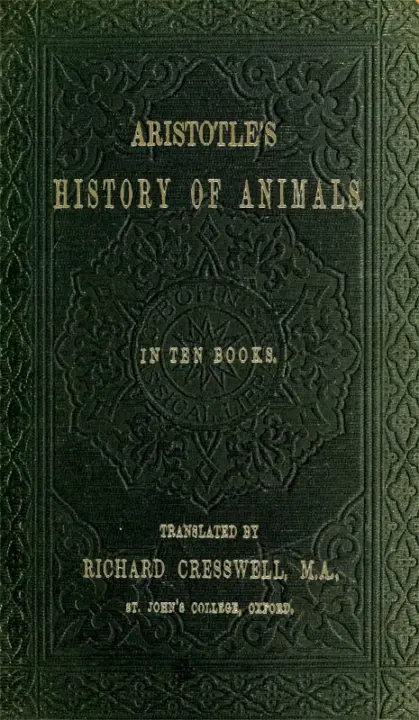
"Aristotle's History of Animals" by Aristotle is a scientific publication written in the late 4th century BC. The work serves as one of the earliest comprehensive surveys of zoology, analyzing and categorizing various animal species based on their anatomy, behaviors, and habitats. It combines observations with the knowledge inherited from previous naturalists to create a foundational text in the history of biological sciences. The opening of "Aristotle's History of Animals" sets the stage for a detailed examination of the animal kingdom. Aristotle begins by classifying animal parts into simple and compound components, continuing with a discussion on the similarities and differences among various species based on their physical attributes and lifestyles. He lays out an extensive framework for understanding animals, including their modes of life—aquatic versus terrestrial—and anatomical structures, using comparative anatomy to illustrate his points. This introduction effectively establishes the categories and criteria Aristotle will use throughout the work to structure his exploration of the biological world.
Introduction adapted from the source catalogue; source summaries may be automatically generated.
Free to read · English · 129,772 words · No account needed
MAKE TIME FOR A GOOD BOOK
On by default. Untick to stop anonymous reading totals. Each page counts after 10 seconds in view. How this works.
Anonymous counting is on unless you have switched it off.
Ὄζολις, a cephalopod mollusk, the same as bolitæna, 76.
Οἰνάνθη, the flower of the vine, 121.
Οἰνάνθη, probably the name of some dark-coloured bird, 276.
Οἰνὰς, a wild pigeon, Columba migratoria, Strack, C. œnas, 111,
138, 203.
Ὄϊς, sheep, Ovis aries, 72;
different kinds, 208.
Οἶστρος, gad fly, Tabanus corvinus, 3, 9, 83, 89;
origin, 125;
a blood sucker, 208;
the marine species probably refers to certain parasites on fish,
Lernæa brachialis, Phalangium balænarum, 135, 208, 212, 219.
Οἶστρος, a bird, perhaps Motacilla sibilatrix, or Trochilus, 202.
Ὁλοθούριον, probably an alga Spongodium, Spratt's Lycia, Holothuria
or Salpa, 4.
Ὄνος, ass, Equus Asinus, 27, 31, 39, 68, 70;
not infested with lice or ticks, 135;
reproduction, 113, 163, 171;
food and drink, 207;
diseases, 224;
a foe to the Ægithus, 232;
eats thorns, 233.
Ὄνος ὁ ἄγριος, the wild ass, 178;
in Epirus, 71;
the Indian ass, perhaps Rhinoceros, 28.
Ὄνος, fish, perhaps Raia squatina, Strack, Gadus mustela, 214, 255.
Ὄνος, woodlouse, Oniscus asellus, 135.
Ὀρεινὸς, a species of titmouse, Parus Ater, 202.
Ὀρειπέλαργος, Grypaetus Barbatus, Strack, 251.
Ὀρεὺς, mule, 5, 11, 27, 31, 39;
females and reproduction, 163, 172, 173;
food and drink, 207.
Ὀρίγανος, plant, Origanum, 238.
Ὄρκυς, a large kind of tunny, Scomber ala longa, 109.
Ὄρνις, domestic fowl, see ἀλεκτόρις and ἀλεκτρυὼν.
Ὄροβος, tares, Orobus, Ervum ervilia, 71, 191.
Ὀρόσπιζος, mountain finch, Fringilla montifringilla, Strack, 202.
Ὀρσοδάκνη, an insect that eats the buds of plants, Chrysomela
oleracea, 126.
Ὀρτυγομήτρα, perhaps Land rail, Rallus Crex, 210.
Ὄρτυξ, quail, Coturnix Vulgaris, 40, 45;
nest, 146, 240;
migration, 210;
does not perch on trees, 242.
Ὄρυξ, Nilghau, Antilope picta, or Antilope Oryx, 27.
Ὀρφὸς, a sea fish, perhaps Scorpæna porcus, Spratt's Lycia, 109,
199, 211, 214.
Ὀρχιλος, a bird, Charadrius minor, 232.
Ὀστρακόδερμα, testaceous mollusca, 8, 10, 13, 73, 81;
reproduction, 110, 115, 117;
compared with plants, 195;
hybernate, 213;
best for food when they have ova, 228.
Ὄστρεον, oyster, 3, 10, 117;
different kinds, 73;
origin, 117;
have an anus, 198;
τά ὀστρεώδη, testacea, 228.
Ὄστρειον, the shell used by painters, 118.
Οὖραξ, Otis houbara, 139.
Οὖς θαλάττιον, sea ear, perhaps Haliotis, 84.
Ὀφίδιον, a small serpent, found in the plant silphium, 227; a small serpent, Coluber ammodytes, or C. Æsculapii, Strack, ib.; an Indian serpent, whose bite is fatal, ib.
Ὄφις, serpent, 5;
winged serpent in Æthiopia, perhaps Draco volans, 9;
a horned serpent in Egypt, Coluber cerastes, 28;
water-serpents, Coluber natrix, 10, 35, 38, 43, 44, 46, 49, 60;
marine serpents, Muræna ophis, or Ammodytes tobianus, Strack,
38, 255; there are many kinds.
Their hissing, 96;
the female larger, 100;
reproduction, 103, 137;
change their skin, 121, 216;
omnivorous, 204;
hybernate, 213;
a large kind in Lybia, Boa constrictor, 226;
the blind serpent, Anguis fragilis, 223.
Ὄφριος, Labrus Anthia, 109.
Πάγουρος, probably the common hermit-crab, Pagurus Bernhardi, 77.
Πανθὴρ, panther, Felis Panthera, 177.
Παρδάλια, 34;
perhaps the spots on the Leopard's skin: an unknown animal, L. and
S. Lex.
Παρδαλίαγχες, a plant poisonous to the Leopard, perhaps aconite, Doronicum pardalianches, or aconitum Napellus, 238.
Πάρδαλις, Leopard, Felis Leopardus, 5, 27, 29, 30;
Asiatic, 226;
the female more bold than the male, 230;
hunts by scent, 238.
Πάρδαλος, a bird, perhaps Sturnus Vulgaris, Starling. Tringa Squaratola, Strack, 248.
Πάρδιον, see ἱππάρδιον, Giraffe.
Πελαργὸς, stork, Ardea Ciconia, 203, 215;
when wounded applies origanum to its wounds, 238;
said to be fed by its young, 245.
Πελειὰς, a kind of dove, distinct from περίστερα, 111;
migratory, 210.
Πελεκᾶν, Pelecan, Pelecanus onocrotalus, migrates from the
Strymon, 209;
gregarious, 210;
eats shell-fish, 243.
Πέλλος, black heron, Ardea cinerea, 233, 247.
Πέρδιξ, partridge, Perdix cinerea, and rufa, Tetrao Perdix and
Græcus, 5, 45, 47, 96;
reproduction, 106, 139, 140, 141, 148;
nest, incubation, habits, 138, 240, 241, 242;
life, 145, 240;
eats snails, 255;
dusts itself, 277.
Περιστερὰ, House-dove, Columba, 4, 5, 39, 45;
differs from πελειὰς, 111;
reproduction, ib., 138, 139, 140, 141, 144, 145;
food, 202;
not migratory, 210;
habits, 239, 240;
those used for lures are blinded, 240;
wash and dust themselves, 277.
Your reading position is saved on this browser. Take it to another device with a library code. Reading pages adapt to text, rather than matching a printed edition.
BEHIND THE BOOK
This eBook is for the use of anyone anywhere in the United States and most other parts of the world at no cost and with almost no restrictions whatsoever. You may copy it, give it away or re-use it under the terms of the Project Gutenberg License included with this eBook or online at www.gutenberg.org. If you are not located in the United States, you will have to check the laws of the country where you are located before using this eBook. Read the source licence.
The original source file, including credits and licence, is retained by this library. Request an original-format copy at no charge. Please include the book title and Project Gutenberg identifier #59058.
KEEP YOUR CURIOSITY GOING
Cécile Tormay

Moritz Busch
John L. Ransom
Frances Wright
Cécile Tormay

Mabel Potter Daggett