THE CLASSIC COLLECTION✦The Athenian ConstitutionCLASSIC FREE BOOKS
The Athenian Constitution
Aristotle
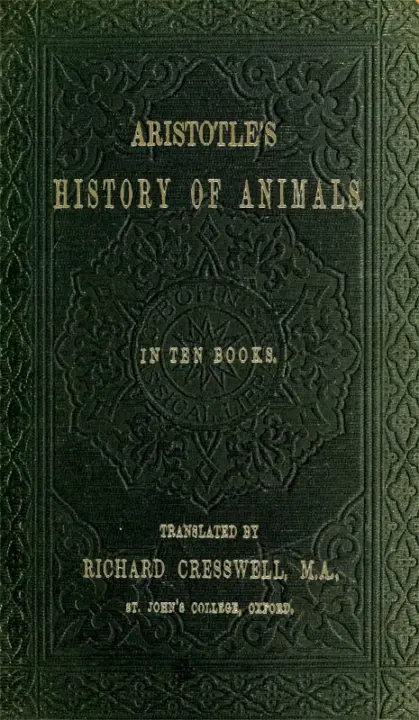
THE CLASSIC COLLECTION · 1887
"Aristotle's History of Animals" by Aristotle is a scientific publication written in the late 4th century BC. The work serves as one of the earliest comprehensive surveys of zoology, analyzing and categorizing various animal species based on their anatomy, behaviors, and habitats. It combines observations with the knowledge inherited from previous naturalists to create a foundational text in the history of biological sciences. The opening of "Aristotle's History of Animals" sets the stage for a detailed examination of the animal kingdom. Aristotle begins by classifying animal parts into simple and compound components, continuing with a discussion on the similarities and differences among various species based on their physical attributes and lifestyles. He lays out an extensive framework for understanding animals, including their modes of life—aquatic versus terrestrial—and anatomical structures, using comparative anatomy to illustrate his points. This introduction effectively establishes the categories and criteria Aristotle will use throughout the work to structure his exploration of the biological world.
Introduction adapted from the source catalogue; source summaries may be automatically generated.
Free to read · English · 129,772 words · No account needed
MAKE TIME FOR A GOOD BOOK
On by default. Untick to stop anonymous reading totals. Each page counts after 10 seconds in view. How this works.
Anonymous counting is on unless you have switched it off.
Περιστοειδῆ, the class of pigeon-like birds, 111, 144, 202.
Πέρκη, perch, Perca fluviatilis, 38, 44, 155, 214.
Περκνόπτερος, dusky eagle, Vultur percnopterus or Gypaietos barbatus, or Falco barbatus, 251.
Πέρκος, grey hawk, Falco subbuteo, 253.
Πέρνης or πτερνὶς, a kind of hawk.
Πεύκη, pine tree, 126.
Πήγανον, rue, Ruta graveolens, 238.
Πηλαμὶς, a tunny fish of a year old, Scomber Thynnus, 4;
reproduction, 108;
where found, 109;
the tunny a year older than the pelamys, 157, 160;
migrate to the Pontus, 211;
gregarious, 235.
Πηνέλοψ, a kind of duck, Anas Penelope, 203.
Πηνίον, some species of larva, Phalænæ geometræ, 124.
Πιθηκοειδῆ, the ape tribe, 26.
Πίθηκος, ape, Simia Sylvanus, 32.
Πίκρις, a bitter herb, endive, Chicorium intybus, or Helminthia
Echionella, 238.
Πίννα, the genus Pinna, 82, 117, 118, 195.
Πιννοθήρης or πιννοτήρης, and πιννοφύλαξ, small crustaceans living in shells and sponges, Pinnotheres veterum, 117.
Πίπος, πίπρα, πιπὼ, woodpecker, Picus viridis, major, minor,
202, 232, 248.
Πισσόκηρος, bees' wax, 261.
Πίφηξ or πίφιγξ, Alauda trivialis, 234.
Πλάγγος, a species of eagle, Aquila albicilla, 251.
Πλόμος or φλόμος, mullein, Verbascum thapsus, fatal to fish, 220.
Πλωτοὶ, certain fish, as the cestreus and labrax, 153, 228, 256, 273; also of birds, 35.
Πνεύμων, a marine animal of low organization, 118.
Πόα Μηδικὴ and Συρία, Medicago sativa, and lupulina, 268.
Ποικιλὶς, perhaps Fringilla Carduelis or Œnanthe, 232.
Πολύπους, Octopus, Spratt's Lycia, Sepia octopodia, a small
variegated kind, has not been determined, Owen, 9, 73, 74, 76;
several kinds, 73, 258;
reproduction, 105, 110, 121;
destroys the lobster, 198;
is destroyed by the conger, ib.;
food, 199;
when good for food, 228;
ink, 75, 257;
changes its colour, ib.;
grows lean, ib.;
goes upon shore, 258.
Πορφύρα, Murex trunculus, Spratt's Lycia, and probably some other
shells, 81, 83, 85, 86, 89, 94;
time of appearance, 110, 115, 116, 117;
several kinds, 116, 117;
said to obtain the purple from Algæ, 155;
carnivorous, 200;
hybernates, 213, 220, 256.
Πορφυρίων, a bird with a long neck, Fulica porphyrion, Strack,
45, 206.
Πράσιον, a species of alga, perhaps Caulerpa prolifera, Spratt's
Lycia, 199.
Πρασοκουρὶς, a grub which destroys leeks, Clerus apiarius, 126.
Πρέσβυς, the same as Trochilus, wren, 232, 244.
Πρημάδες, a kind of tunny, 214.
Πρίστις, perhaps the saw-fish, Squalus pristis, Strack, 152.
Πρόβατον, sheep, Ovis aries, 27, 29;
black lambs, 64, 66, 67;
in Epirus, 71, 72;
voice of the ram, 96;
dreams, 97;
reproduction, 112, 113, 163, 164, 165;
sheep-ticks, 134;
food, 208;
acorns injurious to sheep, 222;
diseases, 223;
Syrian sheep, 225;
Egyptian, 226;
habits, 235;
hostile to bees, 261;
ruminate, 279.
Πρὸξ, roe deer, Cervus Capriolus, 39, 58, 67.
Πτελέα, elm, Ulmus campestris, 206.
Πτερνὶς, a species of hawk, 253.
Πτὺγξ, or πώϋξ, a water-bird, 244.
Πύγαργος, a kind of eagle, perhaps Circus Cyaneus, hen harrier, 146, 250; also a water-bird, perhaps Tringa Ocrophus, L. Schneider, 203, 244.
Πυγολαμπὶς, glow-worm, Lampyris noctiluca, 73, 125.
Πυραλὶς, a bird, enemy of the turtle dove, 232.
Πυραύστης, a moth, Tinea mellonella, Strack, 225.
Πυῤῥούλας, a red bird, Loxia pyrrula, or enucleator, 202.
Πώϋξ, a bird living in marshes, Ardea purpurea, 247.
Ῥαφάνος, cabbage or radish, 124.
Ῥητίνη, resin, 248.
Ῥίνη, a species of shark, Squalus Squatina, Strack, 49;
reproduction, 103, 108, 109, 150, 151;
mode of taking its prey, 255;
changes its colour, 257.
Ῥινόβατης, Raia rhinobatus, a cartilaginous fish, 151.
Ῥυάδες, fish that swim in shoals, 93, 109, 159, 211, 212.
Σαθέριον, a kind of otter or beaver, Lutra Luteola, Strack, 205.
Σαλαμάνδρα, salamander, Lacerta Salamandra, 126.
Σάλπη, the genus Scomber, Strack, Sparus Salpa, 92;
reproduction, 108, 109, 159;
food, 201;
lives in bays of the sea, 211;
is not carnivorous, 256.
Σανδαράκη, red sulphuret of arsenic, 223;
bee bread, 264.
Σαπείριον, σαπήριον or σατύριον, a plant, probably an orchid, Satyrian, 205.
Σαπερδὶς, a fresh-water fish, perhaps Accipenser hugo, 229.
Σαργῖνος, the sardine, migratory, Tetragonus niger, 231.
Σὰργος, Sparus sargus, Strack, a sea-fish, 108, 109, 159, 200.
Σατύριον, Sorex moschatus, 205.
Σαῦρα, Lizard, generic name, 5, 8, 25, 34, 35, 36, 39, 43, 44;
reproduction, 103, 137;
life, 204;
hybernates, 213;
change of skin, 216;
Arabian lizards, 225, 252.
Σαύρος, Salmo Saurus, marine, 234.
Your reading position is saved on this browser. Take it to another device with a library code. Reading pages adapt to text, rather than matching a printed edition.
BEHIND THE BOOK
This eBook is for the use of anyone anywhere in the United States and most other parts of the world at no cost and with almost no restrictions whatsoever. You may copy it, give it away or re-use it under the terms of the Project Gutenberg License included with this eBook or online at www.gutenberg.org. If you are not located in the United States, you will have to check the laws of the country where you are located before using this eBook. Read the source licence.
The original source file, including credits and licence, is retained by this library. Request an original-format copy at no charge. Please include the book title and Project Gutenberg identifier #59058.
KEEP YOUR CURIOSITY GOING
Cécile Tormay

Moritz Busch
John L. Ransom
Frances Wright
Cécile Tormay

Mabel Potter Daggett