THE CLASSIC COLLECTION✦The Athenian ConstitutionCLASSIC FREE BOOKS
The Athenian Constitution
Aristotle
THE CLASSIC COLLECTION · 1887
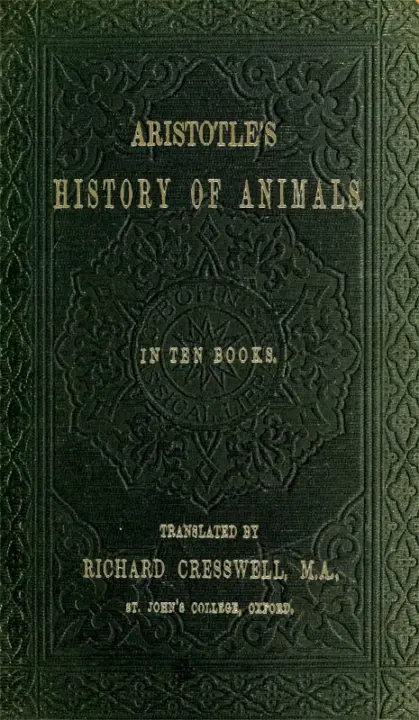
"Aristotle's History of Animals" by Aristotle is a scientific publication written in the late 4th century BC. The work serves as one of the earliest comprehensive surveys of zoology, analyzing and categorizing various animal species based on their anatomy, behaviors, and habitats. It combines observations with the knowledge inherited from previous naturalists to create a foundational text in the history of biological sciences. The opening of "Aristotle's History of Animals" sets the stage for a detailed examination of the animal kingdom. Aristotle begins by classifying animal parts into simple and compound components, continuing with a discussion on the similarities and differences among various species based on their physical attributes and lifestyles. He lays out an extensive framework for understanding animals, including their modes of life—aquatic versus terrestrial—and anatomical structures, using comparative anatomy to illustrate his points. This introduction effectively establishes the categories and criteria Aristotle will use throughout the work to structure his exploration of the biological world.
Introduction adapted from the source catalogue; source summaries may be automatically generated.
Free to read · English · 129,772 words · No account needed
MAKE TIME FOR A GOOD BOOK
On by default. Untick to stop anonymous reading totals. Each page counts after 10 seconds in view. How this works.
Anonymous counting is on unless you have switched it off.
1. First of all we will speak of the internal parts of sanguineous animals, for the greatest number of genera differ from other animals, some being sanguineous, others ex-sanguineous. The sanguineous genera are man, viviparous and oviparous quadrupeds, birds, fishes, and whales, and perhaps others that are anonymous, because they do not form a genus, but simply species amongst each other, as the serpent and the crocodile.
2. All viviparous quadrupeds have an œsophagus and trachea, situated as in man, and so have oviparous quadrupeds and birds, though there is some difference in the formation of these parts; all that breathe by inhaling and exhaling air have lungs, trachea, and œsophagus. The position of the œsophagus and trachea, though similar, is not the same, nor are the lungs alike in all, nor similar in position.
3. All sanguineous animals have a heart, and a division in the middle of the body, called a diaphragm. In small animals its smallness and thinness render it less apparent. The heart of the ox is peculiar; for there is a kind of ox, though not the whole genus, which has a bone in its heart, and there is also a bone in the heart of the horse.
4. Not all animals have lungs, fish and those with gills have no lungs. All sanguineous animals have a liver, generally a spleen also; but in oviparous animals that are not viviparous, the spleen is so small as nearly to escape notice, as in most birds, the pigeon, kite,[58] hawk,[59] and owl. The ægocephalus[60] has none at all. Oviparous quadrupeds are of the same nature, for they have a very small spleen, as the tortoise, emys,[61] phryne, lizard, crocodile, and frog.
[58] Falco milvus.
[59] Falco palurabarius.
[60] Stryx otus.
[61] Testudo coriacea.
5. Some animals have a gall upon the liver, others none. Among viviparous quadrupeds the stag[62] has none, nor the deer,[63] horse, mule, ass, seal, and some swine. The Achaïnian stag appears to have the gall in the tail; that which they call gall in these animals resembles it in colour, but it is not liquid like gall, but more like the spleen in its internal structure.
[62] Cervus elaphus.
[63] Cervus capreolus, or C. Dama.
6. All, while they are alive, have worms[64] in the head; they are produced in the hollow part under the hypoglottis, and near the vertebræ, where the head is joined on. In size they resemble very large maggots; they are numerous, and continuous, in number not generally more than twenty. Stags, as I have observed, have no gall, but their intestines are so bitter that dogs will not eat them if the deer are fat.
[64] Possibly Œstras nasalis.
Your reading position is saved on this browser. Take it to another device with a library code. Reading pages adapt to text, rather than matching a printed edition.
BEHIND THE BOOK
This eBook is for the use of anyone anywhere in the United States and most other parts of the world at no cost and with almost no restrictions whatsoever. You may copy it, give it away or re-use it under the terms of the Project Gutenberg License included with this eBook or online at www.gutenberg.org. If you are not located in the United States, you will have to check the laws of the country where you are located before using this eBook. Read the source licence.
The original source file, including credits and licence, is retained by this library. Request an original-format copy at no charge. Please include the book title and Project Gutenberg identifier #59058.
KEEP YOUR CURIOSITY GOING
Cécile Tormay

Moritz Busch
John L. Ransom
Frances Wright
Cécile Tormay

Mabel Potter Daggett