THE CLASSIC COLLECTION✦The Athenian ConstitutionCLASSIC FREE BOOKS
The Athenian Constitution
Aristotle
THE CLASSIC COLLECTION · 1887
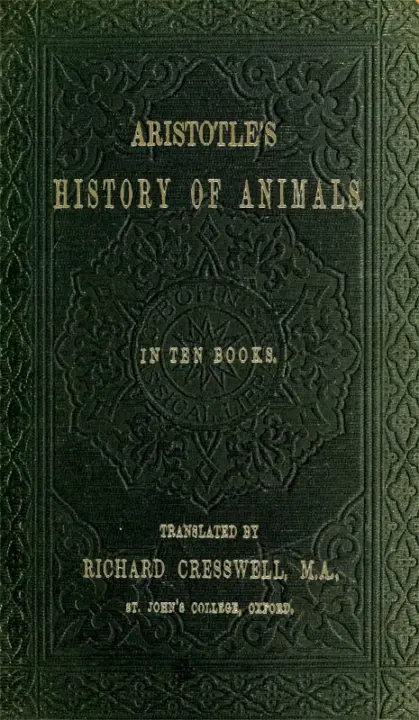
"Aristotle's History of Animals" by Aristotle is a scientific publication written in the late 4th century BC. The work serves as one of the earliest comprehensive surveys of zoology, analyzing and categorizing various animal species based on their anatomy, behaviors, and habitats. It combines observations with the knowledge inherited from previous naturalists to create a foundational text in the history of biological sciences. The opening of "Aristotle's History of Animals" sets the stage for a detailed examination of the animal kingdom. Aristotle begins by classifying animal parts into simple and compound components, continuing with a discussion on the similarities and differences among various species based on their physical attributes and lifestyles. He lays out an extensive framework for understanding animals, including their modes of life—aquatic versus terrestrial—and anatomical structures, using comparative anatomy to illustrate his points. This introduction effectively establishes the categories and criteria Aristotle will use throughout the work to structure his exploration of the biological world.
Introduction adapted from the source catalogue; source summaries may be automatically generated.
Free to read · English · 129,772 words · No account needed
MAKE TIME FOR A GOOD BOOK
On by default. Untick to stop anonymous reading totals. Each page counts after 10 seconds in view. How this works.
Anonymous counting is on unless you have switched it off.
Λύκος, wolf, Canis lupus, 6, 29;
reproduction, 103, 161, 177;
eats grass and earth, 204;
Egyptian, 226;
attacks the ass, bull, and fox, 232;
near the lake Mæotis, 254.
Λύκος, a kind of spider, Aranea tarantula, Strack, 259.
Λύρα, a fish, Trigla Lyra, 95.
Μαῖα, a crustacean, Maia Squinado, 77, 81, 217.
Μαινὶς, sprat or sardine, Sparus mœna, μαινίδια, 157, 158, 159;
when the males are called tragi, 228;
gregarious, 234.
Μαλάκια, the class of cephalopod mollusks, one species which occupies
a shell is probably Camarina mediterranea, Spratt's Lycia, 8, 10,
19, 73, 87;
reproduction, 105, 110, 121, 154;
why they imbibe water, 196;
carnivorous, 198, 199;
best for food when they have ova, 228.
Μαλακοκρανεὺς, perhaps Loxia pyrrhula, Schneider, 248.
Μαλακόστρακα, crustaceans, 10, 73, 77;
reproduction, 106, 120;
imbibe water, 196;
omnivorous, 198;
best for food when they have ova, 228.
Μαρίνος, a sea-fish, 159, 218.
Μαρτιχόρα, a fabulous animal, 30.
Μελαγκόρυφος, probably blackcap, Parus ater, or Muscicarpa
atricapilla, 202;
food, eggs, nest and tongue, 246;
in the autumn called Sycalis, 276.
Μελαναίετος, called also lagophonos, an eagle, Aquila melanaetus, Falco fulvus, 251.
Μελανοῦρος, a sea-fish, Sparus melanurus, 199.
Μελεαγρὶς, Guinea fowl, Meleagris Numidica, 139.
Μελίλωτος, plant, Melilotus officinalis, 266.
Μέλιττα, bee, Apis mellifica, 3, 5, 7, 8, 9, 64, 88, 89, 93, 95;
they sleep, 98;
larva are called nymphæ, 124;
reproduction, 127;
drones, chiefs, also called mothers and kings, 28;
three kinds of bees, ib.;
life, 130;
white bees in plants, and other kinds, ib.;
food, 208;
hybernate, 213;
change their skins, 216;
diseases, 225;
industry, 258;
habits, 260.
Μεμβρὰς, an inferior kind of anchovy, Clupea sardina, 158.
Μέροψ, bee-eater, Merops Apiaster, L. or Congener, L. 138, 245, 265.
Μηδικὴ, a plant, medick grass, Medicago sativa, 71, 207, 268.
Μήκων, a gregarious fish, 234.
Μήκων, plant, poppy, 268.
Μηλολόνθη, cockchafer, Melolonthus aurata, 9, 88, 89, 125.
Μήρυξ, a fish like the Scarus, said to ruminate, Scarus Cretensis, 279.
Μίλτος, vermilion, 139.
Μίτυς, a substance used by bees to cover crevices in their hives, 261.
Μόρμυρος, a sea-fish, Sparus mormyrus, 159.
Μόρφνος, another name of the plangus, Falco nævius, 251.
Μυγαλῆ, shrew mouse, Sorex araneus, 223.
Μυῖα, house fly, Musca domestica, 9, 83, 89;
reproduction, 106, 108, 126;
omnivorous, 208.
Μύξων, a sea fish, perhaps some kind of mullet, 109, 159.
Μυοθῆραι ὄφεις, serpents that hunt mice, attacked by the weasel, 238.
Μύραινα, sea-lamprey, Muræna helena, Strack, 8, 37, 40, 61;
reproduction, 103, 109;
food, 199;
near the shore, 211;
hybernates, 213;
seizes the conger by the tail, 235.
Μύρινος or Μαρίνος, a sea-fish, 218.
Μύρμηξ, ant, Formica, 4;
winged and wingless, 73, 93, 108;
reproduction, 131;
industry, 258, 260.
Μυῤῥίνη, myrtle, Myrtus communis, 266, 268.
Μῦς, mouse, Mus musculus. The Egyptian kind is probably Hierax, those
said to walk on two feet are the Jerboa. The Pontic kind said to
ruminate. Mus Citillus, Schneider, 5, 50;
reproduction, 178;
Persian, Egyptian, and many other kinds, ib.;
manner of drinking, 205;
white mice in Pontus, 216;
Arabian mice, 226;
Lybian, ib.;
the Pontic mouse is said to ruminate, 278.
Μῦς, a bivalve mollusk, perhaps Mitylus, 82.
Μυστίκητος, a whale, Balæna mysticetus, 64.
Balænopterus musculus or Boops.
Μύωψ, horse-fly or gad-fly, Tabanus Cæcutiens, T. pluvialis,
9, 83, 89;
origin, 126;
death, 127;
sucks blood, 208.
Νάρκη, torpedo, Raia Torpedo, 37, 40, 104;
reproduction and young, 109, 150, 151;
habits, 275.
Ναυτίλος, cephalopod, the species adhering to its shell is probably the Nautilus Pompilius, another species Argonauta Argo, Owen in Cyclopædia of Anatomy, 76, 258.
Νεβρίαι γαλεοὶ, dog-fish, Squalus catulus, 149.
Νεβρὸς, fawn, 71.
Νεβροφόνος, a name of the pygargus, 251.
Νεκύδαλος, the larva of the silkworm, Bombyx, 124.
Νηρίτης, different littoral trochi, Trochus, Nerita, Haliotis, 85,
86, 94, 117, 118.
Νῆττα, duck, Anas Boschas, 45, 203.
Νηττοφόνος or Μόρφνος, 251; a name of the plangus.
Νισσαΐοι ἵπποι, Nisæan horses, 278.
Νυκτερὶς, bat, Vespertilio, 4, 9, 50.
Νυκτικόραξ, Ardea Nycticorax, Marabu, 45, 201, 210, 252.
Ξιφίας, sword-fish, Xiphias gladius, 38, 40, 219.
Ξυλοφθόρος, insects in wood, Phryganea, Tinea graminella, 136.
Your reading position is saved on this browser. Take it to another device with a library code. Reading pages adapt to text, rather than matching a printed edition.
BEHIND THE BOOK
This eBook is for the use of anyone anywhere in the United States and most other parts of the world at no cost and with almost no restrictions whatsoever. You may copy it, give it away or re-use it under the terms of the Project Gutenberg License included with this eBook or online at www.gutenberg.org. If you are not located in the United States, you will have to check the laws of the country where you are located before using this eBook. Read the source licence.
The original source file, including credits and licence, is retained by this library. Request an original-format copy at no charge. Please include the book title and Project Gutenberg identifier #59058.
KEEP YOUR CURIOSITY GOING
Cécile Tormay

Moritz Busch
John L. Ransom
Frances Wright
Cécile Tormay

Mabel Potter Daggett