THE CLASSIC COLLECTION✦The Athenian ConstitutionCLASSIC FREE BOOKS
The Athenian Constitution
Aristotle
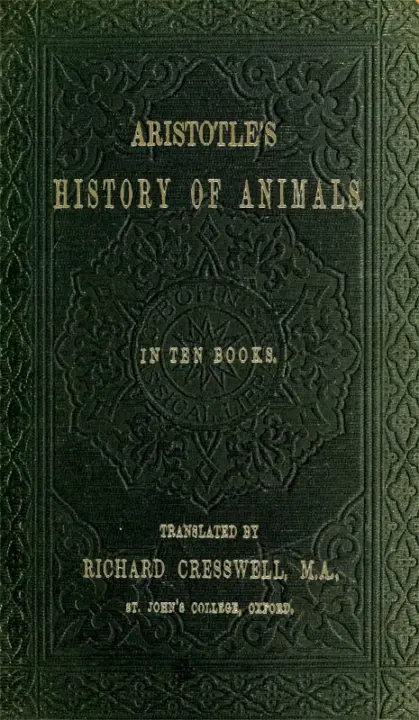
THE CLASSIC COLLECTION · 1887
"Aristotle's History of Animals" by Aristotle is a scientific publication written in the late 4th century BC. The work serves as one of the earliest comprehensive surveys of zoology, analyzing and categorizing various animal species based on their anatomy, behaviors, and habitats. It combines observations with the knowledge inherited from previous naturalists to create a foundational text in the history of biological sciences. The opening of "Aristotle's History of Animals" sets the stage for a detailed examination of the animal kingdom. Aristotle begins by classifying animal parts into simple and compound components, continuing with a discussion on the similarities and differences among various species based on their physical attributes and lifestyles. He lays out an extensive framework for understanding animals, including their modes of life—aquatic versus terrestrial—and anatomical structures, using comparative anatomy to illustrate his points. This introduction effectively establishes the categories and criteria Aristotle will use throughout the work to structure his exploration of the biological world.
Introduction adapted from the source catalogue; source summaries may be automatically generated.
Free to read · English · 129,772 words · No account needed
MAKE TIME FOR A GOOD BOOK
On by default. Untick to stop anonymous reading totals. Each page counts after 10 seconds in view. How this works.
Anonymous counting is on unless you have switched it off.
Κτεὶς, Pecten, 82, 84.
A large kind, which has one valve flat, Pecten maximus, 84, 94, 95;
origin, 117;
small crustaceans in them, ib.;
hybernate, 213;
red pectens, 220;
leap, 256.
Κύαμοι, beans, Vicia faba, 72, 206.
Κύανος, Turdus Cyaneus, blue thrush, 248.
Κύγχραμος or κύχραμος, Corncrake, Rallus Crex, Strack, probably a species of ortolan, Lindell and Scott. Leads the flight of the quails, 210.
Κύκνος, swan, Cycnus olor, 4, 45;[231]
food, 203;
gregarious, 211;
fights with the eagle, 233;
habits, 244;
when dying they go towards the sea, ib.
[231] Accidentally omitted in a list of birds in the translation.
Κύλλαρος or σκύλλαρος, hermit crab, Pagurus, 85.
Κύμινδις, the Ionic name of the χαλκὶς, Stryx Nisoria, 244, 251.
Κυνακάνθη, perhaps the dog-rose, worms in it, 126.
Rosa canina.
Κυνοκέφαλος, dog-headed ape, Simia Cynocephalus, 32.
S. Porcaria.
Κυνοῤῥαϊστής, dog-ticks, Ricinus canis, 135.
Κυπρῖνος, carp, Cyprinus Carpio, 38;
inhabits rivers, 91;
production and growth of young, 155, 156;
star-struck, 219.
Κύτισος, a shrub, Cytisus, Medicago arborea, 71.
Κυφὴ, a kind of shrimp or prawn, 77. Palæmon Squilla or Crangon vulgaris, also Pagurus.
Κύψελλος, a kind of swallow, Martin? Hirundo urbica, makes its nest of mud in rocks and caverns, 250.
Κύων, dog, Canis familiaris, 6, 26, 27, 29, 30, 31, 32, 42, 58;
large dog of Epirus, 71;
dreams, 97;
reproduction, barking, &c., 103, 107, 112, 113, 114, 161, 163;
Laconian dogs, their habits, 166, 167;
when dogs eat grass, 204, 238;
diseases, 222;
Egyptian dogs, 226;
Cyrenian dogs, half-bred, with wolves, Laconian with foxes, Indian
with tigers, 227;
the Molossian shepherd dog, 230;
intestinal worms in dogs, 238.
Κύων, a cartilaginous fish, Squalus carcharias, Strack, S.
galeus, 104, 151.
Κωβιός, gudgeon, Gobio, 44;
ova, 153, 155;
poor ones cast on shore, 157;
food, 200;
live near the land, 211;
fatten in rivers, 218;
gregarious, 197;
in winter does not leave the Pyrrhic Euripus, 256.
Κωλώτης, an animal inhabiting the stables of the ass, a lizard according to some, Scaliger thinks a beetle, 232, Mus minutus.
Κώνωψ, a species of gnat, smaller than the empis, Conops calcitrans, Strack, Culex pipiens or C. calcitrans, 89, 94; springs from a worm in vinegar, Mosillus cellarius, 126.
Λάβραξ, perhaps Perca Labrax, Basse, 8, 92;
sleeps, 98;
reproduction, 108, 109, 153, 159;
food, 199, 200;
has a stone in its head, 218;
unfit to eat when in spawn, 228;
at times associated with cestreus, 244.
Λαγωὸς, hare, Lepus timidus, the Egyptian, 226.
Λαεδὸς, the name of a bird living in rocks and mountains, perhaps it should be λαΐος, 234.
Λαΐος, a species of thrush, Turdus torquatus, 234, 247.
Λαμία, a species of shark, Squalus centrina, or carachias, 104, 255.
Λαμπυρὶς or πυγολαμπὶς, glow-worm, Lampyris notiluca, see Πυγολαμπὶς.
Λάρος, gull or cormorant, Larus canus and marinus, Sterna, 45;
colour, 203;
a white kind, ib.;
hostile to the brenthus and harpa, 232.
Λάταξ, beaver, Castor fiber, 3, 205.
Λάχανα, potherbs, 217.
Λειόβατος, skate, Raia Batis, 40, 151.
Λεπὰς, limpet, Patella, 82, 84, 85, 86, 117.
Λεπιδωτοὶ, scaly fishes, see Πλωτοὶ.
Λευκερώδιος, white heron, Platalea leucerodia, 203.
Λεύκη, probably the unopened flower-bud of the grape, or Populus
alba, 121.
Λεύκος, Ardea argentata, 233.
Λέων, Lion, Felis Leo, 6, 24, 25, 26, 28;
lioness, 29, 30, 32, 42, 59, 61, 69;
reproduction, 102, 161, 176;
existing in one district of Europe, 226;
Syrian Lions, 176;
mane and teeth, ib.;
food, 205;
habits, 271, 272;
two kinds described, 272.
Λιβανώτις, Rosmarinus officinalis, Rosemary, 183.
Λίβυος, a bird, enemy of the woodpecker, 232.
Λίγυες, Lygians who are said to have seven ribs, 16.
Λιμνόστρεα, oysters, Ostrea edulis, 82, 117;
small crustaceans in them, ib.
Λόκαλος, a species of heron, Ciconia dubia, 45.
Λόφουρα, animals with hairy tails, horse, ass, &c., 11, 16, 19, 30.
Λὺγξ, Lynx, Felis Lynx, 28, 29, 102.
Λύκιος, a kind of Jackdaw or chough, Corvus monedula, C.
pyrrocorax, 248.
Your reading position is saved on this browser. Take it to another device with a library code. Reading pages adapt to text, rather than matching a printed edition.
BEHIND THE BOOK
This eBook is for the use of anyone anywhere in the United States and most other parts of the world at no cost and with almost no restrictions whatsoever. You may copy it, give it away or re-use it under the terms of the Project Gutenberg License included with this eBook or online at www.gutenberg.org. If you are not located in the United States, you will have to check the laws of the country where you are located before using this eBook. Read the source licence.
The original source file, including credits and licence, is retained by this library. Request an original-format copy at no charge. Please include the book title and Project Gutenberg identifier #59058.
KEEP YOUR CURIOSITY GOING
Cécile Tormay

Moritz Busch
John L. Ransom
Frances Wright
Cécile Tormay

Mabel Potter Daggett