THE CLASSIC COLLECTION✦The Athenian ConstitutionCLASSIC FREE BOOKS
The Athenian Constitution
Aristotle
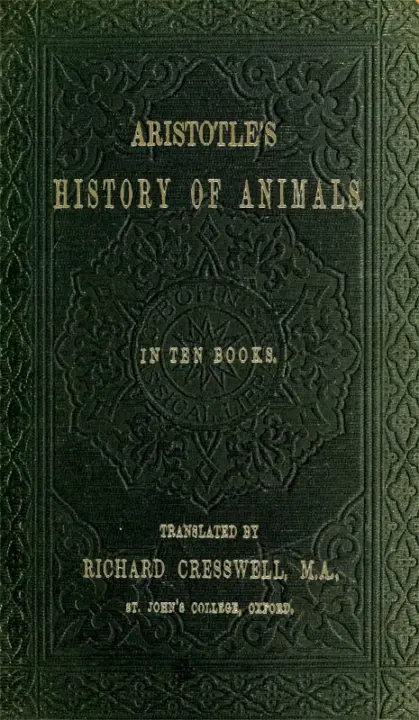
THE CLASSIC COLLECTION · 1887
"Aristotle's History of Animals" by Aristotle is a scientific publication written in the late 4th century BC. The work serves as one of the earliest comprehensive surveys of zoology, analyzing and categorizing various animal species based on their anatomy, behaviors, and habitats. It combines observations with the knowledge inherited from previous naturalists to create a foundational text in the history of biological sciences. The opening of "Aristotle's History of Animals" sets the stage for a detailed examination of the animal kingdom. Aristotle begins by classifying animal parts into simple and compound components, continuing with a discussion on the similarities and differences among various species based on their physical attributes and lifestyles. He lays out an extensive framework for understanding animals, including their modes of life—aquatic versus terrestrial—and anatomical structures, using comparative anatomy to illustrate his points. This introduction effectively establishes the categories and criteria Aristotle will use throughout the work to structure his exploration of the biological world.
Introduction adapted from the source catalogue; source summaries may be automatically generated.
Free to read · English · 129,772 words · No account needed
MAKE TIME FOR A GOOD BOOK
On by default. Untick to stop anonymous reading totals. Each page counts after 10 seconds in view. How this works.
Anonymous counting is on unless you have switched it off.
Κνὶψ or σκνὶψ, an insect, Formica flava, Strack, finds honey by the sense of smell, 93; eaten by the woodpecker, 93, 202, 242.
Κόγχη, a bivalve shell, Mya pictorum, 82;
several species, ib.;
a kind of crustacean is found in them, 85;
origin, 117, 118;
large smooth shell in rivers, 243.
Κογκύλιον, a small bivalve shell, 198, 199.
Κοῖτος or κόττος, a fresh-water fish. Trout, Salmo Fario, Strack, 92.
Κοκκάλιον, Helix, land snail, 81.
Κόκκυξ, cuckoo, Cuculus Canorus, 93, 138;
habits, form, and eggs, 146;
eatable, 147;
lays in the nests of other birds, 249;
changes its note when about to migrate, 276.
Κολεὸς, also ἐλεὸς, and κελεὸς, woodpecker, 233.
Κολίας, a kind of tunny, Scomber colias, in the Propontis, 211;
when taken, 212;
gregarious, 234.
Κολιὸς, Corvus monedula or Picus viridis, 36; in p. 242 colœus should probably be colius.
Κολλυρίων, Ampelis garrula, L. Schneider. Lanius garrula or
excubitor, 248.
Κολοιὸς, Pelecanus graculus, four species, 248.
Κολοκύντη, cucumber, Cucumis Sativus, 124, 208.
Κολυμβὶς, a sea-bird, diver, Colymbis, 3, 203.
Κόνις, knits, 134.
Κόνηξα, plant, Inula Conyza, or I. pulicaria, flea bane, 93.
Κορακίας, probably the Cornish Chough Pyrrocorax Graculus, 248.
Κορακῖνος, sturgeon, Accipenser huso, Strack, Sparus Chromis, 109, 159, 160, 213, 218, 228, 234.
Κορακοειδῶν γένος, the crow tribe, 5.
Κόραξ, raven and rook, Corvus Corax and frugilegus, 40, 45, 64;
eggs, incubation, young, 146;
Egyptian raven, 226;
hostile to the hawk, 232;
pecks the ass and bull, ib.;
friend of the fox, 233;
frequent in towns, 248;
nest and habits, 250.
Κόραξ, a water-bird, Pelecanus Carbo, Strack, 203.
Κορδύλη or σκορδύλη, the young tunny fish, 160.
Κορδύλος, water-newt, Triton aquaticus, 3, 9, 197.
Siren Proteus.
Κόρις, cimex, bug, C. lectularius, 134.
Κορυδαλὸς, lark, Alauda arvensis cristata, 277.
Κορυδὸς, lark, Alauda cristata, A. arborea, A. arvensis, (though
Schneider thinks this identification doubtful), its nest, 146, 249;
hybernates, 215;
hostile to the pœcilis, 232;
is said to eat the eggs of the eagle, 233;
friendly to the schœnilus, 234;
perches on the ground, 242, 245;
two kinds, 249.
Κορώνη, Corvus corone, 45;
feeds its young after they are fledged, 146;
incubation, 147;
lives near the sea, 203;
Egyptian, 226;
foe to the owl, presbys, and typanus, 232;
friend of the heron, 234;
always to be seen, 248.
Κότινος, the wild olive tree, Eleagnus angustifolia, used as food for sheep (accidentally omitted in the translation), 208.
Κόττος, see κοῖτος. Cottus Gobio, 92.
Κόττυφος, blackbird, Turdus merula, Strack, but apparently not
always, Turdus merula, and T. saxatilis, hybernate, 215;
changes its colour, 228;
nest, 245;
two kinds, black and white, 247;
changes its plumage and voice in the winter, 276.
Κόττυφος, a sea-bird, 110, 214.
Κόττυφος, a fish, 228.
Labrus Merula.
Κόχλιας, snail, Helix, several kinds, 73, 81;
land-snails, 83;
when full of ova, 110;
die when the shell is taken off, 136;
form an operculum when they hybernate, 213;
eaten by swine and partridges, 255.
Κόχλος, Fresh-water univalve shells, Limnæa, Planorbis, 81, 83, 84, 86.
Κραγγὼν, prawn, Cancer digitalis (Squilla mantis), Strack, Penæus
sulcatus, 77.
Κράμβη, cabbage or colewort, Brassica, 124, 126.
Κραμβὶς, caterpillars of the cabbage butterfly, Papilio Danais
Brassicæ, 125.
Κράστις, green fodder for horses, 207.
Κρὲξ, Trigna pugnax, hostile to the celeus, 233;
its habits, 247.
Κριθή, barley, 206.
Κριὸς, Ovis aries, ram, breeding season, 114, 161, 199.
Κροκόδειλος, the Land crocodile, Lacerta stellio, Monitor
terrestris, 25, 34;
both kinds mentioned, 43, 46;
reproduction, 137;
brought up in Egypt, 231;
Herodotus, Book 4, c. 192.
Κροκόδειλος, the Egyptian crocodile. Crocodilus Niloticus, 2, 14;
in Egypt, 33, 59;
reproduction, 137;
hybernates, 72.
Κρότων, Ricinus, tick, or dog-louse, Hippobosca ovina, 135;
Acarus ricinus, 125.
Your reading position is saved on this browser. Take it to another device with a library code. Reading pages adapt to text, rather than matching a printed edition.
BEHIND THE BOOK
This eBook is for the use of anyone anywhere in the United States and most other parts of the world at no cost and with almost no restrictions whatsoever. You may copy it, give it away or re-use it under the terms of the Project Gutenberg License included with this eBook or online at www.gutenberg.org. If you are not located in the United States, you will have to check the laws of the country where you are located before using this eBook. Read the source licence.
The original source file, including credits and licence, is retained by this library. Request an original-format copy at no charge. Please include the book title and Project Gutenberg identifier #59058.
KEEP YOUR CURIOSITY GOING
Cécile Tormay

Moritz Busch
John L. Ransom
Frances Wright
Cécile Tormay

Mabel Potter Daggett