THE CLASSIC COLLECTION✦The Athenian ConstitutionCLASSIC FREE BOOKS
The Athenian Constitution
Aristotle
THE CLASSIC COLLECTION · 1887
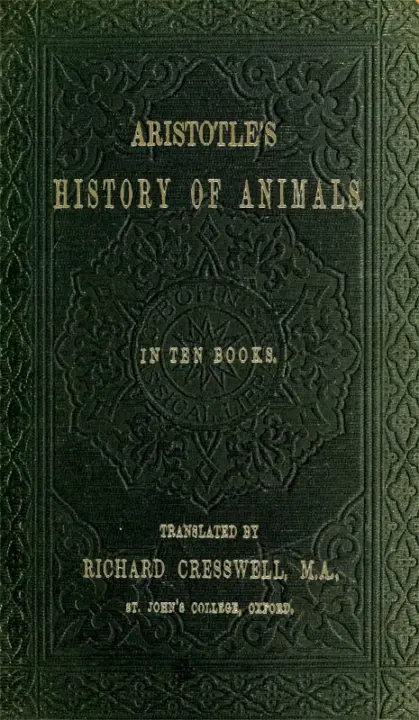
"Aristotle's History of Animals" by Aristotle is a scientific publication written in the late 4th century BC. The work serves as one of the earliest comprehensive surveys of zoology, analyzing and categorizing various animal species based on their anatomy, behaviors, and habitats. It combines observations with the knowledge inherited from previous naturalists to create a foundational text in the history of biological sciences. The opening of "Aristotle's History of Animals" sets the stage for a detailed examination of the animal kingdom. Aristotle begins by classifying animal parts into simple and compound components, continuing with a discussion on the similarities and differences among various species based on their physical attributes and lifestyles. He lays out an extensive framework for understanding animals, including their modes of life—aquatic versus terrestrial—and anatomical structures, using comparative anatomy to illustrate his points. This introduction effectively establishes the categories and criteria Aristotle will use throughout the work to structure his exploration of the biological world.
Introduction adapted from the source catalogue; source summaries may be automatically generated.
Free to read · English · 129,772 words · No account needed
MAKE TIME FOR A GOOD BOOK
On by default. Untick to stop anonymous reading totals. Each page counts after 10 seconds in view. How this works.
Anonymous counting is on unless you have switched it off.
Καλλύντρον, a shrub from the flowers of which the bees are said to procure their young, 127; perhaps Cerinthe, L., Strack, honeysuckle.
Κάμηλος, Camel, Camelus Bactrianus and C. Dromedarius, 25, 27, 29,
30, 70;
reproduction, 103, 114, 161, 173;
endurance of thirst, 207;
life, ib.;
diseases, 222;
purity, 274;
castration of females, 278.
Κάμπη, caterpillar, 124.
Κανθαρὶς, several kinds of beetles, 88;
a kind of fly, 106;
origin, 126.
Κάνθαρος, beetle, Scarabæus pilularius, Schneider, Cantharis
lytta, 9;
origin, 125;
changes its skin, 216.
Κάνθαρος, a sea-fish, lives near the shore, Sparus Cantharus, 211.
Κάπρος, boar, 29;
coition, age, 112, 114;
castration, 277.
Κάπρος, a fish said to make a grunting noise. Cottus cataphractus, or
Squalus centrina, 37;
in the Achelous, 95.
Καραβοειδῆ, crustaceans, 79, 85, 228.
Κάραβος, insect, stag-beetle, Cerambyx. Strack, 89, 125.
Κάραβος, Palinurus vulgaris, Spiny lobster, 7, 9, 10;
as a class, 73, 77;
male and female, 78;
described, 79, 80, 84, 93;
sleep, 97;
reproduction, 120;
where produced, 121;
change their shell, ib.;
kills other fish, is killed by the polypus, 198;
habitation, pursuit, 129;
hides itself and changes its shell, 217.
Καρίδιον πιννοφύλαξ, a small crustacean, Pinnotheres veterum, Bell's Crustaceans, 117.
Καρὶς, shrimp or prawn, Crangon, Palæmon, 77;
different kinds, ib.;
reproduction, 106, 121;
changes its colour in winter, 228.
Καρκίνιον, hermit crab, Pagurus Bernhardi, L., Bell, and probably other species, 85; in Strombi and Neritæ, ib., 118; also a species in Pinnæ distinguished from καρίδιον, 117.
Καρκίνος, crab, of various species. Cancer, Carcinus, &c., 4, 10,
73, 77;
several species, 77;
fluviatile, Telphura fluviatilis, ib.;
number of feet, ib.;
short-tailed ib.;
description, 80, 81, 85;
reproduction, 106;
white crabs in various shells, 117;
change of shell, 121;
rock crabs, 198;
black crabs, hard shelled crabs, 217.
Κάστωρ, beaver, Castor Fiber, 205.
Καυλίον, some kind of sea-weed, 200.
Καταῤῥάκτης, diver, Pelecanus bassanus, L., Schneider, 45; mode of taking its prey, 244.
Κεγχρὶς, Falco tinnunculus, Schneider, 45;
lays many eggs, 138;
red eggs, 139;
mode of drinking, 203.
Κελεὸς, large green woodpecker, Picus viridis, 202, 232, 233.
Κέφρος, petrel, Procellaria pelagica, 203, 253.
Κέρθιος, creeper, Certhia familiaris, 247.
Κερκὶς, Populus tremula, osier, 205.
Κεστραῖοι, mullets as a class, 109, 159.
Κεστρεὺς, mullet. Mugil. In the lake Silpha, 37, 44, 92;
it sleeps, 98;
capture, 87;
birth, 108;
enumeration of species, 109, 153, 157;
enters rivers to spawn, 156, 159;
food, 199, 228;
habits, 200;
near the shore, 211;
associates with the labrax, 235;
the swiftest of fishes, 256;
in season in the autumn, ib.
Κέφαλος, grey mullet. Spratt's Lycia, Mugil cephalus, 109, 153;
reproduction, 159;
food, 199;
injured by cold, 218.
Κήβος, monkey, Simia mora or diona, Strack, 32.
S. Cynologus.
Κηρὶς, κυρὶς, or κιῤῥὶς, a sea-fish, 228.
Κήρυλος, a sea-bird, mentioned with the Halcyon, 203.
Tringa variabilis.
Κήρυξ, whelk, Buccinum, its mecon, 80, 81, 82, 85;
appears in the early spring, 110;
nidulary capsules, 115, 116;
the small whelk, 118;
hides itself, 213.
Κῆτος, whale, as a class, 10, 39;
whales, 69;
other whales, 152.
Κητώδη, Cetacea, 7, 13, 104, 196;
turn on their back to seize their prey, 200.
Κηφὴν, drone, 260.
Κίγκλος, probably Tringa Cinclus, Linn. Dunlin, 244.
Cinclus aquaticus.
Κίθαρος, a kind of turbot, Trigla lyra, 44.
Κιννάμωμον, a spice, cinnamon, 245.
Κιννάμωμον ὄρνεον, cinnamon bird, 245;
Herodotus, Book 3, c. 111.
Κίρκος, perhaps Falco nisus, Liddell and Scott, 232, 253.
Falco pygargus.
Κισσὸς, Ivy. Hedera Helix, 130.
Κίττα or Κίσσα, Jay, Corvus glandarius, captured by the Ægolius and
Eleus, 201;
changes its note, 245;
its nest, ib.
Κίχλη, Turdus labrus and T. merula, nest, 138;
hides, 215;
changes its colour in winter, 276;
three kinds, 244.
Κίχλη, a sea-fish, 37;
near the land, 211;
in pairs, 213;
changes its colour, 228.
Κλῆρος, also called πυραύστης, an insect injurious to beehives, Galeria cerella and G. mellonella, 226, 266.
Κνίδη, sea-nettle, probably an actinia, 118, 255.
Κνιπολόγος, a species of woodpecker, Picus varius, or minor, 202.
Your reading position is saved on this browser. Take it to another device with a library code. Reading pages adapt to text, rather than matching a printed edition.
BEHIND THE BOOK
This eBook is for the use of anyone anywhere in the United States and most other parts of the world at no cost and with almost no restrictions whatsoever. You may copy it, give it away or re-use it under the terms of the Project Gutenberg License included with this eBook or online at www.gutenberg.org. If you are not located in the United States, you will have to check the laws of the country where you are located before using this eBook. Read the source licence.
The original source file, including credits and licence, is retained by this library. Request an original-format copy at no charge. Please include the book title and Project Gutenberg identifier #59058.
KEEP YOUR CURIOSITY GOING
Cécile Tormay

Moritz Busch
John L. Ransom
Frances Wright
Cécile Tormay

Mabel Potter Daggett