THE CLASSIC COLLECTION✦The Athenian ConstitutionCLASSIC FREE BOOKS
The Athenian Constitution
Aristotle
THE CLASSIC COLLECTION · 1887
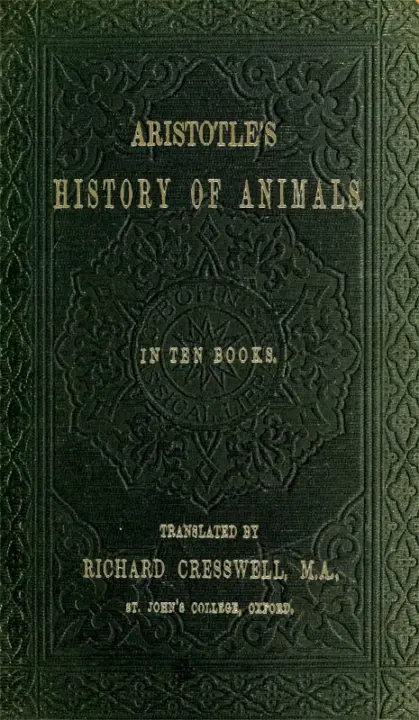
"Aristotle's History of Animals" by Aristotle is a scientific publication written in the late 4th century BC. The work serves as one of the earliest comprehensive surveys of zoology, analyzing and categorizing various animal species based on their anatomy, behaviors, and habitats. It combines observations with the knowledge inherited from previous naturalists to create a foundational text in the history of biological sciences. The opening of "Aristotle's History of Animals" sets the stage for a detailed examination of the animal kingdom. Aristotle begins by classifying animal parts into simple and compound components, continuing with a discussion on the similarities and differences among various species based on their physical attributes and lifestyles. He lays out an extensive framework for understanding animals, including their modes of life—aquatic versus terrestrial—and anatomical structures, using comparative anatomy to illustrate his points. This introduction effectively establishes the categories and criteria Aristotle will use throughout the work to structure his exploration of the biological world.
Introduction adapted from the source catalogue; source summaries may be automatically generated.
Free to read · English · 129,772 words · No account needed
MAKE TIME FOR A GOOD BOOK
On by default. Untick to stop anonymous reading totals. Each page counts after 10 seconds in view. How this works.
Anonymous counting is on unless you have switched it off.
Ζωδάρια, several small animals, 135.
1. Tinea pellionella.
2. T. sarcitella.
3. Psorus pulsatorius.
4. T. graminella.
Ζῶον, several unnamed animals. 1. A small crustacean in shell fish, perhaps Pinnotheres, 86. 2. marine creatures like small pieces of wood, Veretillum, 89. 3. marine creatures like shields, Alcyonium, 89. 4. marine creatures like αἰδοῖον ἀνδρὸς, Pennatula, 89. 5. winged creatures produced from maggots in pulse, Bruchus, 126.
Ἡμίονος, mule, offspring of horse and wild ass, the female larger and more long lived, 99, 170; the so-called mules of Syria, Equus hemionus, 11, 172, 177.
Ἥπατος, a fish so called from its colour, Theutis hepatus, Strack, Stromatos fiatola, 44.
Ἠπίολος, moth, Tinea mellonella, 225.
Ἡρακλεοτικὸς καρκίνος, Heracleotic crab, has a long tail, 77, 81.
Θαλλὸς, a shoot of a plant, especially the olive, 208.
Θηρία, animals larger than flies in fire, 126;
animals which destroy honey-combs, 225;
an animal like a moth, ib.
Θὶς, black shore weed, fucus, 211.
Θραυπὶς, a small bird like a goldfinch, Fringilla Carduelis, or F.
Cannabina, 202.
Θρίσσα, a fish with prickly scales, 256.
Θρίψ, timber worm, 207.
Θύμον, thyme, Thymus vulgaris, 266.
Θυννὶς, the female tunny, 108, 109;
aged, 160;
food, 200;
migration, 211;
gregarious, 234.
Θύννος, tunny fish, Scomber Thynnus, 4, 38;
sleeps, 98;
swims in shoals, 108;
male and female, ib.;
reproduction, 109, 135;
life, 149;
they appear to be a year older than the pelamys, 160;
food, 199;
migrates after the scombri, 209;
when best for food, 211;
migrations, 212;
how concealed, 214;
delights in warmth, 219;
old fish unfit for salting, their weight, 228.
Θὼς, jackal or ounce, Felis onza, or perhaps Canis aureus,
Strack, 42;
habits, 177;
hates the lion, 234;
carnivorous, ib.;
several kinds, 272.
Ἴβις, Tantalus Ibis, Strack, two species, white, Tantalus sacer, and black, T. falcinellus, 249.
Ἱέραξ, hawk, 9, 39, 40;
incubation, 146;
like the cuckoo, 146, 147;
the young good to eat, 147;
a kind which builds in rocks, ib.;
three species, 201;
enumeration of species, 253;
the Egyptian hawk, 226;
its nest, 243;
does not eat the heart of birds, ib.
Ἱέρας or ἱέρος, a kind of serpent, 228.
Ἰκτῖνος, kite, Falco milvius, 39, 40;
incubation, 146;
food, 201;
drink, 203;
migration, 215;
a foe to the raven, 232.
Ἴκτις, weasel or ferret, Mustela furo, 29;
habits, 239.
Ἰλλὰς, a kind of thrush, gregarious, Turdus iliaceus, Strack, 248; this identification is very doubtful, Schneider.
Ἰξόβορος, a kind of thrush, Turdus viscivorus, Strack, 248.
Ἰξὸς, miseltoe, 248.
Ἵννος, hinnus, the offspring of a horse and she ass, 163.
Ἰουλὶς, a red fish, Labrus Iulis, Strack, 234.
Ἴουλος, Iulus, scolopendra, centipede, 73.
Ἱππάρδιον, giraffe, Giraffa cameleopardalis, 26.
Ἱππέλαφος, perhaps the Nilghau, Antilope picta, 26.
Ἱππεὺς, a crustacean, Ocyopode cursor, 77.
Ἱππομύρμηξ, a large kind of ant, Formica Herculanea, 225.
Ἵππος, horse, Equus Caballus, 13, 26, 27, 29, 39, 62, 66, 69, 70;
dreams, 97;
neighing, 112;
reproduction, age, life, 113, 161, 169;
food and drink, 205, 207;
small horses in the country of the Pygmies, 209;
diseases, 219, 222, 223;
story of a Scythian horse, 274.
Ἵππος ὁ ποτάμιος, river horse, Hippopotamus amphibius, 32, 196; in Egypt, 32.
Ἵππουρος, fish, Coryphæna hippurus, 109;
hides in holes, 213.
Ἰτέα, willow, 155.
Ἴϋγξ, wryneck, Jynx torquilla, 35.
Ἰχνεύμων, Ichneumon, Viverra Ichneumon, 177;
attacks the asp in Egypt, 238.
Ἰχνεύμων, Ichneumon (insect) Sphex, hunts spiders, 124, 232.
Κάλαμος, reed, Acorus calamus, and perhaps also some of the larger
grasses, 122, 155;
its flower, 127;
used to support vine, 133, 155, 216;
flourishes in rainy weather, 217.
Κάλαρις or κόλαρις, a bird preyed on by the little owl. Motacilla alba
L., Schneider, 232.
Fringilla petronia.
Καλίδρις, Tringa, Sandpiper, Scolopax calidris, 203.
Καλλιώνυμος, fish, Uranoscopus, Strack, U. Scaber, 40;
lives near the shore.
Your reading position is saved on this browser. Take it to another device with a library code. Reading pages adapt to text, rather than matching a printed edition.
BEHIND THE BOOK
This eBook is for the use of anyone anywhere in the United States and most other parts of the world at no cost and with almost no restrictions whatsoever. You may copy it, give it away or re-use it under the terms of the Project Gutenberg License included with this eBook or online at www.gutenberg.org. If you are not located in the United States, you will have to check the laws of the country where you are located before using this eBook. Read the source licence.
The original source file, including credits and licence, is retained by this library. Request an original-format copy at no charge. Please include the book title and Project Gutenberg identifier #59058.
KEEP YOUR CURIOSITY GOING
Cécile Tormay

Moritz Busch
John L. Ransom
Frances Wright
Cécile Tormay

Mabel Potter Daggett