THE CLASSIC COLLECTION✦The Athenian ConstitutionCLASSIC FREE BOOKS
The Athenian Constitution
Aristotle
THE CLASSIC COLLECTION · 1887
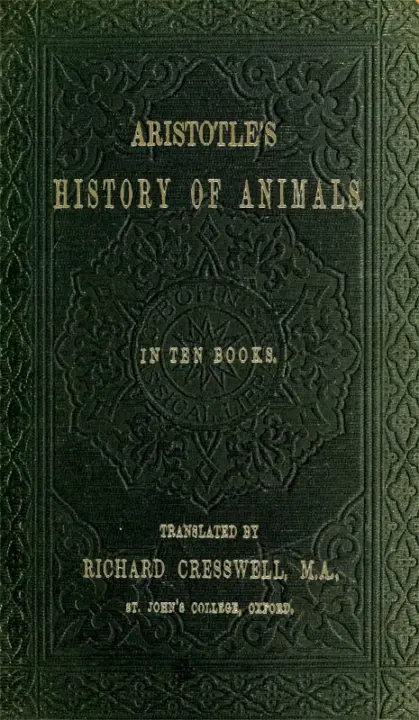
"Aristotle's History of Animals" by Aristotle is a scientific publication written in the late 4th century BC. The work serves as one of the earliest comprehensive surveys of zoology, analyzing and categorizing various animal species based on their anatomy, behaviors, and habitats. It combines observations with the knowledge inherited from previous naturalists to create a foundational text in the history of biological sciences. The opening of "Aristotle's History of Animals" sets the stage for a detailed examination of the animal kingdom. Aristotle begins by classifying animal parts into simple and compound components, continuing with a discussion on the similarities and differences among various species based on their physical attributes and lifestyles. He lays out an extensive framework for understanding animals, including their modes of life—aquatic versus terrestrial—and anatomical structures, using comparative anatomy to illustrate his points. This introduction effectively establishes the categories and criteria Aristotle will use throughout the work to structure his exploration of the biological world.
Introduction adapted from the source catalogue; source summaries may be automatically generated.
Free to read · English · 129,772 words · No account needed
MAKE TIME FOR A GOOD BOOK
On by default. Untick to stop anonymous reading totals. Each page counts after 10 seconds in view. How this works.
Anonymous counting is on unless you have switched it off.
Ἔγχελυς, eel, Muræna anguilla, 8, 37, 40, 41, 61, 66, 93;
is neither male nor female, 99;
the so-called male and female are different species, 97;
migrates to the sea to spawn, 156;
its origin, 158;
description and habits, 200, 201;
those called female are better for food, 229.
Ἐλαίας ἄνθος, the flower of the olive, 127, 133, 216, 242.
Ἔλαφος, stag, Cervus Elaphus, 5, 26, 27, 28;
those called Achaïnæ, 39, 237;
blood, 58, 67;
horns, 60, 236, 237;
the female, 100;
coition, 103, 174;
voice, 112;
habits, 236, 237;
the castrated animal, 278;
rumination, ib.
Ἐλέα, Emberiza arundinacea, or Turdus arundinaceus, Strack, or E.
schœnilus, 246.
Ἐλεγῖνος, a migratory fish, 234.
Ἐλεδώνη, Eledone cirhosa, Leach, (Owen, in Cyclopædia of
Anatomy), 76.
Ἐλειὸς, dormouse, Myoxus Avellanarius; or perhaps squirrel, Sciurus vulgaris, lives in holes in trees, 216.
Ἔλειοι, a kind of hawk, 253; probably an incorrect reading.
Ἐλεὸς, an owl, Stryx Aluco, Strack, see Ἀείσκοψ, 201.
Ἐλέφας, Elephas Indicus, 5, 13, 14, 24, 26, 28, 29, 40, 43, 46, 61, 72;
voice, 96;
reproduction, 103, 115, 161, 173;
food, 207;
life and diseases, 222, 224;
strength, 234;
capture, ib.;
habits, docility, 274.
Ἔλλοψ, a fish with four simple branchia, sword fish or sturgeon,
Liddell and Scott, Centriscus scolopax, Strack, Accipenser
stellatus, 37;
ἔλοψ, 40.
Ἕλμινς, worms, especially intestinal worms, tænia and lumbricus, some
exist in sponges, 119;
origin, 123;
three kinds, flat worms, round worms, ascarides, 124;
worms in snow, Podura nivalis, 126;
some insect larvæ are described as worms, 135;
small worms in eels, 158;
worms in dogs, Tænia sevrata, 238.
Ἐμπὶς, gnat, larger than κώνωψ, Tabanus, or Phryganea,
Strack, 3, 9, 206.
Εμὺς, Testudo coriacea, fresh-water tortoise, Emys lutraria, 39;
reproduction, 136;
habits, 194, 216.
Ἔντελις or ἔτελις, probably sea bream, Sparus, Strack, Sparus
Rayi, 153.
Ἔντερα γῆς, the decomposing matter in which eels have their
origin, 158.
Ἔντομα, insects, as a class, 3, 10, 73, 123.
Ἐνυδρίς, otter, Lutra vulgaris, 2;
its food, 205.
Ἐπιλαΐς or ὑπολαΐς, Sylvia curruca, Strack, or perhaps hedge
sparrow, 202.
Ἔποψ, hoopoe, Upupa Epops, 1;
its nest, 138;
lives in woods and mountains, 244;
changes its colour, 246, 276.
Ἐρέβινθος, a plant, leguminous seeds, Ervum sativum, 221.
Ἐρίθακη, bee bread, 267.
Ἐρίθακος, Sylvia erithacus, or S. Phœnicurus, Strack,
Redstart, 202;
in its summer plumage called Phœnicurus, 276.
Ἐρινεὸς, wild fig tree, 136.
Ἕρπυλλος, Thymus serpyllum, wild thyme, 261.
Ἐρυθρῖνος, a red kind of mullet, Perea marina, Sparus Erythrymus, Strack, Perea scriba, all have roes, there are no males, 99, 153, 211.
Ἐρωδιὸς, heron, Ardea major, 203; a foe to the woodpecker, 212; three kinds, ὁ πέλλος, the black, Ardea cinerea, ὁ λευκος, the white, A. egretta, ὁ ἀστεριας, A. stellaris, 233, 247; a friend of the crow, 323.
Εὐλαὶ, maggots in flesh.
Ἐφήμερον, ephemera, insect, 10, 126.
Ἐχενηΐς, probably Goby or Blenny, Forbes in Spratt's Lycia, not the Remora, which was unknown to the ancients. Echeneis remora, Strack, 38.
Ἔχιδνα, viper, Coluber vivipara, C. verus, 10;
hides under stones, 213.
Ἐχινομήτρα, Echinus Esculentus, Forbes in Spratt's Lycia, 86.
Ἐχῖνος, sea urchin, Echinus lividus; another species, with hard
spines, is Cidaris hystrix, also a long species, Amphidetus
Mediterraneus, Forbes, 10, 11;
eatable kinds, 86;
small species, E. saxatilis; white species at Torone, E.
decadactylus, ib., 87, 94;
at what season they are full of ova, 110.
Ἐχῖνος, hedgehog, Erinaceus Europæus, 10, 46, 61, 81; coition, 102; changes the entrance of its hole when the wind changes, 239.
Ἔχις, a serpent, Coluber vivipara, Vipera Reedii, viviparous, 49;
reproduction, 137;
how captured, 204;
changes its skin, 216;
becomes more poisonous by eating scorpions, 227.
Ἑψητὸς, a small fish, Atherina Hepsetus, Strack, 156.
Ζύγαινα, a shark, Squalus Zygæna, Strack, 40.
Ζυγνὶς, a lizard, see χαλκὶς, 223.
Your reading position is saved on this browser. Take it to another device with a library code. Reading pages adapt to text, rather than matching a printed edition.
BEHIND THE BOOK
This eBook is for the use of anyone anywhere in the United States and most other parts of the world at no cost and with almost no restrictions whatsoever. You may copy it, give it away or re-use it under the terms of the Project Gutenberg License included with this eBook or online at www.gutenberg.org. If you are not located in the United States, you will have to check the laws of the country where you are located before using this eBook. Read the source licence.
The original source file, including credits and licence, is retained by this library. Request an original-format copy at no charge. Please include the book title and Project Gutenberg identifier #59058.
KEEP YOUR CURIOSITY GOING
Cécile Tormay

Moritz Busch
John L. Ransom
Frances Wright
Cécile Tormay

Mabel Potter Daggett