THE CLASSIC COLLECTION✦The Athenian ConstitutionCLASSIC FREE BOOKS
The Athenian Constitution
Aristotle
THE CLASSIC COLLECTION · 1887
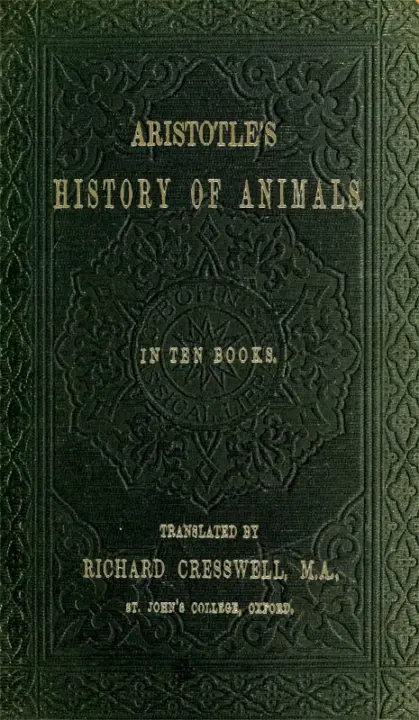
"Aristotle's History of Animals" by Aristotle is a scientific publication written in the late 4th century BC. The work serves as one of the earliest comprehensive surveys of zoology, analyzing and categorizing various animal species based on their anatomy, behaviors, and habitats. It combines observations with the knowledge inherited from previous naturalists to create a foundational text in the history of biological sciences. The opening of "Aristotle's History of Animals" sets the stage for a detailed examination of the animal kingdom. Aristotle begins by classifying animal parts into simple and compound components, continuing with a discussion on the similarities and differences among various species based on their physical attributes and lifestyles. He lays out an extensive framework for understanding animals, including their modes of life—aquatic versus terrestrial—and anatomical structures, using comparative anatomy to illustrate his points. This introduction effectively establishes the categories and criteria Aristotle will use throughout the work to structure his exploration of the biological world.
Introduction adapted from the source catalogue; source summaries may be automatically generated.
Free to read · English · 129,772 words · No account needed
MAKE TIME FOR A GOOD BOOK
On by default. Untick to stop anonymous reading totals. Each page counts after 10 seconds in view. How this works.
Anonymous counting is on unless you have switched it off.
Ἄνθος, yellow bunting, Emberiza citrinella, Strack, Motacilla
barula, 202;
feeds in meadows, imitates the neighing of the horse, 233;
hostile to the acanthis and ægithus, ib.;
it lives by the side of rivers, 244.
Ἀνθρήνη, wild bee, Apis terrestris, or Vespa crabro, 88;
the larvæ, 124;
reproduction, 130;
a diligent insect, 258;
makes honey, 260;
its manners and habits, 270.
Ἄπιος, the pear tree, 126.
Ἀπλυσίας, a dark-coloured sponge, 119.
Ἀποῤῥαΐς, various reading for αἱμοῤῥοΐς, Murex, or Natica.
Ἄπους, swift, Hirundo apus, 4;
also called κύψελλος, 271.
Ἀράχνης, spider, 5, 85, 135;
its web, reproduction, 123, 131, 132;
is driven away by its young, 131;
it sucks its prey, 213;
is eaten by the lizard, 232;
four kinds, 258, 259.
Ψύλλα, Salticus scenicus--The smaller kind Dolomedes mirabilis--the
larger Lycosa ruricola, another Dolomedes fimbriatus.
Ἄρκτος, bear, Ursus Arctus, 25, 27, 29, 42;
coition, 102;
at this time it becomes fierce, 161;
period of gestation, imperfect young, 175;
mode of drinking, 205;
hybernation, 215;
eats the arum, ib.;
the females courageous, 230;
its habits, 237.
Ἄρκτος, a crustacean, perhaps Cancer spinosissimus, Strack, Scyllaris arctus, reproduction, 121; its food and manner of seizing it, 205.
Ἅρπη, a bird of prey, falcon, lives near the sea, and attacks the gull and brenthus, 232; the piphinx and ictinus are friendly to it, 234; its mode of life, attacks the eyes of its prey, 247.
Ἀρχάνος, a fish, see Ἀχάρνας.
Ἀσκαλαβώτης, lizard, Lacerta Gecko, Stellio veterum, 160;
it lives in holes, 213;
changes its skin, 216;
its bite poisonous in some parts of Italy, 227;
it eats spiders, 232;
it can walk in an inverted position, 242.
Ἀσκάλαφος, probably some kind of owl, Stryx ulula, 45.
Ἀσκαλώπας, Scolopax gallinago, snipe, Strack, (Schneider disapproves of this identification), S. phæopus, 249. See σκολόπαξ.
Ἀσκαρίδες, ascaris, intestinal worm, 124.
Ἀσκαρὶς, the larva of the empis (gnat), 125.
Ἀσπάλαξ, mole, Talpa vulgaris, lives in holes, 5;
its eyes, 13, 90;
there are many in Bœotia, none in Lebadia, 225.
Ἀσπὶς, Coluber aspis, asp, from which a poison is made in Lybia, 227; in Egypt it is attacked by the ichneumon, 238.
Ἀστακὸς, lobster, Cancer Gammarus, and Astacus, 138;
compared with the spiny lobster, 77, 78, 79;
a small fresh-water species, Astacus fluviatilis, crayfish, 86;
its reproduction, 106, 121;
changes its shell, 217.
Ἀσταφὶς, a raisin used for feeding cattle, 206.
Ἀστερίας, a cartilaginous fish, 109, 151.
Squalus asterias.
Ἀστερίας, a hawk, 109, 151, 253.
Ἀστερίας, Ardea stellaris, bittern, 233.
Ἀστὴρ, star-fish, Uraster rubens, 118.
Ἀσφόδελος, a plant, asphodel, A. ramosus, 260.
Ἀτρακτυλλὶς, a plant of the thistle tribe, Carthamus creticus.
Ἀτταγὴν, grouse, Tetrao bonasia, or T. attagen, 249;
it lives on the ground, 276.
Ἀττέλαβος, a kind of locust, Gryllus, 123;
reproduction and death, 133.
Αὐλωπίας, the same as ἀνθίας, 159.
Αὐξὶς, the young tunny, 160.
Ἀφάκη, plant, a kind of vetch, 208.
Ἄφρος, fish spawn, 157.
Ἀφύη, anchovy or sardine, Melanurus juvenculus, 157,
its origin, ib.;
other kinds, ib.;
in modern Greek ἀφροψαρο.
Ἀχαΐνης ἔλαφος, a variety of large stag with a strong mane, Strack; a brocket, or two-year old stag, from his single-pointed horns, Liddell and Scott, 39, 237.
Ἀχάρνας, a sea fish, Anarrhicas rufus, 200;
does not bear heat, 218.
Ἀχέτας, the male grasshopper, Cicada Orni, 89.
Ἀχρὰς, a kind of wild pear, Pyrus communis, 206, 268.
Βάλαγρος, a fresh-water fish, Cobitis barbus, 98.
Βάλανος, Balanus, Cirripede, acorn shell, 94, 117.
Βάλανος, acorn, 221.
Βάλλερος, a fresh-water fish, Cyprinus blicca, 156, 219; βάλερος, βαλῖνος, βαρῖνος, are various readings.
Your reading position is saved on this browser. Take it to another device with a library code. Reading pages adapt to text, rather than matching a printed edition.
BEHIND THE BOOK
This eBook is for the use of anyone anywhere in the United States and most other parts of the world at no cost and with almost no restrictions whatsoever. You may copy it, give it away or re-use it under the terms of the Project Gutenberg License included with this eBook or online at www.gutenberg.org. If you are not located in the United States, you will have to check the laws of the country where you are located before using this eBook. Read the source licence.
The original source file, including credits and licence, is retained by this library. Request an original-format copy at no charge. Please include the book title and Project Gutenberg identifier #59058.
KEEP YOUR CURIOSITY GOING
Cécile Tormay

Moritz Busch
John L. Ransom
Frances Wright
Cécile Tormay

Mabel Potter Daggett