THE CLASSIC COLLECTION✦The Athenian ConstitutionCLASSIC FREE BOOKS
The Athenian Constitution
Aristotle
THE CLASSIC COLLECTION · 1887
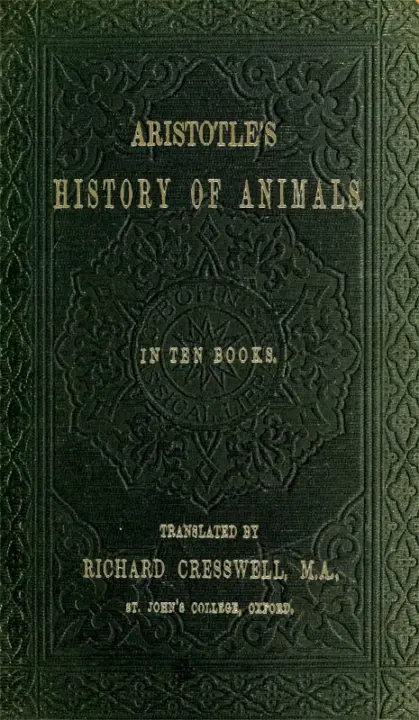
"Aristotle's History of Animals" by Aristotle is a scientific publication written in the late 4th century BC. The work serves as one of the earliest comprehensive surveys of zoology, analyzing and categorizing various animal species based on their anatomy, behaviors, and habitats. It combines observations with the knowledge inherited from previous naturalists to create a foundational text in the history of biological sciences. The opening of "Aristotle's History of Animals" sets the stage for a detailed examination of the animal kingdom. Aristotle begins by classifying animal parts into simple and compound components, continuing with a discussion on the similarities and differences among various species based on their physical attributes and lifestyles. He lays out an extensive framework for understanding animals, including their modes of life—aquatic versus terrestrial—and anatomical structures, using comparative anatomy to illustrate his points. This introduction effectively establishes the categories and criteria Aristotle will use throughout the work to structure his exploration of the biological world.
Introduction adapted from the source catalogue; source summaries may be automatically generated.
Free to read · English · 129,772 words · No account needed
MAKE TIME FOR A GOOD BOOK
On by default. Untick to stop anonymous reading totals. Each page counts after 10 seconds in view. How this works.
Anonymous counting is on unless you have switched it off.
Αἴξ, goat, male and female, Ibex or wild goat, Spratt's Lycia, Caper
hircus, Strack, 13, 27, 28, 31, 66;
the she goats of Œta, 70;
the he goat in Lemnos, ib.;
it is mentioned with the chimæra or domestic goat in 71;
dreams, 97;
infested with ticks, 134;
discharges of the female, 163, 164;
gestation, 165;
food, drink, &c., 207;
the wild goat, 225;
Syrian Caper hircus Mambricus and Lycian goat, C. Angorensis, ib.;
Egyptian, 226;
its mode of life, 235;
wild goats in Crete, 238;
rumination, 278.
Αἴξ, a water bird, probably Tantalus arquatus, Strack, Scolopax
Gallinago, 208.
Αἰσάλων, a small hawk, perhaps sparrow-hawk or merlin, Falco
Æsalon, 253.
Αἰτώλιος, see Αἰγώλιος.
Ἀκαλήφη, Medusa, and probably also some species of Actinia, 2, 3; fixed and locomotive kinds, 87, 88; small and edible species, others large and hard, 88; a fleshy kind, 195; a large kind, its food, mouth, and anus, 198.
Ἀκανθίας, a kind of shark, Squalus Acanthias, Strack, 256.
Ἀκανθὶς, thistle finch or gold finch, Fringilla carduelis, or Fringilla cannabina, Strack, or F. spinus, brown linnet, 202; hates the ass, lives on worms, 233; a foe to the anthus and ægithus, 234; its food, colour, song, 247.
Ἀκανθυλλὶς, Parus pendulinus, or caudatus, Strack, 202;
its nest, 245.
Ἄκαρι, mite, Dermestes fatidicus, or perhaps Bostrichus, Strack, 135.
Ἀκρὶς, locust, Tetigonia, Strack. Acridium, 89, 95;
its birth, 123;
reproduction, 132;
changes its skin, 216;
it is said to contend with serpents, 238;
the Spex lacerticida corresponds with this description, Schneider.
Ἀκύλος, the acorn of the evergreen oak, used for fattening pigs, 206.
Ἀλεκτορὶς, the domestic hen, Phasianus gallus, different
kinds, 111, 138;
sometimes produces soft eggs, 139;
chickens, 140, 141;
barren eggs, and times of laying, ib.;
growth of the chick in the egg, 142;
twin eggs, 144;
the hen sometimes takes the form of the cock, 215;
rolls in the dust, 277.
Ἀλεκτρυὼν, domestic fowl, male, also used of the class, 5;
his comb, 36;
crop, 45;
appendages to intestines, ib.;
crowing, 96;
manner of coition, 102;
appearances like ova when cut open, 139;
testicles, 148;
habits in temples, 241;
sometimes they assume the form and habits of hens, 275;
method of castration, 277.
Ἁλιαίετος, sea-eagle, different from the osprey, perhaps Aquila albicilla or Falco haliœtus, 203, 251, 253.
Ἀλκυὼν, Alcedo, kingfisher, or perhaps Turdus arundinaceus,
reproduction, 107, 108;
two species described, 203;
materials and form of its nest, 246.
It is doubtful whether either of the species is our kingfisher.
Schneider.
Ἁλοσάχη, probably a species of Zoophyte Alcyonia, 246.
Ἀλώπηξ, fox, Canis vulpes, 6, 29;
it breeds with the Laconian dogs, 227;
attacks the heron, 233;
is friendly with the crow, ib.;
a troglodyte, ib.
Ἀλώπηξ, Vampire, Vespertilio caninus, Strack, V. dinops or Sciurus
volans, 9;
reproduction, 177;
it hunts mice, 178.
Ἀλώπηξ, a cartilaginous fish, reproduction, 149;
represents a class, 151;
Egyptian species, 226;
stratagems, 255.
Ἀμία, a kind of tunny, mackerel, Scomber, Strack, 4, 40, 91;
its rapid growth, 160, 199, 200;
lives in bays, 211;
and enters rivers, 218;
its teeth and mode of defence, 255.
Ἀμυγδαλή, Amygdala communis, almond tree, 268;
almonds, 242.
Ἀνθίας, a migratory sea fish, also called αὐλωπίας, Scomber ala
longa, 159;
gregarious, 234;
also called sacred, 255.
Your reading position is saved on this browser. Take it to another device with a library code. Reading pages adapt to text, rather than matching a printed edition.
BEHIND THE BOOK
This eBook is for the use of anyone anywhere in the United States and most other parts of the world at no cost and with almost no restrictions whatsoever. You may copy it, give it away or re-use it under the terms of the Project Gutenberg License included with this eBook or online at www.gutenberg.org. If you are not located in the United States, you will have to check the laws of the country where you are located before using this eBook. Read the source licence.
The original source file, including credits and licence, is retained by this library. Request an original-format copy at no charge. Please include the book title and Project Gutenberg identifier #59058.
KEEP YOUR CURIOSITY GOING
Cécile Tormay

Moritz Busch
John L. Ransom
Frances Wright
Cécile Tormay

Mabel Potter Daggett