THE CLASSIC COLLECTION✦The Athenian ConstitutionCLASSIC FREE BOOKS
The Athenian Constitution
Aristotle
THE CLASSIC COLLECTION · 1887
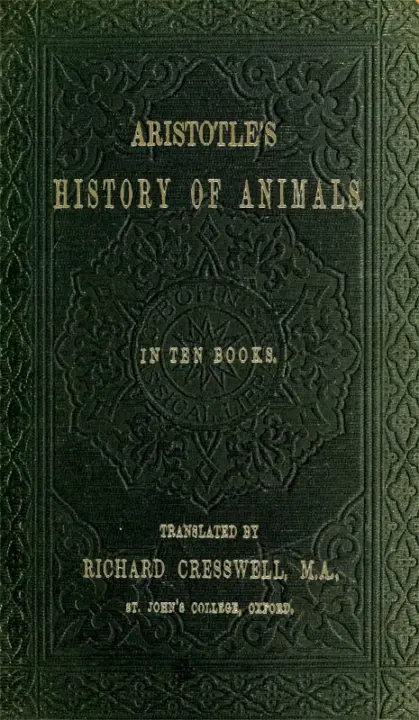
"Aristotle's History of Animals" by Aristotle is a scientific publication written in the late 4th century BC. The work serves as one of the earliest comprehensive surveys of zoology, analyzing and categorizing various animal species based on their anatomy, behaviors, and habitats. It combines observations with the knowledge inherited from previous naturalists to create a foundational text in the history of biological sciences. The opening of "Aristotle's History of Animals" sets the stage for a detailed examination of the animal kingdom. Aristotle begins by classifying animal parts into simple and compound components, continuing with a discussion on the similarities and differences among various species based on their physical attributes and lifestyles. He lays out an extensive framework for understanding animals, including their modes of life—aquatic versus terrestrial—and anatomical structures, using comparative anatomy to illustrate his points. This introduction effectively establishes the categories and criteria Aristotle will use throughout the work to structure his exploration of the biological world.
Introduction adapted from the source catalogue; source summaries may be automatically generated.
Free to read · English · 129,772 words · No account needed
MAKE TIME FOR A GOOD BOOK
On by default. Untick to stop anonymous reading totals. Each page counts after 10 seconds in view. How this works.
Anonymous counting is on unless you have switched it off.
Βασιλεὺς, also called trochilus, and presbys, lives in holes, 244;
has a bright crest, 202;
probably Regulus Cristatus, golden-crested wren, or Sylvia
troglodytes.
Βατὶς, a bird that frequents bushes, Sylvia rubicola, eats worms, 202; mentioned with finch and sparrow.
Βατὶς, a fish, the prickly roach, Liddell and Scott, 149, 152.
Βάτος, ray, Raia batos, not the skate, which is perhaps
leiobatos, 8, 37;
its manner of coition, 104;
it does not receive its young into itself, 150, 151;
it lives in holes, 214;
its manner of taking its prey, 255.
Βάτραχος, frog, Rana esculenta and R. temporaria, 3, 39, 87;
croaks, 96;
the female larger than the male, 100;
coition, 103;
tadpole, 154;
its united spawn, 155;
spoken of as a class, 196;
no croaking frogs in Cyrene, 225;
marsh frogs are foes to bees, 261.
Βάτραχος, a cartilaginous fish, Lophius piscatorius and L.
barbatus, 8, 37, 38, 40;
among the selache, 104;
oviparous, 148, 150;
it produces many young, 159.
Βελόνη, fish, Syngnathus acus, 40;
its reproduction, 109, 154, 160;
gregarious, 234;
the Halcyon builds its nest with the bones of this fish.
Βολίταινα, cephalopod, Eledone moschites, Leach, 76; also called ὄζολις; it does not exist in the Euripus, 256.
Βομβύκια, Apis cementaria, or also Megachile muraria, and Bombus terrestris, forms an angular cell of mud, 131.
Βομβυλιὸς, larva of silk worm, 124;
the humble bee, 260, 271.
Βόμβυξ, silkworm.
Βόνασσος, Antelope bonassus, or Bos Urus, Bison, 26, 28; its country, form, habits, hunting, 273.
Βοσκὰς, Anas boscas, or A. Crecca, 203.
Βόστρυχος, insect, Lampyris noctiluca, Strack, 125.
Βουβαλὶς, Antilope Gnou, 58.
Βοῦς, Bos taurus, Ox, 5, 27, 28, 29, 30, 41, 62;
milk, 69;
dreams, 97;
lowing of the bull, 100, 112;
coition, 103;
tormented with lice, 135;
sexual desires, 161, 162;
discharges and urine of the cow, 163;
reproductive powers of bull, 168;
the castrated animal is taught to lead the herd, ib.;
teeth, milk, and habits, ib.;
veins in the embryo, 190;
mode of drinking, 205;
care of the ox, 206;
red cattle of Epirus, 207;
diseases, 219, 222;
the ox drinks pure water, 224;
Egyptian oxen, 226;
habits, 236;
wild oxen, B. Bubalus, 26;
one species of ox has a bone in its heart, 39;
oxen in Phrygia which can move their horns, 61;
small oxen in Phasis, 71;
oxen in Epirus, ib.;
in Tortona, 72;
the cow brings forth at a year old, 113;
Syrian oxen, 226;
castration of the young, 278;
rumination, ib.
Βοῦς, a cartilaginous fish, Raia cornuta, 104, 152.
Βρένθος, a sea-bird, Anas tadorna, hostile to the larus and harpa, 232; makes its nest in hills and woody places, 244.
Βρύας, a large owl, Stryx bubo, 201.
Βρύον, algæ, both fresh-water and marine, 155, 200, 220.
Βρύσσος, an echinite, Scutella, 102.
Βωμολόχος, Corvus monedula, 248
Βὼξ, a gregarious fish, Sparus boops, 234; contracted from Βόαξ, from the sound it makes.
Γαλας, a kind of smooth shell-fish, mya pictorum, 82.
Γαλεὸς, a cartilaginous fish, Squalus galeus and charachias, Strack,
or Gadus lota, 8, 44, 49, 108, 149, 151;
uterus and ova, 150;
receives its young into itself, ib.;
not found in the Pyrrhæan Euripus, 256.
Γαλεώδη, fish of the shark kind, 37, 40, 41;
placed under the selache, 104, 149;
the males have appendages, 104;
the uterus, 149;
galei and galeodes, 151.
Your reading position is saved on this browser. Take it to another device with a library code. Reading pages adapt to text, rather than matching a printed edition.
BEHIND THE BOOK
This eBook is for the use of anyone anywhere in the United States and most other parts of the world at no cost and with almost no restrictions whatsoever. You may copy it, give it away or re-use it under the terms of the Project Gutenberg License included with this eBook or online at www.gutenberg.org. If you are not located in the United States, you will have to check the laws of the country where you are located before using this eBook. Read the source licence.
The original source file, including credits and licence, is retained by this library. Request an original-format copy at no charge. Please include the book title and Project Gutenberg identifier #59058.
KEEP YOUR CURIOSITY GOING
Cécile Tormay

Moritz Busch
John L. Ransom
Frances Wright
Cécile Tormay

Mabel Potter Daggett