THE CLASSIC COLLECTION✦The Athenian ConstitutionCLASSIC FREE BOOKS
The Athenian Constitution
Aristotle
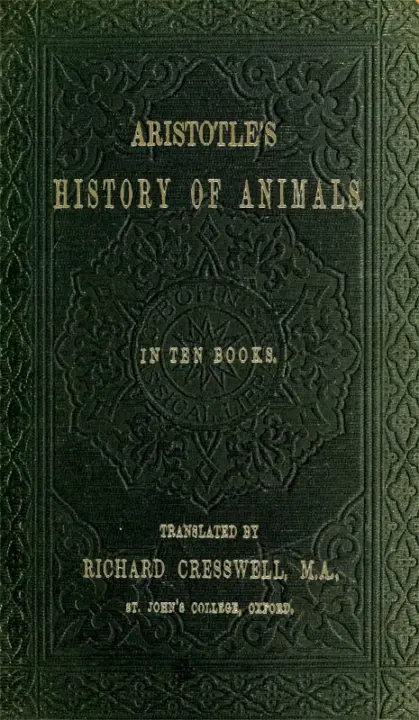
THE CLASSIC COLLECTION · 1887
"Aristotle's History of Animals" by Aristotle is a scientific publication written in the late 4th century BC. The work serves as one of the earliest comprehensive surveys of zoology, analyzing and categorizing various animal species based on their anatomy, behaviors, and habitats. It combines observations with the knowledge inherited from previous naturalists to create a foundational text in the history of biological sciences. The opening of "Aristotle's History of Animals" sets the stage for a detailed examination of the animal kingdom. Aristotle begins by classifying animal parts into simple and compound components, continuing with a discussion on the similarities and differences among various species based on their physical attributes and lifestyles. He lays out an extensive framework for understanding animals, including their modes of life—aquatic versus terrestrial—and anatomical structures, using comparative anatomy to illustrate his points. This introduction effectively establishes the categories and criteria Aristotle will use throughout the work to structure his exploration of the biological world.
Introduction adapted from the source catalogue; source summaries may be automatically generated.
Free to read · English · 129,772 words · No account needed
MAKE TIME FOR A GOOD BOOK
On by default. Untick to stop anonymous reading totals. Each page counts after 10 seconds in view. How this works.
Anonymous counting is on unless you have switched it off.
The writings of physicians who prescribed the food, both of sick and well, have handed down similar and much more extensive observations on the animals and fishes which were brought to the tables of the Greeks. Of this kind Athenæus has given many passages from Dorio, and Diphilus of Siphnus. Oribasius has made a long extract from the work of Xenocrates, on the aquatic animals used in food, which I purpose some day to publish with Xenocrates, if my life should be spared long enough.
Ἄγνος, Vitex agnus castus, a tree like a willow, the branches of which the matrons strewed on their beds at the Thesmophoria, 266.
Ἀδριανικαὶ ἀλεκτορίδες, a small kind of domestic fowl, 138.
Ἀείσκωψ, a kind of owl. Stryx aluco, Strack, 249. Brown Owl. There is also another migratory kind mentioned, 249, which does not hoot.
Ἀέροψ, the Bœotian name of the Merops, M. apiaster, 138.
Ἀετὸς, or αἰετὸς, Eagle, hence the Latin avis, 9, 61;
its eggs and young, 146;
two species, the Pygargus haliætus, and the black eagle, Aquila
anataria or Falco nævius, ib.;
several species, 201, 250;
used in augury, 217;
eats serpents, 231;
food and manners, 251;
true eagles, Falco chrysaetos, ib.;
the eagle kills the heron, 233;
it fights with the vulture and the swan, ib.;
a kind of eagle in Scythia, 252.
Ἀηδῶν, nightingale, Sylvia luscinia, its song, 95, 96;
reproduction, 108;
its tongue, 246;
changes its song and colour, 276.
Ἀθερίνη, Atherina presbyter, Spratt's Lycia, or A. vera, in modern
Greek atherno, 159;
its reproduction, 160, 234.
Αἰγίθαλος, Parus, Tit or Titmouse, eats worms, 202;
three species, ib.;
lays many eggs, 246;
an enemy to bees, 265;
σπιξίτης, parus major, Strack. ὀρεινὸς, Parus ater, Strack, or
P. caudatus. ἐλάχιστος, Parus cœruleus.
Αἴγιθος, Bunting, Emberiza, Strack, or hedge sparrow or Parus cœruleus, dislikes the ass, builds in hedges, 232; hostile to the anthus and acanthis, 233; its food and young, 246.
Αἰγοθήλας, goat sucker, Caprimulgus Europæus, 250.
Αἰγοκέφαλος, Stryx otus, Strack, 39.
Αἰγυπιὸς, the Vulture, it is hostile to the Æsalon (small hawk), 9, 23; and fights with the eagle, ib.
Αἴγυπτος, Egypt, the Egyptians batch eggs in manure, 139;
two kinds of Egyptian mice, one with stiff hair (Hierax, or
Aulacodus Swinderianus), another with long hind legs (Jerboa, or
Cavia), 178;
the care of animals among the Egyptians, 231;
a large kind of oxen in Egypt, 226;
asp and ichneumon, 238;
white and black ibis, 242.
Αἰγώλιος, a night bird of prey, Stryx passerina, Strack, or S. flammea. Camus. La chouette, little owl, 201; kills the calaris, 232; its habit and mode of life, 247; in p. 139 this bird is called αἰτώλιος.
Αἰετὸς, a cartilaginous fish, one of the class selache, Raia
aquila, 104.
Αἰθιοπία, Æthiopia, winged serpents in Æthiopia, probably Draco
volans, 9;
Æthiopian sheep, 165.
Αἰθίοψ, Æthiopian, teeth, 60;
semen, 72, 188.
Αἴθυια, a large waterbird, Larus parasiticus, or L. Marinus, Strack,
or L. argentatus, 2;
its reproduction, 108;
food, 203.
Αἴλουρος, cat, Felis cattus, copulation, 103;
its young, food, and mode of life, 177;
kills birds, 239.
Αἱμοῤῥοΐς, or ἀποῤῥαΐς, a kind of shell fish, perhaps Murex, 85, 86.
Your reading position is saved on this browser. Take it to another device with a library code. Reading pages adapt to text, rather than matching a printed edition.
BEHIND THE BOOK
This eBook is for the use of anyone anywhere in the United States and most other parts of the world at no cost and with almost no restrictions whatsoever. You may copy it, give it away or re-use it under the terms of the Project Gutenberg License included with this eBook or online at www.gutenberg.org. If you are not located in the United States, you will have to check the laws of the country where you are located before using this eBook. Read the source licence.
The original source file, including credits and licence, is retained by this library. Request an original-format copy at no charge. Please include the book title and Project Gutenberg identifier #59058.
KEEP YOUR CURIOSITY GOING
Cécile Tormay

Moritz Busch
John L. Ransom
Frances Wright
Cécile Tormay

Mabel Potter Daggett