
Last letters from the living dead man
David Patterson (Spirit) Hatch
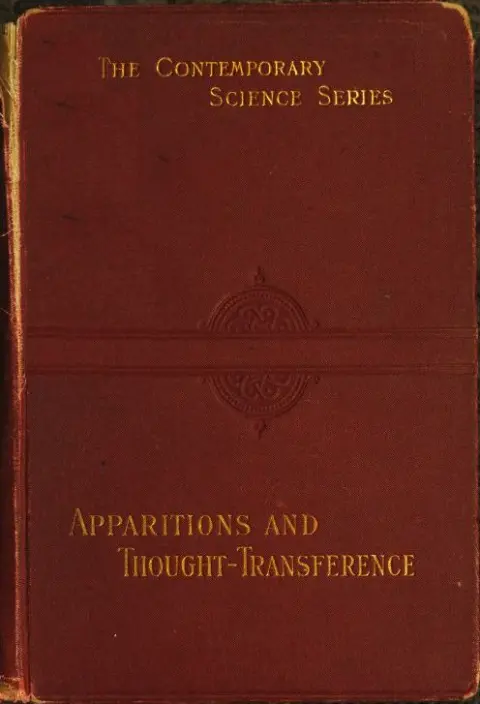
THE CLASSIC COLLECTION · 1894
"Apparitions and Thought-Transference: An Examination of the Evidence for Telepathy" by Frank Podmore is a scientific publication written in the late 19th century. This work delves into the topic of telepathy, presenting a detailed examination and critique of various experimental evidence and case studies concerning thought transfer and associated phenomena. The book aims to provide the reader with a clearer understanding of telepathic communication that occurs outside the known sensory channels, while also acknowledging the complexities and challenges in achieving conclusive proof. The opening of the book introduces the context for the ongoing study of psychical research, pointing to the emergence of the Society for Psychical Research and the foundations laid by previous scientific inquiries. Podmore discusses the historical perspectives on supernatural phenomena, particularly apparitions and clairvoyance, and underscores the skepticism that comes from both the scientific community and the general public. He outlines fundamental challenges in the research, such as defining telepathy, potential errors in observation, common misconceptions, and the need for rigorous experimentation to validate the phenomena observed. Overall, the introduction sets a tone of inquiry, caution, and a commitment to applying scientific rigor in exploring the enigmatic territory of thought-transference.
Introduction adapted from the source catalogue; source summaries may be automatically generated.
Free to read · English · 144,986 words · No account needed
MAKE TIME FOR A GOOD BOOK
On by default. Untick to stop anonymous reading totals. Each page counts after 10 seconds in view. How this works.
Anonymous counting is on unless you have switched it off.
That in general the so-called physical phenomena of Spiritualism are due to self-deception and exaggeration on the one hand, and to fraud on the other, is a proposition which to most readers, it is likely, will seem to need little demonstration. And there are of course many cases, such as the recent experiments with Eusapia Palladino[160] at Milan, where, though competent observers--Richet, Schiaparelli, Lombroso, Brofferio--have seen things beyond their power to explain, yet the line between what was possible to fraudulent ingenuity and what was not possible cannot be drawn with sufficient sharpness to warrant the invocation of any new agency. But there are other records which cannot be so summarily dismissed. Thus Mr. Crookes, F.R.S.,[161] has described the movements of a balance, specially constructed for the purpose of the experiments, in the presence of himself and other observers, under conditions which seemed to render it impossible for the effects to have been produced by the muscular force of any of those present. Lord Lindsay has testified to having seen Home's stature elongated to the extent of 11 inches, and heavy tables and other articles of furniture rise in the air without visible support, and to having himself, at Home's instance, handled, and seen others handle, red-hot coals with impunity. Other witnesses of repute have testified to the appearance of strange luminous bodies, the raining down of liquid scent, the production of inexplicable musical sounds and other phenomena equally marvellous.[162]
Now it is difficult to believe that Mr. Crookes and those with him could in their normal senses have imagined movements of a self-registering balance which never really took place, or have failed to detect actual movements on Home's part; or that Home could have seemed to Lord Lindsay and others to add some fraction of a cubit to his stature or to float unsupported in the air, when he was really only stretching cramped muscles, or supporting himself on a captive balloon, or by unseen wires; or that when he was seen to carry hot coals about the room, and to place them, still glowing, upon the bare head of Mr. S. C. Hall, he relied upon the observers overlooking such inconspicuous objects as a pair of tongs and an asbestos skull-cap--alternatives which must have been at least as obvious at the time to the observers who, by recording these things, have imperilled their reputation for scientific acumen, and even for common sense, as now to their irresponsible critics. But it is certainly not less difficult to believe, on such grounds as these, in the discovery of a new physical force--or rather new forces; for the energy which could move a balance cannot properly be assumed to be identical with the energy which could increase Home's stature, or restrain the action of fire; or, as elsewhere recorded, bring delicate flowers uninjured through closed doors. But fortunately we are not compelled to choose between the alternatives of such almost incredible stupidity and a multiplicity of new modes of energy. It has been plausibly suggested that the observers in such cases are the subjects of a collective hallucination. It is true that we have no precise analogy to support such a hypothesis. The hallucinations of hypnotism can be imposed upon several subjects simultaneously by dint of repeated verbal suggestions. But here there were none of the recognised preliminaries to the hypnotic trance: in many of the recorded cases the observers did not know what to expect, and it is clear that verbal suggestion was not essential to the results; while there is no trace of that break in the continuity of consciousness which elsewhere marks the passage from the hypnotic to the normal state. Moreover, in some of the best-attested cases it was the presumed operator, and not the witnesses, who was entranced. Assuredly if the phenomena described were due to hypnotic hallucination, it was hallucination without any of the characteristic features of hypnotism. But if we assume--as in the absence of any evidence to the contrary we are entitled, if not bound, to assume--that the observers were in their normal state, we can find no nearer parallel to this supposed hallucination than the collective telepathic hallucinations of which examples have been given in Chapter XII.[163]
Your reading position is saved on this browser. Take it to another device with a library code. Reading pages adapt to text, rather than matching a printed edition.
BEHIND THE BOOK
This eBook is for the use of anyone anywhere in the United States and most other parts of the world at no cost and with almost no restrictions whatsoever. You may copy it, give it away or re-use it under the terms of the Project Gutenberg License included with this eBook or online at www.gutenberg.org. If you are not located in the United States, you will have to check the laws of the country where you are located before using this eBook. Read the source licence.
The original source file, including credits and licence, is retained by this library. Request an original-format copy at no charge. Please include the book title and Project Gutenberg identifier #56489.
KEEP YOUR CURIOSITY GOING
David Patterson (Spirit) Hatch
Coulson Kernahan

Ralph Waldo Emerson
Frances Wright

Edwin Abbott Abbott

Joseph Droz