
Last letters from the living dead man
David Patterson (Spirit) Hatch
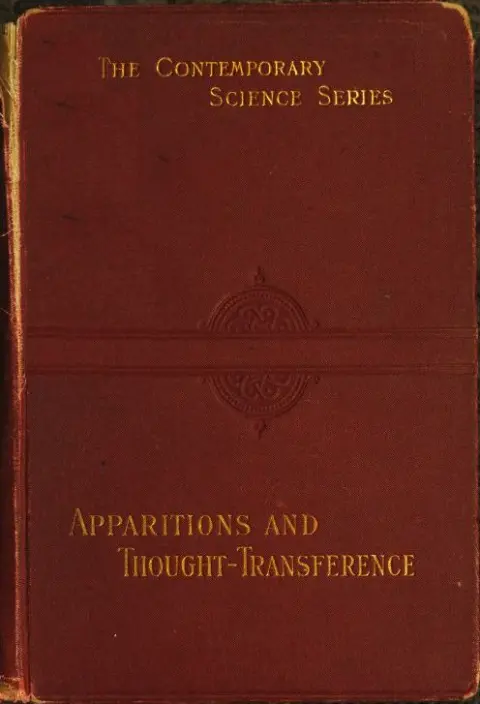
THE CLASSIC COLLECTION · 1894
"Apparitions and Thought-Transference: An Examination of the Evidence for Telepathy" by Frank Podmore is a scientific publication written in the late 19th century. This work delves into the topic of telepathy, presenting a detailed examination and critique of various experimental evidence and case studies concerning thought transfer and associated phenomena. The book aims to provide the reader with a clearer understanding of telepathic communication that occurs outside the known sensory channels, while also acknowledging the complexities and challenges in achieving conclusive proof. The opening of the book introduces the context for the ongoing study of psychical research, pointing to the emergence of the Society for Psychical Research and the foundations laid by previous scientific inquiries. Podmore discusses the historical perspectives on supernatural phenomena, particularly apparitions and clairvoyance, and underscores the skepticism that comes from both the scientific community and the general public. He outlines fundamental challenges in the research, such as defining telepathy, potential errors in observation, common misconceptions, and the need for rigorous experimentation to validate the phenomena observed. Overall, the introduction sets a tone of inquiry, caution, and a commitment to applying scientific rigor in exploring the enigmatic territory of thought-transference.
Introduction adapted from the source catalogue; source summaries may be automatically generated.
Free to read · English · 144,986 words · No account needed
MAKE TIME FOR A GOOD BOOK
On by default. Untick to stop anonymous reading totals. Each page counts after 10 seconds in view. How this works.
Anonymous counting is on unless you have switched it off.
But there are two special kinds of marvels, whose occurrence has been widely vouched for within quite recent times by men of proved ability and trained in the experimental methods of the modern laboratory, which deserve to be considered in this connection--the influence of metals and magnets on the human organism, and the physical phenomena of Spiritualism. Baron von Reichenbach in the last generation published the results of numerous observations on various sensitives, who alleged that they could see flame-like emanations from crystals, from the poles of a magnet, from the bodies of the sick, and from newly-made graves, and that they experienced various sensations from contact with magnets and metals. On the evidence of Reichenbach's prolonged and laborious researches the existence of this supposed magnetic sense obtained a certain degree of credence. Accordingly the S.P.R., shortly after its foundation in 1882, conducted a series of control experiments on a number of persons with a powerful electro-magnet, which was alternately magnetised and demagnetised by a commutator in an adjoining room. Of forty-five persons tested three professed to see luminous appearances on the poles of the magnet; and on two or three occasions they were able to indicate with surprising accuracy throughout a whole evening the exact moment at which the current was switched on or off--the light, as they alleged, appearing or disappearing simultaneously. But these isolated successes were not repeated, and the very conditions of the experiment implied that it was known to some of those present whether or not the magnet was charged. Now it is obvious that unless special precautions are taken to guard against the telepathic[152] communication of this knowledge all experiments of the kind must be inconclusive; and other investigators have failed to detect any trace of the so-called magnetic sense.[153]
Within the last few years this supposed sensitiveness has appeared in another form. M. Babinski of the Salpetrière claims to have shown that certain ailments--such, for example, as hemiplegia and hysterical mutism--can be transferred by the influence of a magnet from one side of the body to another, or from one patient to another. MM. Binet and Féré[154] find that unilateral hallucinations can be shifted by the same influence from one side of the body to the other, and that in general memories and sensations--real or imaginary--can be modified and destroyed by the magnet. And MM. Bourru, Burot, Luys, and others have published whole treatises dealing with the alleged influence of various drugs and metals on certain patients. A few drops of laurel-water enclosed in a flask and brought near to the patient, will, according to these writers, induce ecstasy; ipecacuanha will cause vomiting; alcohol intoxication, and so on; each drug, though securely stoppered and sealed, giving rise to the appropriate physical symptoms in the patient. However, MM. Bernheim,[155] Delboeuf,[156] and Jules Voisin[157] showed some time since, and Mr. Ernest Hart[158] has lately repeated the demonstration, that the same results can be made to follow if the patient is led to believe that an inert piece of wood is a magnet, or that an empty flask contains a powerful drug. It may be fairly assumed therefore that when special precautions are not shown to have been taken--and there is little evidence that such precautions were as a rule taken--suggestion by word or look would be sufficient to account for the phenomena observed. But it is obvious that negative experiments of this kind are not in themselves conclusive; and it is difficult to believe that all the results recorded by investigators of such experience as Babinski, Féré, and others could have been due simply to carelessness on their part, or hypnotic cunning on the part of the subject. Indeed, in commenting on the counter experiments made by M. Jules Voisin, MM. Bourru and Burot expressly state that if the results obtained by them are to be attributed to suggestion, as he proposes, it is "une suggestion sans parole, sans geste, sans pensée même."[159] But a suggestion without word, gesture, or conscious thought is an accurate description of one form of telepathic suggestion; and if such suggestion has indeed been at work we have an explanation of the otherwise inexplicable reliance placed by these French investigators upon experiments so much controverted, and their faith in an interpretation so little supported by scientific analogy.
Your reading position is saved on this browser. Take it to another device with a library code. Reading pages adapt to text, rather than matching a printed edition.
BEHIND THE BOOK
This eBook is for the use of anyone anywhere in the United States and most other parts of the world at no cost and with almost no restrictions whatsoever. You may copy it, give it away or re-use it under the terms of the Project Gutenberg License included with this eBook or online at www.gutenberg.org. If you are not located in the United States, you will have to check the laws of the country where you are located before using this eBook. Read the source licence.
The original source file, including credits and licence, is retained by this library. Request an original-format copy at no charge. Please include the book title and Project Gutenberg identifier #56489.
KEEP YOUR CURIOSITY GOING
David Patterson (Spirit) Hatch
Coulson Kernahan

Ralph Waldo Emerson
Frances Wright

Edwin Abbott Abbott

Joseph Droz