
Last letters from the living dead man
David Patterson (Spirit) Hatch
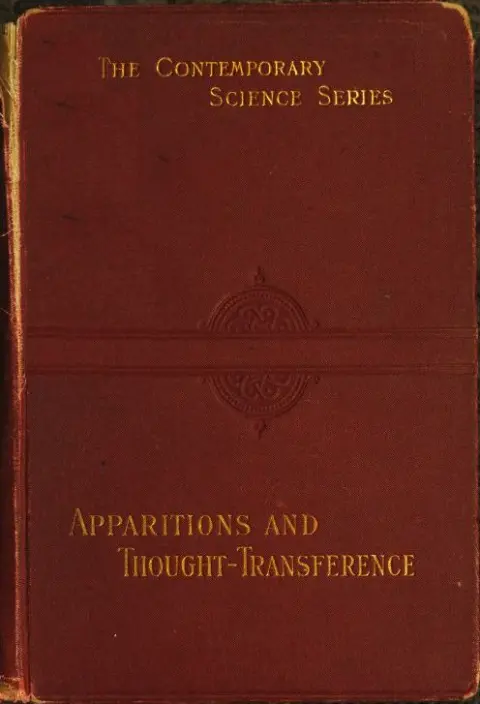
THE CLASSIC COLLECTION · 1894
"Apparitions and Thought-Transference: An Examination of the Evidence for Telepathy" by Frank Podmore is a scientific publication written in the late 19th century. This work delves into the topic of telepathy, presenting a detailed examination and critique of various experimental evidence and case studies concerning thought transfer and associated phenomena. The book aims to provide the reader with a clearer understanding of telepathic communication that occurs outside the known sensory channels, while also acknowledging the complexities and challenges in achieving conclusive proof. The opening of the book introduces the context for the ongoing study of psychical research, pointing to the emergence of the Society for Psychical Research and the foundations laid by previous scientific inquiries. Podmore discusses the historical perspectives on supernatural phenomena, particularly apparitions and clairvoyance, and underscores the skepticism that comes from both the scientific community and the general public. He outlines fundamental challenges in the research, such as defining telepathy, potential errors in observation, common misconceptions, and the need for rigorous experimentation to validate the phenomena observed. Overall, the introduction sets a tone of inquiry, caution, and a commitment to applying scientific rigor in exploring the enigmatic territory of thought-transference.
Introduction adapted from the source catalogue; source summaries may be automatically generated.
Free to read · English · 144,986 words · No account needed
MAKE TIME FOR A GOOD BOOK
On by default. Untick to stop anonymous reading totals. Each page counts after 10 seconds in view. How this works.
Anonymous counting is on unless you have switched it off.
Consideration more or less adequate has now been given to the various phenomena in which there is proof apparent of the action of telepathy. The experimental evidence has shown that a simple sensation or idea may be transferred from one mind to another, and that this transference may take place alike in the normal state and in the hypnotic trance. It has been shown also that the transferred idea may be reproduced in the percipient's organism under various disguises; at one time, for instance, it may cause vague distress or terror, or a blind impulse to action; under other circumstances it may inspire definite and complicated movements, as those involved in writing. Again, it may induce sleep or even more deep-seated organic effects, such as hysteria or local anæsthesia. Once more, it may be embellished with imagery presumably furnished by the percipient's own mind, and may appear as a dream or hallucination representing the distant agent. And these various results may be obtained either by deliberate experiment; as the result of some crisis affecting another mind; or, lastly, as following on some peculiar state of receptivity established, under conditions not yet clearly ascertained, in the percipient's mind.
But it would not be reasonable to infer that the few hundreds or thousands of examples collected during the last twelve years by a few groups of investigators exhaust the possibilities or indicate the limits of telepathic action. By those, at least, who accept the demonstration of telepathy as a real agency it will hardly be anticipated that its action should be confined to the comparatively few cases which present a coincidence sufficiently striking to be quoted as ostensive instances. That the distribution, indeed, of telepathic sensitiveness at the present time should be sporadic--as the distribution of a musical ear or the power of visualisation is sporadic--may appear not improbable. But we should be prepared to find instances of its presumptive operation which fall below the level of demonstration, and might with almost equal plausibility be referred to some other cause. And such instances we do certainly find, in simultaneous dreams and in vague presentiments, and in innumerable coincidences of thought and expression in ordinary life. And the suggestion that the same power may serve as an auxiliary to more completely systematised modes of expression, though incapable of proof, may yet be thought worthy of consideration. It is conceivable, for instance, that it may aid the intercourse of a mother with her infant child, that the influence of the orator may be due not only to the spoken word, and that even in our daily conversation thoughts may pass by this means which find no outward expression. The personal influence of the operator in hypnotism may perhaps be regarded as a proof presumptive of telepathy. When all the phenomena of "mesmerism" were attributed, by the few who believed in them, to the passage of a fluid from the mesmerist to his patient, it was easy to credit the successful operator with as large an endowment of available fluid as the facts might seem to require. But from those who assert that the results are not merely explicable, but are in practice to be explained, as due to suggestion alone, no entirely satisfactory explanation has ever been forthcoming of the observed differences between one operator and another. It is difficult to believe that Liébeault, Bernheim, Schrenck-Notzing, Van Eeden, Lloyd Tuckey, Bramwell, etc., have succeeded where so many others have failed, merely through the exercise of greater patience, or the possession of an established reputation, which after all is based on the successes which it is now invoked to explain.[150] And the fact that a large proportion of well-known hypnotists have acted as agents in successful telepathic experiments of an unusual kind is a further argument in the same direction. There are, moreover, some more dubious beliefs, for the most part discredited by educated persons, yet persisting with a singular vitality, which receive in telepathy a simple and perhaps sufficient explanation. It has already been shown that some of the marvels of Dr. Dee and the Specularii have been paralleled by recent visions in "the crystal," revealing events then passing at a distance unknown to the seer; and that the nucleus of fact in some legends of ghosts and haunted houses is probably to be sought in a telepathic hallucination. And many of the alleged wonders of witchcraft and of ancient magic in general, when disentangled from the accretions formed round them by popular myth and superstition, present a marked resemblance to some of the facts recorded in this book. It is obvious, for instance, that the same power which inhibited Mr. Beard's utterance (p. 83) could have prevented the witch's victim from repeating the Lord's Prayer. And Mr. Godfrey (p. 228), in the sixteenth century, might have found that to appear in two places at once would be perilously strong evidence of unlawful powers.[151]
Your reading position is saved on this browser. Take it to another device with a library code. Reading pages adapt to text, rather than matching a printed edition.
BEHIND THE BOOK
This eBook is for the use of anyone anywhere in the United States and most other parts of the world at no cost and with almost no restrictions whatsoever. You may copy it, give it away or re-use it under the terms of the Project Gutenberg License included with this eBook or online at www.gutenberg.org. If you are not located in the United States, you will have to check the laws of the country where you are located before using this eBook. Read the source licence.
The original source file, including credits and licence, is retained by this library. Request an original-format copy at no charge. Please include the book title and Project Gutenberg identifier #56489.
KEEP YOUR CURIOSITY GOING
David Patterson (Spirit) Hatch
Coulson Kernahan

Ralph Waldo Emerson
Frances Wright

Edwin Abbott Abbott

Joseph Droz