
Last letters from the living dead man
David Patterson (Spirit) Hatch
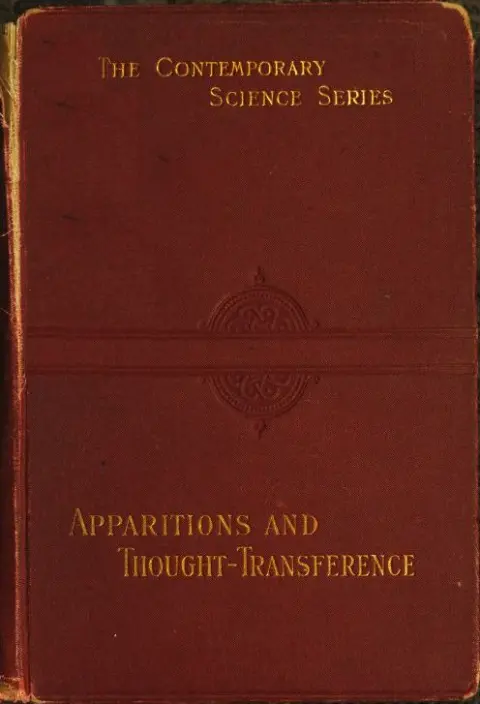
THE CLASSIC COLLECTION · 1894
"Apparitions and Thought-Transference: An Examination of the Evidence for Telepathy" by Frank Podmore is a scientific publication written in the late 19th century. This work delves into the topic of telepathy, presenting a detailed examination and critique of various experimental evidence and case studies concerning thought transfer and associated phenomena. The book aims to provide the reader with a clearer understanding of telepathic communication that occurs outside the known sensory channels, while also acknowledging the complexities and challenges in achieving conclusive proof. The opening of the book introduces the context for the ongoing study of psychical research, pointing to the emergence of the Society for Psychical Research and the foundations laid by previous scientific inquiries. Podmore discusses the historical perspectives on supernatural phenomena, particularly apparitions and clairvoyance, and underscores the skepticism that comes from both the scientific community and the general public. He outlines fundamental challenges in the research, such as defining telepathy, potential errors in observation, common misconceptions, and the need for rigorous experimentation to validate the phenomena observed. Overall, the introduction sets a tone of inquiry, caution, and a commitment to applying scientific rigor in exploring the enigmatic territory of thought-transference.
Introduction adapted from the source catalogue; source summaries may be automatically generated.
Free to read · English · 144,986 words · No account needed
MAKE TIME FOR A GOOD BOOK
On by default. Untick to stop anonymous reading totals. Each page counts after 10 seconds in view. How this works.
Anonymous counting is on unless you have switched it off.
We have to remark here not merely the exhibition of a will and an intelligence differing from the writer's normal self, but the display of a yet more alien disingenuousness. Similar evasions and inventions occur more than once in the course of these experiments. Indeed, a certain degree of moral perversity is a frequent and notorious characteristic of automatic expression.
Some interesting experiments of the same kind were conducted, in the winter of 1892-93, by Mr. R. H. Buttemer, of Emanuel College, Cambridge, and Mr. H. T. Green. Throughout the series the questions were, as in the preceding case, written down, so that the percipient was completely ignorant of their purport. The following is the record of the last experiments of the series.
No. 25.--By MR. R. H. BUTTEMER.
February 18th, 1893, 8 P.M. Mrs. H., Miss B., Mr. and Miss M. present, in addition to Mr. Green, and Messrs. S., W., and Buttemer.
Mr. Green, as usual, operated Planchette, and on this occasion sat with his back to all the other persons present.
Q. (from Mr. M.): What was I doing this afternoon?
A. i. ---- the sun ---- (all else illegible). ii. Enjoying the
fresh air of heaven.
Q. What was Mr. Rogers doing in Cambridge?
A. i. (Irrelevant, or possibly connected vaguely with the question.) ii. Ask another, but Mr. Rogers came up on important business connected with the Lodge. (Correct.)
Q. Where has Mrs. M. gone?
A. i. (Irrelevant.) ii. Far, far away, but more next time. iii. Her mother has gone to--oh, what a happy place is London! iv. All change here for Bletchley. (Mrs. M. had possibly passed this station on her journey.)
Q. Who has won the Association Match to-day?
A. i. (Illegible.) ii. O ye simple ones, how long will ye love simplicity? Why, Oxford, of course. [This fact was known to some persons in the room, but not to Mr. Green.]
One of the company then suggested the attempt to get the name on a visiting card transmitted, and the question was written, "Write name on card." Mr. Green did not know that this experiment was about to be tried, and the card was picked from a pile at random. The name was John B. Bourne. A sentence was written by Mr. Green, which proved to be, "Think of one letter at a time and then see what will happen." We did so.
A. i. J for Jerusalem, O for Omri, H for Honey, and N for Nothing. ii. B for Benjamin, O for Olive, U for Unicorn. (The remaining letters were given incorrectly.)
Q. How many of the Society's books are here? (There were two volumes of Proceedings on the table.)
Your reading position is saved on this browser. Take it to another device with a library code. Reading pages adapt to text, rather than matching a printed edition.
BEHIND THE BOOK
This eBook is for the use of anyone anywhere in the United States and most other parts of the world at no cost and with almost no restrictions whatsoever. You may copy it, give it away or re-use it under the terms of the Project Gutenberg License included with this eBook or online at www.gutenberg.org. If you are not located in the United States, you will have to check the laws of the country where you are located before using this eBook. Read the source licence.
The original source file, including credits and licence, is retained by this library. Request an original-format copy at no charge. Please include the book title and Project Gutenberg identifier #56489.
KEEP YOUR CURIOSITY GOING
David Patterson (Spirit) Hatch
Coulson Kernahan

Ralph Waldo Emerson
Frances Wright

Edwin Abbott Abbott

Joseph Droz