THE CLASSIC COLLECTION✦Notes on witchcraftCLASSIC FREE BOOKS
Notes on witchcraft
George Lyman Kittredge
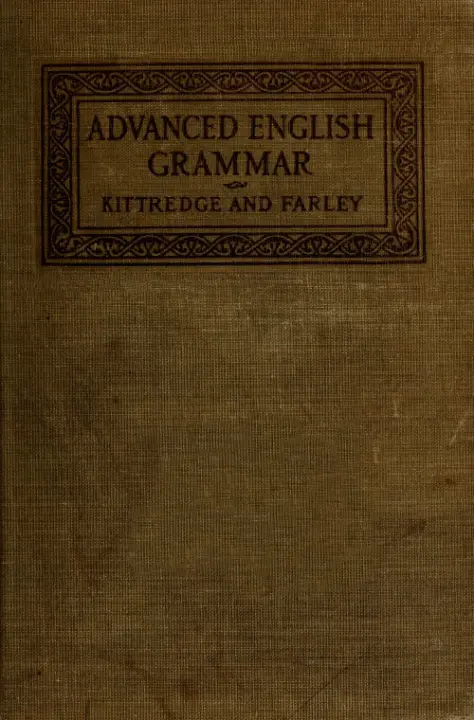
THE CLASSIC COLLECTION · 1913
"An Advanced English Grammar with Exercises" by George Lyman Kittredge and Frank Edgar Farley is an educational grammar textbook written in the early 20th century. This comprehensive guide aims to enhance students' understanding of English grammar, focusing on various elements such as parts of speech, inflections, and syntax. It is designed for learners who have a foundational knowledge of English and seeks to provide in-depth insights into sentence structure, grammatical rules, and usage. The opening of the text presents a clear structure for the book, beginning with a preface that outlines the organization of its content into distinct parts covering the essentials of English grammar. It sets the stage for a systematic study that includes both definitions and examples of various grammatical components and their functions within sentences. Additionally, the introduction emphasizes the relationship between language, thought, and grammar, establishing a foundational understanding of how grammar serves as a framework for effective communication. This portion effectively presents both the purpose of the text and the strategic approach it will take in facilitating advanced English grammar learning.
Introduction adapted from the source catalogue; source summaries may be automatically generated.
Free to read · English · 100,928 words · No account needed
MAKE TIME FOR A GOOD BOOK
On by default. Untick to stop anonymous reading totals. Each page counts after 10 seconds in view. How this works.
Anonymous counting is on unless you have switched it off.
+105.+ +Some verbs of giving, telling, refusing, and the like, may take two objects, a direct object and an indirect object.+
+The indirect object denotes the person or thing toward whom or toward which is directed the action expressed by the rest of the predicate.+
Dick sold his bicycle. Dick sold John his bicycle. I gave permission. I gave this man permission. He paid a dollar. He paid the gardener a dollar. She taught Latin. She taught my children Latin.
Most of the verbs that admit an indirect object are included in the
following list:--
allot, allow, assign, bequeath, bring, deny, ensure, fetch, fling, forbid, forgive, give, grant, guarantee, hand, lease, leave, lend, let, owe, pardon, pass, pay, refund, refuse, remit, restore, sell, send, show, sing, spare, teach, tell, throw, toss, vouchsafe.
Pronouns are commoner as indirect objects than nouns.
They denied her the necessities of life.
I guaranteed them a handsome profit.
The king vouchsafed them an audience.
+It is always possible to insert the preposition to before the indirect object without changing the sense.+
Since the indirect object is equivalent to an adverbial phrase, it is classed as a modifier of the verb.
Thus, in “Dick sold John his bicycle,” John is an adverbial modifier of the predicate verb sold.
The indirect object is sometimes used without a direct object
expressed. Thus,--
He paid the hatter.
Here hatter may be recognized as an indirect object by inserting to before it and adding a direct object (“his bill,” “his money,” or the like).
+106.+ The objective case sometimes expresses the person for whom
anything is done.
William made his brother a kite [= made a kite for his brother].
Sampson built me a boat [= built a boat for me].
This construction may be called the +objective of service+.
NOTE. The objective of service is often included under the head of the indirect object. But the two constructions differ widely in sense, and should be carefully distinguished. To do an act to a person is not the same thing as to do an act for a person. Contrast “John paid the money to me,” with “John paid the money for me”; “Dick sold a bicycle to me,” with “Dick sold a bicycle for me.”
+107.+ The objective case is used after like, unlike, near, and next, which are really adjectives or adverbs, though in this construction they are often regarded as prepositions.
She sang like a bird. [Like is an adverb.]
The earth is like a ball. [Like is an adjective.]
My office is near the station. [Near is an adjective.]
That answer was unlike Joseph. [Unlike is an adjective.]
Your reading position is saved on this browser. Take it to another device with a library code. Reading pages adapt to text, rather than matching a printed edition.
BEHIND THE BOOK
This eBook is for the use of anyone anywhere in the United States and most other parts of the world at no cost and with almost no restrictions whatsoever. You may copy it, give it away or re-use it under the terms of the Project Gutenberg License included with this eBook or online at www.gutenberg.org. If you are not located in the United States, you will have to check the laws of the country where you are located before using this eBook. Read the source licence.
The original source file, including credits and licence, is retained by this library. Request an original-format copy at no charge. Please include the book title and Project Gutenberg identifier #45814.
KEEP YOUR CURIOSITY GOING

Charles G. (Charles Griffith) Ross
Hannah Webster Foster

Emily Lawless
Edwin Hamlin Carr

Charles De Lano Hine
Andrew Ure