THE CLASSIC COLLECTION✦Notes on witchcraftCLASSIC FREE BOOKS
Notes on witchcraft
George Lyman Kittredge
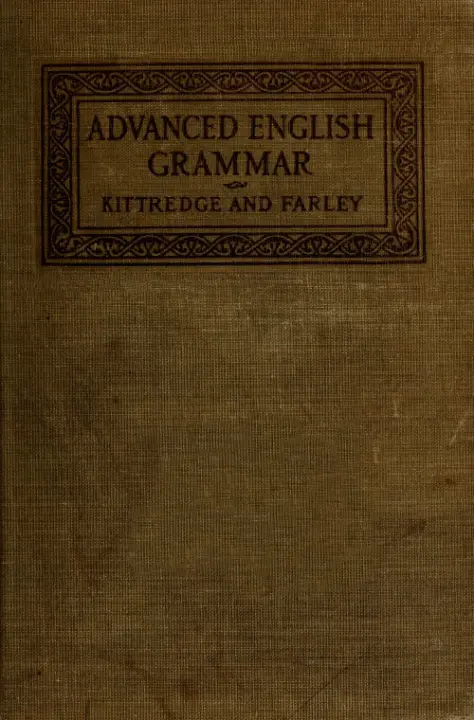
THE CLASSIC COLLECTION · 1913
"An Advanced English Grammar with Exercises" by George Lyman Kittredge and Frank Edgar Farley is an educational grammar textbook written in the early 20th century. This comprehensive guide aims to enhance students' understanding of English grammar, focusing on various elements such as parts of speech, inflections, and syntax. It is designed for learners who have a foundational knowledge of English and seeks to provide in-depth insights into sentence structure, grammatical rules, and usage. The opening of the text presents a clear structure for the book, beginning with a preface that outlines the organization of its content into distinct parts covering the essentials of English grammar. It sets the stage for a systematic study that includes both definitions and examples of various grammatical components and their functions within sentences. Additionally, the introduction emphasizes the relationship between language, thought, and grammar, establishing a foundational understanding of how grammar serves as a framework for effective communication. This portion effectively presents both the purpose of the text and the strategic approach it will take in facilitating advanced English grammar learning.
Introduction adapted from the source catalogue; source summaries may be automatically generated.
Free to read · English · 100,928 words · No account needed
MAKE TIME FOR A GOOD BOOK
On by default. Untick to stop anonymous reading totals. Each page counts after 10 seconds in view. How this works.
Anonymous counting is on unless you have switched it off.
The horse shied when he saw the locomotive. [The subordinate clause depends upon the independent (main) clause.]
The horse shied when he saw the locomotive, which was puffing violently. [The second subordinate clause depends upon the first, being an adjective modifier of locomotive.]
In such cases, the whole group of subordinate clauses may be taken together as forming one +complex subordinate clause+.
Thus, in the second example, when he saw the locomotive, which was puffing violently may be regarded as a complex adverbial clause modifying shied, and containing an adjective clause (which was puffing violently).
+506.+ From the principles summarized in § 505, it appears that--
+Clauses (like sentences) may be simple, compound, or complex.+
1. A +simple clause+ contains but one subject and one predicate, either or both of which may be compound (§ 451).
2. A +compound clause+ consists of two or more coördinate clauses (§
454).
3. A +complex clause+ consists of at least two clauses, one of which is subordinate to the other.
+507.+ The +unit+ in all combinations of clauses is clearly the +simple sentence+, which, when used as a part of a more complicated sentence, becomes a +simple clause+.
The processes used in such combinations, as we have seen, are really but two in number,--+coördination+ and +subordination+.
+Coördination of clauses produces compound sentences or compound clauses; subordination of one clause to another produces complex sentences or complex clauses.+
+508.+ Every sentence, however long and complicated, belongs (in
structure) to one of the three classes,--+simple+, +compound+, and
+complex+.
+509.+ A simple sentence may have a +compound subject or predicate+ (or both), and may also include a number of modifiers and complements.
Obviously, then, a simple sentence need not be short. It remains +simple in structure+ so long as it contains but one simple or compound subject and one simple or compound predicate. Thus,--
1. You leave Glasgow in a steamboat, go down the Clyde fourteen miles, and then come to Dumbarton Castle, a huge rock five or six hundred feet high, not connected with any other high land, and with a fortress at the top.--WEBSTER.
The length of this sentence is due partly to its compound predicate, partly to the modifier (and modifiers of the modifier) attached to the noun Dumbarton Castle.
2. He was little disposed to exchange his lordly repose for the insecure and agitated life of a conspirator, to be in the power of accomplices, to live in constant dread of warrants and king’s messengers, nay, perhaps, to end his days on a scaffold, or to live on alms in some back street of the Hague.--MACAULAY.
Your reading position is saved on this browser. Take it to another device with a library code. Reading pages adapt to text, rather than matching a printed edition.
BEHIND THE BOOK
This eBook is for the use of anyone anywhere in the United States and most other parts of the world at no cost and with almost no restrictions whatsoever. You may copy it, give it away or re-use it under the terms of the Project Gutenberg License included with this eBook or online at www.gutenberg.org. If you are not located in the United States, you will have to check the laws of the country where you are located before using this eBook. Read the source licence.
The original source file, including credits and licence, is retained by this library. Request an original-format copy at no charge. Please include the book title and Project Gutenberg identifier #45814.
KEEP YOUR CURIOSITY GOING

Charles G. (Charles Griffith) Ross
Hannah Webster Foster

Emily Lawless
Edwin Hamlin Carr

Charles De Lano Hine
Andrew Ure