THE CLASSIC COLLECTION✦Notes on witchcraftCLASSIC FREE BOOKS
Notes on witchcraft
George Lyman Kittredge
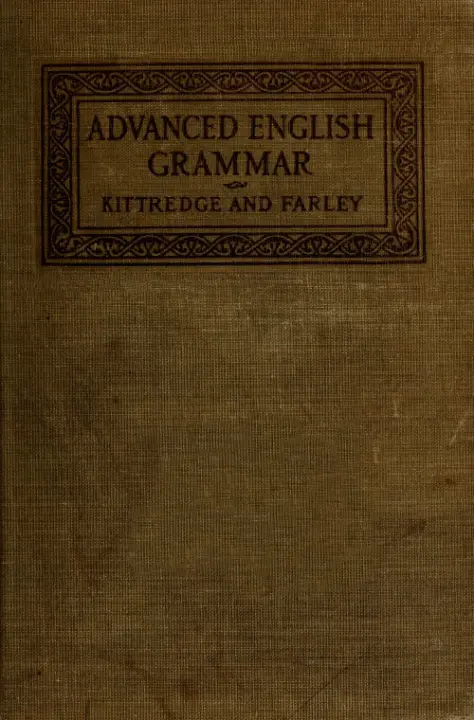
THE CLASSIC COLLECTION · 1913
"An Advanced English Grammar with Exercises" by George Lyman Kittredge and Frank Edgar Farley is an educational grammar textbook written in the early 20th century. This comprehensive guide aims to enhance students' understanding of English grammar, focusing on various elements such as parts of speech, inflections, and syntax. It is designed for learners who have a foundational knowledge of English and seeks to provide in-depth insights into sentence structure, grammatical rules, and usage. The opening of the text presents a clear structure for the book, beginning with a preface that outlines the organization of its content into distinct parts covering the essentials of English grammar. It sets the stage for a systematic study that includes both definitions and examples of various grammatical components and their functions within sentences. Additionally, the introduction emphasizes the relationship between language, thought, and grammar, establishing a foundational understanding of how grammar serves as a framework for effective communication. This portion effectively presents both the purpose of the text and the strategic approach it will take in facilitating advanced English grammar learning.
Introduction adapted from the source catalogue; source summaries may be automatically generated.
Free to read · English · 100,928 words · No account needed
MAKE TIME FOR A GOOD BOOK
On by default. Untick to stop anonymous reading totals. Each page counts after 10 seconds in view. How this works.
Anonymous counting is on unless you have switched it off.
+169.+ +An adjective is a word which describes or limits a substantive.+
+An adjective is said to belong to the substantive which it describes
or limits.+
+An adjective which describes is called a descriptive adjective; one which points out or designates is called a definitive adjective+ (§ 13).
Most adjectives are descriptive: as,--round, cold, red, angry, graceful, excessive, young, sudden, Roman.
NOTE. Many descriptive adjectives are +compound+ (see § 64): as,--steadfast, lionlike, fireproof, downright, heartsick, everlasting, brown-eyed, broad-shouldered, ill-tempered, dear-bought, far-fetched, never-ending, self-evident, self-important. “He was a matter-of-fact person.” “Tom is hail-fellow-well-met with everybody.” “This is an out-of-the-way place.” “A dashing, down-at-the-heel youth answered my knock.”
+170.+ A proper noun used as an adjective, or an adjective derived from a proper noun, is called a +proper adjective+ and usually begins with a capital letter.
EXAMPLES: a Panama hat, Florida oranges, a Bunsen burner; Virginian, Spenserian, Newtonian, Icelandic, Miltonic, Byronic, Turkish, English, Veronese.
NOTE. Many so-called proper adjectives begin with a small letter because their origin is forgotten or disregarded: as,--china dishes, italic type, mesmeric power, a jovial air, a saturnine expression, a mercurial temperament, a stentorian voice.
+171.+ +Definitive adjectives+ include:--pronouns used as adjectives (as, this opportunity; those pictures; either table; what time is it?); numeral adjectives (as, two stars; the third year); the +articles+, a (or an) and the.
Pronouns used as adjectives (often called pronominal adjectives) have been studied under Pronouns--demonstratives (§§ 131–134), indefinites (§§ 135–142), relatives (§§ 143–162), interrogatives (§§ 163–167).
Numeral adjectives will be treated, along with other numerals (nouns and adverbs), in §§ 204–208.
The articles will be treated in §§ 173–180.
+172.+ Adjectives may be classified, according to their position in the sentence, as +attributive+, +appositive+, and +predicate adjectives+.
1. An +attributive adjective+ is closely attached to its noun and
regularly precedes it.
The angry spot doth glow on Cæsar’s brow.
O you hard hearts, you cruel men of Rome!
Yond Cassius has a lean and hungry look.
2. An +appositive adjective+ is added to its noun to explain it, like a noun in apposition (§ 88, 5).
The castle, a ruin, The castle, ancient and ruinous, stood on the edge of the cliff. stood on the edge of the cliff.
Bertram, the ringleader, Bertram, undaunted, refused to surrender. refused to surrender.
3. A +predicate adjective+ completes the meaning of the predicate verb, but describes or limits the subject.
Predicate adjectives are common after is (in its various forms) and other copulative verbs, particularly become and seem (§ 17).
The sea is rough to-day.
Burton soon became cautious in his judgments.
You seem anxious about your future.
The air grew hot and sultry.
Our first experiment proved unsuccessful.
The milk turned sour.
Our agent proved trustworthy.
Your reading position is saved on this browser. Take it to another device with a library code. Reading pages adapt to text, rather than matching a printed edition.
BEHIND THE BOOK
This eBook is for the use of anyone anywhere in the United States and most other parts of the world at no cost and with almost no restrictions whatsoever. You may copy it, give it away or re-use it under the terms of the Project Gutenberg License included with this eBook or online at www.gutenberg.org. If you are not located in the United States, you will have to check the laws of the country where you are located before using this eBook. Read the source licence.
The original source file, including credits and licence, is retained by this library. Request an original-format copy at no charge. Please include the book title and Project Gutenberg identifier #45814.
KEEP YOUR CURIOSITY GOING

Charles G. (Charles Griffith) Ross
Hannah Webster Foster

Emily Lawless
Edwin Hamlin Carr

Charles De Lano Hine
Andrew Ure