THE CLASSIC COLLECTION✦Notes on witchcraftCLASSIC FREE BOOKS
Notes on witchcraft
George Lyman Kittredge
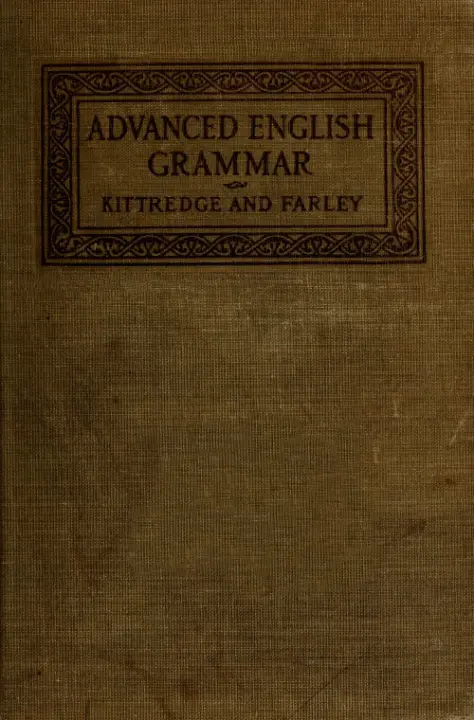
THE CLASSIC COLLECTION · 1913
"An Advanced English Grammar with Exercises" by George Lyman Kittredge and Frank Edgar Farley is an educational grammar textbook written in the early 20th century. This comprehensive guide aims to enhance students' understanding of English grammar, focusing on various elements such as parts of speech, inflections, and syntax. It is designed for learners who have a foundational knowledge of English and seeks to provide in-depth insights into sentence structure, grammatical rules, and usage. The opening of the text presents a clear structure for the book, beginning with a preface that outlines the organization of its content into distinct parts covering the essentials of English grammar. It sets the stage for a systematic study that includes both definitions and examples of various grammatical components and their functions within sentences. Additionally, the introduction emphasizes the relationship between language, thought, and grammar, establishing a foundational understanding of how grammar serves as a framework for effective communication. This portion effectively presents both the purpose of the text and the strategic approach it will take in facilitating advanced English grammar learning.
Introduction adapted from the source catalogue; source summaries may be automatically generated.
Free to read · English · 100,928 words · No account needed
MAKE TIME FOR A GOOD BOOK
On by default. Untick to stop anonymous reading totals. Each page counts after 10 seconds in view. How this works.
Anonymous counting is on unless you have switched it off.
[4] In this book, several old forms and constructions which the student is constantly encountering in the English classics are treated in their proper places,--always with an indication of their difference from the modern standard.
[5] In the technical language of grammar an adjective is said to describe a substantive when it describes the object which the substantive denotes.
[6] Definitive adjectives are often called +limiting adjectives+. All adjectives, however, limit, even those that also describe.
[7] The usual brief definition of a verb is, “A verb is a word which asserts.” But this definition in strictness applies only to verbs in declarative sentences.
[8] For full inflection see pp. 300–301.
[9] +Compound complex+ sentences are also called +complex compound+ sentences. For further treatment of such sentences, see pp. 187, 190, 215–216.
[10] Vixen is really formed from fox (compare the German Füchsin
from Fuchs).
[11] Halo, memento, zero also form a plural in es (haloes,
etc.).
[12] This list is intended for reference.
[13] The English word animalcule (plural animalcules) is preferable. The plural animalculæ is erroneous.
[14] Messrs. is an abbreviation of the French messieurs.
[15] When such nouns as chemistry refer to textbooks, they may be used in the plural: as,--“Bring your chemistries to-morrow.”
[16] This section is intended chiefly for reference.
[17] Note the ambiguity to the ear though not to the eye.
[18] The only exception is in reflexive action, where the object is a compound personal pronoun (“Charles deceived himself”). See § 126.
[19] The pupil should not “supply nouns” in such sentences as these. For example, it is unscientific to expand the first sentence into “This [morning] is a fine morning,” and then to parse this as an adjective. It is even more objectionable to expand the fifth sentence by inserting thing or the like after this. The plan of “supplying” unexpressed words (as being “understood”) tends to confuse real distinctions of language, and should never be resorted to when it can be avoided.
[20] The negative not (§ 190, 4) is merely a shortened form of
naught.
[21] Because of their use as connectives, relative pronouns are sometimes called +conjunctive pronouns+.
[22] For indirect questions, see § 441.
[23] In some of these cases the comparative and superlative are really different words from the positive.
[24] The four classes are not absolute, for the same adverb may be used in different senses and thus belong to different classes. Sometimes, too, there is room for difference of opinion. Thus in the fourth and fifth examples under 1, terribly and surprisingly are equivalent to “in a terrible (or surprising) manner,” and therefore are classified as adverbs of manner; but they may also be regarded as adverbs of degree.
[25] Many comparatives and superlatives in er and est that are no longer allowable in prose are still used in poetry.
Your reading position is saved on this browser. Take it to another device with a library code. Reading pages adapt to text, rather than matching a printed edition.
BEHIND THE BOOK
This eBook is for the use of anyone anywhere in the United States and most other parts of the world at no cost and with almost no restrictions whatsoever. You may copy it, give it away or re-use it under the terms of the Project Gutenberg License included with this eBook or online at www.gutenberg.org. If you are not located in the United States, you will have to check the laws of the country where you are located before using this eBook. Read the source licence.
The original source file, including credits and licence, is retained by this library. Request an original-format copy at no charge. Please include the book title and Project Gutenberg identifier #45814.
KEEP YOUR CURIOSITY GOING

Charles G. (Charles Griffith) Ross
Hannah Webster Foster

Emily Lawless
Edwin Hamlin Carr

Charles De Lano Hine
Andrew Ure