THE CLASSIC COLLECTION✦Notes on witchcraftCLASSIC FREE BOOKS
Notes on witchcraft
George Lyman Kittredge
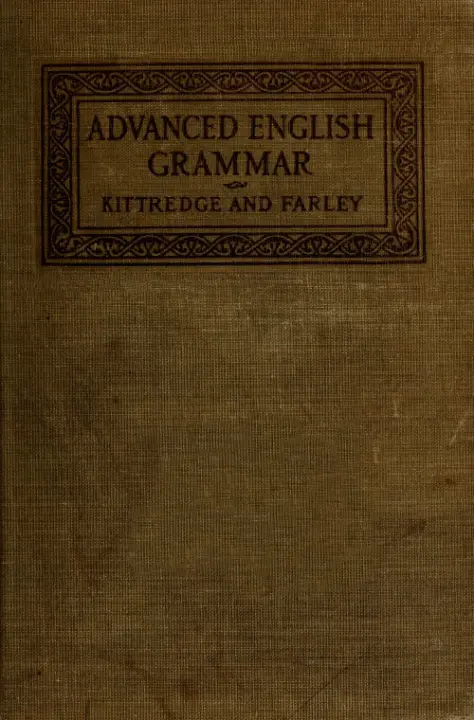
THE CLASSIC COLLECTION · 1913
"An Advanced English Grammar with Exercises" by George Lyman Kittredge and Frank Edgar Farley is an educational grammar textbook written in the early 20th century. This comprehensive guide aims to enhance students' understanding of English grammar, focusing on various elements such as parts of speech, inflections, and syntax. It is designed for learners who have a foundational knowledge of English and seeks to provide in-depth insights into sentence structure, grammatical rules, and usage. The opening of the text presents a clear structure for the book, beginning with a preface that outlines the organization of its content into distinct parts covering the essentials of English grammar. It sets the stage for a systematic study that includes both definitions and examples of various grammatical components and their functions within sentences. Additionally, the introduction emphasizes the relationship between language, thought, and grammar, establishing a foundational understanding of how grammar serves as a framework for effective communication. This portion effectively presents both the purpose of the text and the strategic approach it will take in facilitating advanced English grammar learning.
Introduction adapted from the source catalogue; source summaries may be automatically generated.
Free to read · English · 100,928 words · No account needed
MAKE TIME FOR A GOOD BOOK
On by default. Untick to stop anonymous reading totals. Each page counts after 10 seconds in view. How this works.
Anonymous counting is on unless you have switched it off.
Those dangers which, in the vigor of youth, we had learned to despise, assume new terrors as we grow old.--GOLDSMITH.
When Farmer Oak smiled, the corners of his mouth spread till they were within an unimportant distance of his ears.--HARDY.
As Florian Deleal walked, one hot afternoon, he overtook by the wayside a poor aged man, and, as he seemed weary with the road, helped him on with the burden which he carried, a certain distance.--PATER.
While Joe was absent on this errand, the elder Willet and his three companions continued to smoke with profound gravity and in a deep silence, each having his eyes fixed on a huge copper boiler that was suspended over the fire.--DICKENS.
+521.+ +Two or more subordinate clauses in the same construction, forming one compound clause, may be attached to the main clause as a modifier or complement.+
1. The truth was that Leonard had overslept, that he had missed the train, and that he had failed to keep his appointment.
2. The guide told us that the road was impassable, that the river was in flood, and that the bridge had been swept away.
3. Ellis, whose pockets were empty and whose courage was at a low ebb, stared dismally at the passing crowd.
4. Before the battle was over and while the result was still in doubt, the general ordered a retreat.
5. After we had arrived at the hotel, but before we had engaged our rooms, we received an invitation to stay at the castle.
6. My first thought was, that all was lost, and that my only chance for executing a retreat was to sacrifice my baggage.--DE QUINCEY.
7. The author fully convinced his readers that they were a race of cowards and scoundrels, that nothing could save them, that they were on the point of being enslaved by their enemies, and that they richly deserved their fate.--MACAULAY.
In the first and second examples, three coördinate noun clauses are joined to make one compound clause, which is used as a complement,--as a predicate nominative in the first sentence, as the direct object of told in the second.
In the third example, a compound adjective clause modifies Ellis. In the fourth and fifth, a compound adverbial clause modifies the predicate verb (ordered, received). In the seventh, four that-clauses unite in one compound clause.
+522.+ +Two or more successively subordinate clauses, forming one
complex clause, may be joined to the main clause as a modifier or
complement.+
In such a series, the first subordinate clause is attached directly to the main clause, the second is subordinate to the first, the third to the second, and so on in succession.
Your reading position is saved on this browser. Take it to another device with a library code. Reading pages adapt to text, rather than matching a printed edition.
BEHIND THE BOOK
This eBook is for the use of anyone anywhere in the United States and most other parts of the world at no cost and with almost no restrictions whatsoever. You may copy it, give it away or re-use it under the terms of the Project Gutenberg License included with this eBook or online at www.gutenberg.org. If you are not located in the United States, you will have to check the laws of the country where you are located before using this eBook. Read the source licence.
The original source file, including credits and licence, is retained by this library. Request an original-format copy at no charge. Please include the book title and Project Gutenberg identifier #45814.
KEEP YOUR CURIOSITY GOING

Charles G. (Charles Griffith) Ross
Hannah Webster Foster

Emily Lawless
Edwin Hamlin Carr

Charles De Lano Hine
Andrew Ure