THE CLASSIC COLLECTION✦Notes on witchcraftCLASSIC FREE BOOKS
Notes on witchcraft
George Lyman Kittredge
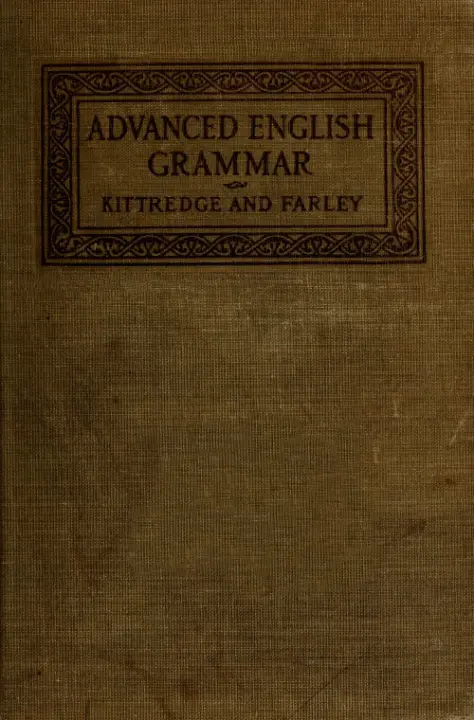
THE CLASSIC COLLECTION · 1913
"An Advanced English Grammar with Exercises" by George Lyman Kittredge and Frank Edgar Farley is an educational grammar textbook written in the early 20th century. This comprehensive guide aims to enhance students' understanding of English grammar, focusing on various elements such as parts of speech, inflections, and syntax. It is designed for learners who have a foundational knowledge of English and seeks to provide in-depth insights into sentence structure, grammatical rules, and usage. The opening of the text presents a clear structure for the book, beginning with a preface that outlines the organization of its content into distinct parts covering the essentials of English grammar. It sets the stage for a systematic study that includes both definitions and examples of various grammatical components and their functions within sentences. Additionally, the introduction emphasizes the relationship between language, thought, and grammar, establishing a foundational understanding of how grammar serves as a framework for effective communication. This portion effectively presents both the purpose of the text and the strategic approach it will take in facilitating advanced English grammar learning.
Introduction adapted from the source catalogue; source summaries may be automatically generated.
Free to read · English · 100,928 words · No account needed
MAKE TIME FOR A GOOD BOOK
On by default. Untick to stop anonymous reading totals. Each page counts after 10 seconds in view. How this works.
Anonymous counting is on unless you have switched it off.
When the rain at last ceased, we were drenched [that is, very
wet].
In the first sentence, were drenched is the past passive of the verb drench (compare the active “every time a gust of wind struck us, it drenched us”). In the second, the participle drenched expresses mere condition, and is therefore a predicate adjective. The distinction, however, is not always sharp, and in cases of doubt the phrase may be taken together as a passive verb.
NOTE. The real test is the following. Whenever a person or thing is distinctly present to the mind as the doer of the action, we have a passive verb-phrase. Whenever, on the other hand, the participle merely describes condition with no thought of its being the result of an antecedent act, the construction is that of a predicate adjective (§ 172, 3).
+344.+ A substantive, with the participle belonging to it, is often used to make a peculiar form of adverbial modifying phrase: as,--
The wind failing, we lowered the sail.
Here the wind failing is equivalent to an adverbial phrase (on the failure of the wind) or an adverbial clause (when the wind failed). It defines the time of the action.
{The wind failing, | On the failure of the wind, | When the wind failed,} we lowered the sail.
+345.+ +A substantive, with a participle, may express the cause, time, or circumstances of an action.+
+This is called the absolute construction.+
+The substantive is in the nominative case and is called a nominative
absolute.+
My knife slipping, I cut myself severely. [The phrase my knife slipping is equivalent to because my knife slipped: it expresses +cause+.]
Two days having elapsed, we again set forward. [The phrase in
italics is equivalent to when two days had elapsed: it expresses
+time+.]
Evenings he read aloud, his wife sewing by his side. [The phrase expresses one of the +circumstances+ that attended the reading.]
This done, proceed to business. [The phrase this done is equivalent to the clause since (or when) this is done, and indicates +cause+ or +time+.]
NOTE. This construction is called +absolute+ (that is, “free” or “loosened”) because the substantive is not in any one of the constructions (subject, object, apposition, etc.) which ordinarily attach nouns grammatically to other words in the sentence. Nevertheless, the whole phrase, though standing apart from the rest of the sentence, is in meaning an adverbial modifier of some verb.
+346.+ The participle being is sometimes omitted in the absolute
construction.
Allen once mayor, my chance of advancement would be ruined. [That is: Allen once being mayor.]
Peter stood before me, his hands in his pockets.
His clothing in shreds, he presented a sorry sight.
Your reading position is saved on this browser. Take it to another device with a library code. Reading pages adapt to text, rather than matching a printed edition.
BEHIND THE BOOK
This eBook is for the use of anyone anywhere in the United States and most other parts of the world at no cost and with almost no restrictions whatsoever. You may copy it, give it away or re-use it under the terms of the Project Gutenberg License included with this eBook or online at www.gutenberg.org. If you are not located in the United States, you will have to check the laws of the country where you are located before using this eBook. Read the source licence.
The original source file, including credits and licence, is retained by this library. Request an original-format copy at no charge. Please include the book title and Project Gutenberg identifier #45814.
KEEP YOUR CURIOSITY GOING

Charles G. (Charles Griffith) Ross
Hannah Webster Foster

Emily Lawless
Edwin Hamlin Carr

Charles De Lano Hine
Andrew Ure