THE CLASSIC COLLECTION✦Notes on witchcraftCLASSIC FREE BOOKS
Notes on witchcraft
George Lyman Kittredge
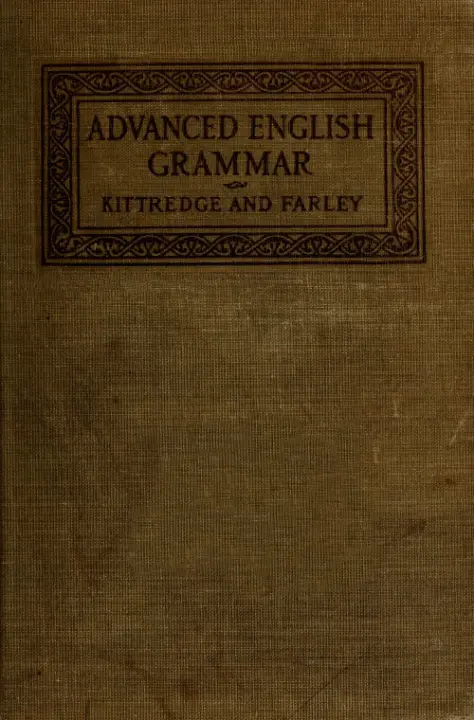
THE CLASSIC COLLECTION · 1913
"An Advanced English Grammar with Exercises" by George Lyman Kittredge and Frank Edgar Farley is an educational grammar textbook written in the early 20th century. This comprehensive guide aims to enhance students' understanding of English grammar, focusing on various elements such as parts of speech, inflections, and syntax. It is designed for learners who have a foundational knowledge of English and seeks to provide in-depth insights into sentence structure, grammatical rules, and usage. The opening of the text presents a clear structure for the book, beginning with a preface that outlines the organization of its content into distinct parts covering the essentials of English grammar. It sets the stage for a systematic study that includes both definitions and examples of various grammatical components and their functions within sentences. Additionally, the introduction emphasizes the relationship between language, thought, and grammar, establishing a foundational understanding of how grammar serves as a framework for effective communication. This portion effectively presents both the purpose of the text and the strategic approach it will take in facilitating advanced English grammar learning.
Introduction adapted from the source catalogue; source summaries may be automatically generated.
Free to read · English · 100,928 words · No account needed
MAKE TIME FOR A GOOD BOOK
On by default. Untick to stop anonymous reading totals. Each page counts after 10 seconds in view. How this works.
Anonymous counting is on unless you have switched it off.
Economics is an important study.
The gallows has been abolished in Massachusetts.
In some words usage varies. Thus, pains, in the sense of care or effort, is sometimes regarded as a singular and sometimes as a plural.
Great pains has (or have) been taken about the matter.
+229.+ +Collective nouns+ take sometimes a singular and sometimes a
plural verb.
When the persons or things denoted are thought of as +individuals+, the plural should be used. When the collection is regarded as a +unit+, the singular should be used.[33]
1. The Senior Class requests the pleasure of your company. [Here the class is thought of +collectively+, acting as a unit.]
2. The Senior Class are unable to agree upon a president. [Here the speaker has in mind the +individuals+ of whom the class is composed.]
3. The nation welcomes Prince Joseph. [The whole nation unites as a single individual to welcome a distinguished guest.]
4. The American nation are descended from every other nation on earth. [The separate qualities of the individuals who constitute the nation are in the speaker’s mind.]
+230.+ A number in the sense of “several” or “many” regularly takes the plural; the number takes the singular.
A number of sailors were loitering on the pier.
The number of tickets is limited.
+231.+ Half, part, portion, and the like, take either the singular or the plural according to sense.
Half of a circle is a semicircle.
Half of the passengers were lost.
+232.+ A verb which has for its subject a +relative pronoun+ is in the same person and number as the antecedent. For examples, see § 149.
Errors are especially common in such sentences as,--
This is one of the strangest sights that ever were seen. [The antecedent of that is sights (not one); hence the relative (that) is plural, and accordingly the verb is plural (were, not was).]
Mr. Winn’s oration was among the most eloquent that have [NOT has] been delivered in this state for many years.
This is one of the finest paintings there are in the hall. [For the omission of the relative, see § 151.]
+233.+ The +future tense+ is a verb-phrase consisting of the auxiliary verb shall or will followed by the infinitive without to (§ 29).
The following table shows the form of the +future+ for each of the three persons (1) in +assertions+ and (2) in +questions+:--
SINGULAR PLURAL
1. I shall fall. 1. We shall fall.
2. Thou wilt fall. 2. You will fall.
3. He will fall. 3. They will fall.
SINGULAR PLURAL
1. Shall I fall? 1. Shall we fall?
2. Shalt thou fall? 2. Shall you fall?
3. Will he fall? 3. Will they fall?
Your reading position is saved on this browser. Take it to another device with a library code. Reading pages adapt to text, rather than matching a printed edition.
BEHIND THE BOOK
This eBook is for the use of anyone anywhere in the United States and most other parts of the world at no cost and with almost no restrictions whatsoever. You may copy it, give it away or re-use it under the terms of the Project Gutenberg License included with this eBook or online at www.gutenberg.org. If you are not located in the United States, you will have to check the laws of the country where you are located before using this eBook. Read the source licence.
The original source file, including credits and licence, is retained by this library. Request an original-format copy at no charge. Please include the book title and Project Gutenberg identifier #45814.
KEEP YOUR CURIOSITY GOING

Charles G. (Charles Griffith) Ross
Hannah Webster Foster

Emily Lawless
Edwin Hamlin Carr

Charles De Lano Hine
Andrew Ure