THE CLASSIC COLLECTION✦Notes on witchcraftCLASSIC FREE BOOKS
Notes on witchcraft
George Lyman Kittredge
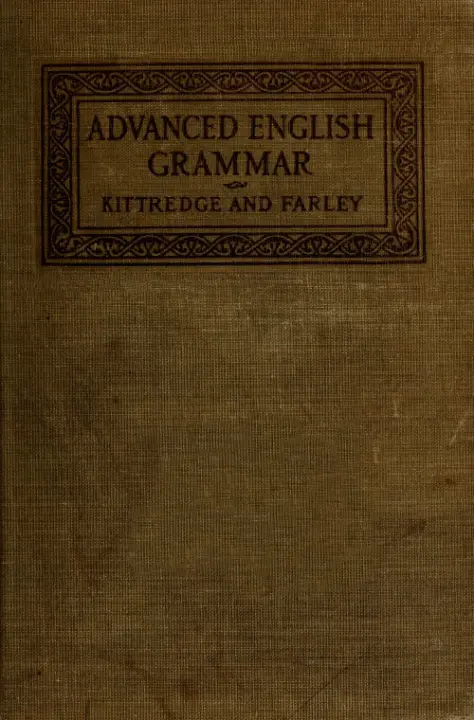
THE CLASSIC COLLECTION · 1913
"An Advanced English Grammar with Exercises" by George Lyman Kittredge and Frank Edgar Farley is an educational grammar textbook written in the early 20th century. This comprehensive guide aims to enhance students' understanding of English grammar, focusing on various elements such as parts of speech, inflections, and syntax. It is designed for learners who have a foundational knowledge of English and seeks to provide in-depth insights into sentence structure, grammatical rules, and usage. The opening of the text presents a clear structure for the book, beginning with a preface that outlines the organization of its content into distinct parts covering the essentials of English grammar. It sets the stage for a systematic study that includes both definitions and examples of various grammatical components and their functions within sentences. Additionally, the introduction emphasizes the relationship between language, thought, and grammar, establishing a foundational understanding of how grammar serves as a framework for effective communication. This portion effectively presents both the purpose of the text and the strategic approach it will take in facilitating advanced English grammar learning.
Introduction adapted from the source catalogue; source summaries may be automatically generated.
Free to read · English · 100,928 words · No account needed
MAKE TIME FOR A GOOD BOOK
On by default. Untick to stop anonymous reading totals. Each page counts after 10 seconds in view. How this works.
Anonymous counting is on unless you have switched it off.
The tendency in modern English has been to confine the form without ending to the adjective use and to restrict the adverbial function to forms in -ly. Thus, a writer of the present time would not say, in prose, “The fire burns hot,” but “The fire burns hotly.” Nevertheless, a number of the old adverbs without ending still remain in good use, and must not be regarded as erroneous.
In poetry, moreover, such adverbs are freely employed; as,--“The boy like a gray goshawk stared wild.” [In prose: stared wildly.]
For adverbial phrases, see §§ 41–42, 475.
For the adverbial objective, see § 109.
+192.+ Yes and no are peculiar adverbs used in assenting and
denying. Thus,--
Are you hungry?
No.
NOTE. As now used, yes and no stand for complete sentences. Originally, however, they were modifiers, and hence they are still classed as adverbs. The original meaning of no was “never.” Compare never as an emphatic negative in modern English: as,--“Will you surrender?” “Never!” The oldest affirmative adverb was yea. Yes was originally a compound of yea with a form of so, and was used in emphatic affirmatives (like our just so!).
Other adverbs or adverbial phrases are sometimes used like yes or no. Such are certainly, assuredly, by no means, not at all. In these cases, however, the modifying effect of the word or phrase may easily be seen when the sentence is supplied. Thus,--“Will you help me?” “Certainly [I will help you].”
+193.+ There is often used merely to introduce a sentence in the
inverted order (§ 5).
There is a hole in my shoe.
There are many strangers in town.
There rose a thick smoke from the volcano.
In this use, there is sometimes called an +expletive+ (or “filler”). It is unemphatic, and has lost all its force as an adverb of place. Contrast “THERE [emphatic] stood an Indian under a tree” with, “There [unemphatic expletive] stood an Indian under a tree.”
+194.+ +Relative adverbs introduce subordinate clauses and are similar in their use to relative pronouns.+
I know a farmhouse {in which | where} we can spend the night.
Where is an adverb of place, modifying can spend. But it also introduces the subordinate clause, as the relative pronoun which does. Hence where is called a +relative adverb+.
+195.+ The principal relative adverbs are:--where, whence, whither, wherever, when, whenever, while, as, how, why, before, after, till, until, since.
Because of their similarity to conjunctions, these words are often called +conjunctive adverbs+.
He had a fever when he was in Spain.
Work while it is day.
As the ship passed, we observed that her decks were crowded with
Malays. [Time.]
Your reading position is saved on this browser. Take it to another device with a library code. Reading pages adapt to text, rather than matching a printed edition.
BEHIND THE BOOK
This eBook is for the use of anyone anywhere in the United States and most other parts of the world at no cost and with almost no restrictions whatsoever. You may copy it, give it away or re-use it under the terms of the Project Gutenberg License included with this eBook or online at www.gutenberg.org. If you are not located in the United States, you will have to check the laws of the country where you are located before using this eBook. Read the source licence.
The original source file, including credits and licence, is retained by this library. Request an original-format copy at no charge. Please include the book title and Project Gutenberg identifier #45814.
KEEP YOUR CURIOSITY GOING

Charles G. (Charles Griffith) Ross
Hannah Webster Foster

Emily Lawless
Edwin Hamlin Carr

Charles De Lano Hine
Andrew Ure