THE CLASSIC COLLECTION✦My diaries, being a personal narrative of events 1888-1914, Part 2 (1900-1914)CLASSIC FREE BOOKS
My diaries, being a personal narrative of events 1888-1914, Part 2 (1900-1914)
Wilfrid Scawen Blunt
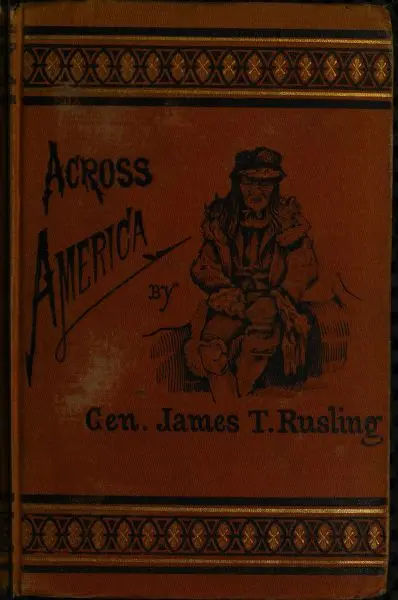
THE CLASSIC COLLECTION · 1874
"Across America; Or, The Great West and the Pacific Coast" by James Fowler Rusling is a historical account written in the mid-19th century. The work details the author's extensive journey across America, specifically focusing on the exploration and inspection of military posts from Fort Leavenworth to the Pacific Coast, including his observations of the people, landscapes, and changing cultures he encounters along the way. At the start of the narrative, Rusling sets the stage for his journey with a description of his orders to inspect various military posts in the West following the Civil War. He describes the logistical aspects of his travels, including the modes of transportation, the people he travels with, and his initial impressions of the landscapes he traverses. The opening chapters cover his departure from New York, passage through multiple states, and his encounter with both settlers and Indigenous peoples, illustrating the rich and often challenging realities of the American frontier during that era. The author employs a vivid and engaging style, inviting readers into the world of 1866 America as he navigates varied terrains and unfamiliar cultures.
Introduction adapted from the source catalogue; source summaries may be automatically generated.
Free to read · English · 147,892 words · No account needed
MAKE TIME FOR A GOOD BOOK
On by default. Untick to stop anonymous reading totals. Each page counts after 10 seconds in view. How this works.
Anonymous counting is on unless you have switched it off.
Prescott had been described to us, as resembling very much a "New England village." We were told so in San Francisco. It was repeated at Fort Yuma. It was hinted at Tucson. Well, perhaps, it did, except as regards school-houses and churches, white paint and green blinds, general thriftiness, and a wholesome respect for law and order. Eliminating these, Prescott, perhaps, was quite New-Englandish; but, otherwise, it resembled rather some country cross-roads in Missouri, or Arkansas. In brief, there was not a school-house, or church, or bank, in the place. Business we found at a general stand-still, because of absolute stagnation among the mines. And the peaceable and quiet population had just shown their New-Englandlike disposition, by robbing and beating a squad of United States soldiers--a part of those recently sent out better to protect that region--mortally wounding one, and severely injuring several others. Of course, the Blue-Coats were off duty, or the cowards wouldn't have assailed them.
Said I to an old acquaintance I met, an ex-Army of the Potomac officer:
"I hear you have quite a New England village here?"
"Yes, indeed, it is very New-Englandlike! Last night I was in our billiard-saloon here. A game of monte was going on in one corner, brag-poker in another, and a couple of dogs were having a free fight under the billiard-table. I lived in Boston once for some time, but have no recollection of seeing anything exactly like that!"
"But you have a good class of population, have you not, as a general
thing?"
"O yes! Excellent! Less than five hundred, altogether! But we have ten drinking-saloons, and a dozen gambling-hells, more or less! What kind of a population that implies, judge for yourself!"
I think my friend was, perhaps, somewhat prejudiced. He had, probably, invested in mining "feet," and found out he had made a "permanent investment," with slight prospect of "dividends." Nevertheless, Prescott had been much overrated and bepraised, and, consequently, suffered somewhat in the estimation of strangers. We found it well laid-out, on a scale of Magnificent Distances, like its illustrious prototype, the National Capital, and lacking only--buildings and people to be a fine city. Its site, though nearly six thousand feet above the sea, is a good one, along the undulating bottoms of Granite Creek, about a mile or so from Fort Whipple, then the chief military-post in northern Arizona. Its houses were grouped mostly around a spacious plaza, after the old Spanish custom, though a few straggled off into ragged streets either way. They were chiefly of logs and rough lumber, and guiltless of paint, though some brick and adobe structures appeared here and there. The population seemed to be between four and five hundred. The autumn previous, it had been largely increased by a notable immigration from Montana, which came to Prescott with the expectation of finding rich placer mines, from what they had seen published about the region. But the most of these had already left, cruelly disappointed, and others would follow, if they had the means. The barber, who shaved me one day, proved to be a Montanian, from Helena City. I asked him, casually, what he thought of Arizona.
Your reading position is saved on this browser. Take it to another device with a library code. Reading pages adapt to text, rather than matching a printed edition.
BEHIND THE BOOK
This eBook is for the use of anyone anywhere in the United States and most other parts of the world at no cost and with almost no restrictions whatsoever. You may copy it, give it away or re-use it under the terms of the Project Gutenberg License included with this eBook or online at www.gutenberg.org. If you are not located in the United States, you will have to check the laws of the country where you are located before using this eBook. Read the source licence.
The original source file, including credits and licence, is retained by this library. Request an original-format copy at no charge. Please include the book title and Project Gutenberg identifier #42706.
KEEP YOUR CURIOSITY GOING
Wilfrid Scawen Blunt
Wilfrid Scawen Blunt

E. W. (Edgar Watson) Howe
Cécile Tormay

Moritz Busch
John L. Ransom