THE CLASSIC COLLECTION✦My diaries, being a personal narrative of events 1888-1914, Part 2 (1900-1914)CLASSIC FREE BOOKS
My diaries, being a personal narrative of events 1888-1914, Part 2 (1900-1914)
Wilfrid Scawen Blunt
THE CLASSIC COLLECTION · 1874
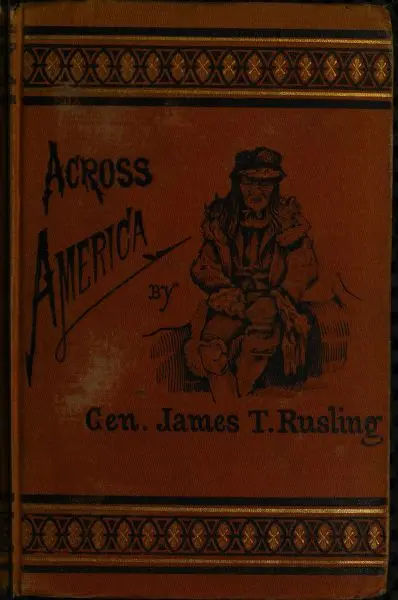
"Across America; Or, The Great West and the Pacific Coast" by James Fowler Rusling is a historical account written in the mid-19th century. The work details the author's extensive journey across America, specifically focusing on the exploration and inspection of military posts from Fort Leavenworth to the Pacific Coast, including his observations of the people, landscapes, and changing cultures he encounters along the way. At the start of the narrative, Rusling sets the stage for his journey with a description of his orders to inspect various military posts in the West following the Civil War. He describes the logistical aspects of his travels, including the modes of transportation, the people he travels with, and his initial impressions of the landscapes he traverses. The opening chapters cover his departure from New York, passage through multiple states, and his encounter with both settlers and Indigenous peoples, illustrating the rich and often challenging realities of the American frontier during that era. The author employs a vivid and engaging style, inviting readers into the world of 1866 America as he navigates varied terrains and unfamiliar cultures.
Introduction adapted from the source catalogue; source summaries may be automatically generated.
Free to read · English · 147,892 words · No account needed
MAKE TIME FOR A GOOD BOOK
On by default. Untick to stop anonymous reading totals. Each page counts after 10 seconds in view. How this works.
Anonymous counting is on unless you have switched it off.
As already intimated, we found the Gila very high and still rising. In several places, it had just washed the banks away, destroying the road, and we had to pick our way across the bottoms, through the chemisal and mesquite, to the connecting part, the best we could. In this way, it seems, its channel is constantly shifting, and this was said to be one of the chief drawbacks to constructing acequias, and cultivating its fine bottom lands by irrigation. The head of an acequia to-day, tapping the river well, a month hence may be three feet or more out of water, and then all the work of excavating ditches, damming the river, etc., has to be done over again. The bed of the Gila itself, in the main, seems to be pure quicksand. At one point, a station-keeper showed us where a year before piles had been driven down fifty feet, in making a wing-dam to divert a portion of the river into an acequia; but at the first freshet, the cross currents had underbored everything, and left the head of the acequia high and dry. No doubt the river-bottoms are all exceedingly fertile, and would produce well, if irrigated; but not otherwise. Of these, there is a considerable breadth, at many points along the Gila, and, here and there, there had been some attempts at cultivation, but scarcely any worth mentioning.
These bottoms nearly everywhere abound with bunch-grass and mesquite-timber--the one the delight of horses and cattle, the other invaluable in that treeless region. The mesquite has but little height; but its trunk is often two and three feet in diameter, though only about as many high, from which point it throws out great, sturdy, black, gnarled limbs for a distance of thirty or forty feet all around. We saw many of them, that I think could not have been more than five or six feet in height, the bend of the branches included; nevertheless, with their crooked and gnarled limbs, they sprawled over the ground for a diameter of fully seventy-five or one hundred feet. At first they strike you as dwarfs, puny in aspect and purpose; but afterwards, as stunted giants, massive in strength and power, writhing in very anguish, because unable to tower higher. For lumber purposes, the mesquite amounts to but little; but for fuel, it is invaluable, and the future settlers on the Gila will prize it highly. It occurs pretty much all through Arizona, on the best river-bottoms, and everywhere seems a providential institution. It makes a fire-wood scarcely inferior to oak or hickory, and bears a bean besides, which constitutes a large part of the subsistence of the Mexicans and the Indians there. These mesquite beans make a very sweet and palatable dish, and horses, mules, cattle, etc. are especially fond of them. The Mexicans we met en route to California, were subsisting upon them almost entirely, and subsequently in wandering through a Pimo village, we found them in every storehouse. A Pimo belle, for a bundle of cigarritos, cooked us a dish of them, and we have eaten worse things in New York and Washington. Said an old Arizonian one day, "Wherever you see mesquites, strangers, look out for good land, you bet!" and we found it so invariably. Indeed, with a moderate amount of enterprise, and a small amount of capital, we saw no good reason why the valley of the Gila should not eventually be dotted with excellent farms. The land is all there, and plenty of water to irrigate it (if only the Gila can be subdued, and surely it can), and the climate the year round must be delicious. But, as a rule, we found the country desolate and forsaken, with the exception of a starving ranch here and there, whose dirty and dilapidated proprietor cared more to swear at his snarling half-cayote dogs, and sell an occasional glass of mescal or whiskey, than to do an honest hard day's work. The truth is, the most of these settlers, as well as too many throughout Arizona generally, were exiles or emigrants from Arkansas and Texas, with little in them of the kind of stuff that founds states and builds empires. They knew how to drink, and swear, and "shoot a Red Skin, sir, on sight;" but were strangers to honest toil and steady industry, and therefore missed their logical and golden fruits--prosperity and thrift. Of course, like all such everywhere, they were opposed to "Chinese cheap labor;" and, like the good William Nye, hated the "Heathen Chinee," even worse than the negro.
Your reading position is saved on this browser. Take it to another device with a library code. Reading pages adapt to text, rather than matching a printed edition.
BEHIND THE BOOK
This eBook is for the use of anyone anywhere in the United States and most other parts of the world at no cost and with almost no restrictions whatsoever. You may copy it, give it away or re-use it under the terms of the Project Gutenberg License included with this eBook or online at www.gutenberg.org. If you are not located in the United States, you will have to check the laws of the country where you are located before using this eBook. Read the source licence.
The original source file, including credits and licence, is retained by this library. Request an original-format copy at no charge. Please include the book title and Project Gutenberg identifier #42706.
KEEP YOUR CURIOSITY GOING
Wilfrid Scawen Blunt
Wilfrid Scawen Blunt

E. W. (Edgar Watson) Howe
Cécile Tormay

Moritz Busch
John L. Ransom