THE CLASSIC COLLECTION✦My diaries, being a personal narrative of events 1888-1914, Part 2 (1900-1914)CLASSIC FREE BOOKS
My diaries, being a personal narrative of events 1888-1914, Part 2 (1900-1914)
Wilfrid Scawen Blunt
THE CLASSIC COLLECTION · 1874
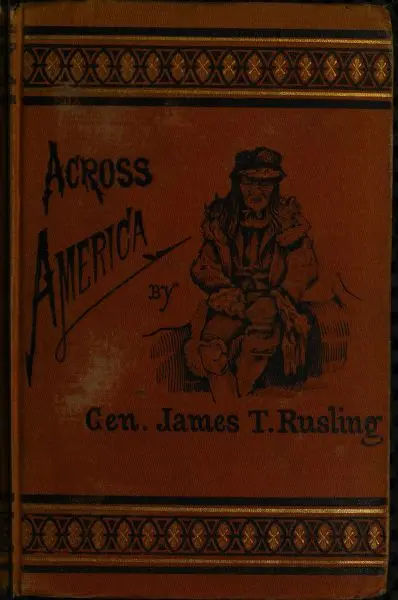
"Across America; Or, The Great West and the Pacific Coast" by James Fowler Rusling is a historical account written in the mid-19th century. The work details the author's extensive journey across America, specifically focusing on the exploration and inspection of military posts from Fort Leavenworth to the Pacific Coast, including his observations of the people, landscapes, and changing cultures he encounters along the way. At the start of the narrative, Rusling sets the stage for his journey with a description of his orders to inspect various military posts in the West following the Civil War. He describes the logistical aspects of his travels, including the modes of transportation, the people he travels with, and his initial impressions of the landscapes he traverses. The opening chapters cover his departure from New York, passage through multiple states, and his encounter with both settlers and Indigenous peoples, illustrating the rich and often challenging realities of the American frontier during that era. The author employs a vivid and engaging style, inviting readers into the world of 1866 America as he navigates varied terrains and unfamiliar cultures.
Introduction adapted from the source catalogue; source summaries may be automatically generated.
Free to read · English · 147,892 words · No account needed
MAKE TIME FOR A GOOD BOOK
On by default. Untick to stop anonymous reading totals. Each page counts after 10 seconds in view. How this works.
Anonymous counting is on unless you have switched it off.
But a few years before, it was a common thing for ships to go East empty or in ballast, for want of a return cargo; but in 1867 San Francisco shipped grain alone to the amount of thirteen millions of dollars, and of manufactures about as much more. Here are some other statistics that are worth one's considering. In 1849, then called Yerba Buena, she numbered perhaps 1,000 souls, all told; in 1869, nearly 200,000. In 1868, 59,000 passengers arrived by sea, and only 25,000 departed, leaving a net gain of 34,000. The vessels which entered the bay that year, numbered 3,300, and measured over 1,000,000 tons. She exported 4,000,000 sacks of wheat that year, and half a million barrels of flour. Her total exports of all kinds were estimated at not less than $70,000,000, and her imports about the same. Her sales of real-estate aggregated $27,000,000, and of mining and other stocks $115,000,000, on which she paid over $5,000,000 of dividends. The cash value of her real and personal property was estimated at $200,000,000. She sent away six tons of gold, and forty tons of silver every month, and in all since 1849 had poured into the coffers of the world not less than $1,030,000,000.[15] Her net-work of far-reaching and gigantic enterprises already embraced the whole Pacific Coast, northward to Alaska and southward to Panama, while beyond she stretched out her invisible arms to Japan and China, and shook hands with the Orient.
One cloudless morning, after days of dismal drizzle, an enthusiastic Forty-Niner took me up Telegraph Hill, and bade me "view the landscape o'er!" I remembered when a school-boy reading Dana's "Two Years before the Mast," in which he speaks so contemptuously of Yerba Buena, and its Mexican Rip Van Winkles. What a change here since then! Off to the west rolled the blue Pacific, sea and sky meeting everywhere. Then came Fort Point, with its formidable batteries, commanding the Golden Gate; and then the old Presidio, with the stars and stripes waving over it. Farther inland were the stunted live-oaks and gleaming marbles of Lone Mountain Cemetery, with the Broderick Monument rising over all. Then came the live, busy, bustling, pushing city, with its quarter of a million of inhabitants nearly, soon to be a million, its wharves thronged with the ships of all nations, but with harbor-room to spare sufficient to float the navies of the world. Beyond, lay Oakland, loveliest of suburbs, smiling in verdure and beauty, with Mount Diabolo towering in the distance--his snow-crowned summit flashing in the sunlight. The Sacramento and Stockton boats, from the heart of California were already in. Past the Golden Gate, and up the noble bay, with boom of welcoming cannon, came the Hong Kong steamer fresh from Japan. The Panama steamer, with her fires banked and flag flying, was just ready to cast off. While off to the south, a long train of cars, from down the bay and San Josè, came thundering in. A hundred church spires pierced the sky; the smoke from numberless mills and factories, machine-shops and foundries, drifted over the harbor; the horse-car bells tinkled on every side--the last proofs of American progress--and all around us were the din and boom of Yankee energy, and thrift, and go-ahead-ative-ness, in place of the old Rip Van Winkleism. I don't wonder, that all good Pacific Coasters believe in San Francisco, and expect to go there when they die! Her hotels, her school-houses, her churches, her Bank of California, her Wells-Fargo Express, her Mission Woollen Mills, her lines of ocean steam-ships, and a hundred other things, all suggest great wealth and brains; and yet they are only the first fruits of nobler fortune yet to come. She is what Carlyle might call an undeniable fact, a substantial verity; and, in spite of her "heavy job of work," moves onward to empire with giant strides. She contained already fully a third of the population of the whole state of California, and was "lifting herself up like a young lion" in all enterprises--at all times and everywhere--on the Pacific slope.
Your reading position is saved on this browser. Take it to another device with a library code. Reading pages adapt to text, rather than matching a printed edition.
BEHIND THE BOOK
This eBook is for the use of anyone anywhere in the United States and most other parts of the world at no cost and with almost no restrictions whatsoever. You may copy it, give it away or re-use it under the terms of the Project Gutenberg License included with this eBook or online at www.gutenberg.org. If you are not located in the United States, you will have to check the laws of the country where you are located before using this eBook. Read the source licence.
The original source file, including credits and licence, is retained by this library. Request an original-format copy at no charge. Please include the book title and Project Gutenberg identifier #42706.
KEEP YOUR CURIOSITY GOING
Wilfrid Scawen Blunt
Wilfrid Scawen Blunt

E. W. (Edgar Watson) Howe
Cécile Tormay

Moritz Busch
John L. Ransom