THE CLASSIC COLLECTION✦My diaries, being a personal narrative of events 1888-1914, Part 2 (1900-1914)CLASSIC FREE BOOKS
My diaries, being a personal narrative of events 1888-1914, Part 2 (1900-1914)
Wilfrid Scawen Blunt
THE CLASSIC COLLECTION · 1874
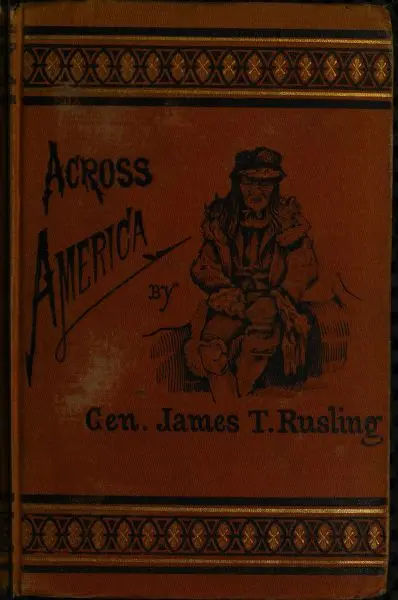
"Across America; Or, The Great West and the Pacific Coast" by James Fowler Rusling is a historical account written in the mid-19th century. The work details the author's extensive journey across America, specifically focusing on the exploration and inspection of military posts from Fort Leavenworth to the Pacific Coast, including his observations of the people, landscapes, and changing cultures he encounters along the way. At the start of the narrative, Rusling sets the stage for his journey with a description of his orders to inspect various military posts in the West following the Civil War. He describes the logistical aspects of his travels, including the modes of transportation, the people he travels with, and his initial impressions of the landscapes he traverses. The opening chapters cover his departure from New York, passage through multiple states, and his encounter with both settlers and Indigenous peoples, illustrating the rich and often challenging realities of the American frontier during that era. The author employs a vivid and engaging style, inviting readers into the world of 1866 America as he navigates varied terrains and unfamiliar cultures.
Introduction adapted from the source catalogue; source summaries may be automatically generated.
Free to read · English · 147,892 words · No account needed
MAKE TIME FOR A GOOD BOOK
On by default. Untick to stop anonymous reading totals. Each page counts after 10 seconds in view. How this works.
Anonymous counting is on unless you have switched it off.
We reached the mouth of the Columbia, the same evening; but Capt. Conner thought it risky to venture over the bar, until morning. The next morning early, we lifted anchor, and steamed down to Astoria--a higgledy-piggledy village, of only four or five hundred inhabitants still, though begun long before prosperous Portland. Her anchorage seemed fair; but ashore the land abounded in a congeries of wooded bluffs and ridges, that evidently made a town or farms there difficult, if not impossible. A short street or two of straggling houses, propped along the hillsides, was about all there was of Astoria; and yet she was a port of entry, with a custom-house and full corps of officials, while Portland with all her enterprise and commerce was not, and could not get to be. What her custom-officials would have to do, were it not for the business of Portland, it seemed pretty hard to say. A venture of John Jacob Astor's a half century before, as a trading post with the Indians, she had never become of much importance, because lacking a good back country; and it appeared, had no future now, because wanting a good town-site. This was unfortunate perhaps for Oregon, and the whole Columbia region; but over it Portland rejoiced, and continued to wax fat.
Of course, it had begun to rain again, and by the time we had passed the ordeal of the custom-house at Astoria, the weather had thickened up into a drizzly fog, that caused Capt. C. much anxiety--especially, when he observed the barometer steadily going down. The bar of the Columbia, always bad, is peculiarly rough in winter, and only the voyage before the Oriflamme had to lay to here, nearly a week, unable to venture out. Her provisions became exhausted, and she had to "clean out" Astoria, and all the farm-houses up and down the river for miles, before she finally got away. Our company of four hundred passengers had no fancy for an experience of this sort, and "dirty" as the weather promised to be, Capt. C. at last decided to try the bar, even if we had to return, hoping to find better skies when fairly afloat in blue water. Our engines once in motion, we soon ran down past Forts Stevens and Cape Disappointment, at the mouth of the Columbia, on the Oregon and Washington sides respectively, with the black throats of their heavy cannon gaping threateningly at us. Both forts seem necessary there, as they completely command the mouth of the Columbia, and so hold the key to all that region. But life in them must be an almost uninterrupted series of rains and fogs, with the surf forever thundering at your feet, and one can but pity the officers and men really exiled there. Gathered about the flag-staff or lounging along the ramparts, they gazed wistfully at us as we steamed past; and already in the distance we could see the white-caps, racing in over the dreaded bar. Heading for the north channel, we put all steam on, and once out of the jaws of the Columbia were soon fairly a-dancing on the bar. The wind and tide both strong, were both dead ahead, which made our exit about as bad, as could well be. The sea went hissing by, or broke into huge white-caps all about us. The engines creaked and groaned, and at times seemed to stand still, as if exhausted with the struggle. The good ship Oriflamme pitched and tossed, battling with the waves like a practiced pugilist, yet ever advanced, though sometimes apparently drifting shoreward. At one period, indeed, Capt. C. feared we would have to about ship and run for the Columbia--we progressed so slowly; but something of a lull in the wind just then helped us on, and at last we saw by the receding head-lands, that we were fairly over the bar and out into the broad Pacific. We congratulated ourselves in thus getting speedily to sea; but our tussle on the bar had been too much for the majority of our passengers, and soon our bulwarks were thronged with scores "casting up their accounts" with Father Neptune. Sea-sickness, that deathliest of all human ailments, had set in, and our "rough and tumble" with the waves had been so sharp, that many began to suffer from it, who declared they had never been attacked before. A notable New Yorker, a brawny son of Æsculapius at that, bravely protested, that sea-sickness was "Only a matter of the imagination. Anyone can overcome it. It only requires a vigorous exercise of the will." But, unfortunately for his theory, soon afterwards he himself became the sickest person on board, not excepting the ladies. My own experience ended with a qualm or two; but the majority of our passengers suffered very much, for several days. Our steamer really had accommodations for only about one hundred passengers; but some four hundred had crowded aboard of her at Portland, mostly miners eager to get "below" to winter, and those who had no state-rooms now "roughed it" pitiably. They lay around loose--on deck, in the cabin, in the gang-way, everywhere--the most disconsolate-looking fellows I ever saw, outside of a yellow-fever hospital. The few ladies aboard were even sicker; but these all had state-rooms, and kept them mostly for the voyage.
Your reading position is saved on this browser. Take it to another device with a library code. Reading pages adapt to text, rather than matching a printed edition.
BEHIND THE BOOK
This eBook is for the use of anyone anywhere in the United States and most other parts of the world at no cost and with almost no restrictions whatsoever. You may copy it, give it away or re-use it under the terms of the Project Gutenberg License included with this eBook or online at www.gutenberg.org. If you are not located in the United States, you will have to check the laws of the country where you are located before using this eBook. Read the source licence.
The original source file, including credits and licence, is retained by this library. Request an original-format copy at no charge. Please include the book title and Project Gutenberg identifier #42706.
KEEP YOUR CURIOSITY GOING
Wilfrid Scawen Blunt
Wilfrid Scawen Blunt

E. W. (Edgar Watson) Howe
Cécile Tormay

Moritz Busch
John L. Ransom