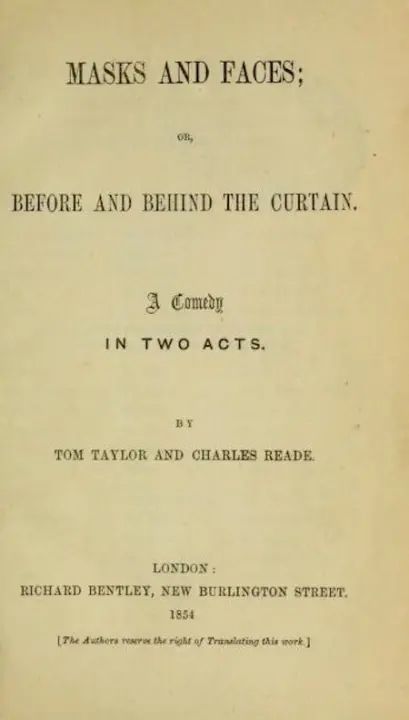
Masks and Faces; or, Before and Behind the Curtain: A Comedy in Two Acts
Tom Taylor & Charles Reade
THE CLASSIC COLLECTION · 1863
"A Simpleton" by Charles Reade is a novel written during the late 19th century. The story centers around a young lady named Rosa Lusignan and her romantic entanglements, particularly with a dedicated physician, Dr. Christopher Staines, and the societal constraints they face. Set against the backdrop of evolving notions of love and marriage, the book explores themes of class, gender roles, and the complexities of human relationships. The beginning of the novel introduces us to Rosa, who is anxiously waiting for Dr. Staines while engaged in an unproductive sewing project. We learn about her beauty and her various skills, but also her dissatisfaction with her current life. The scene shifts when Dr. Staines arrives, highlighting their budding romance filled with youthful hopes and aspirations. However, complications arise when Rosa's father, Mr. Lusignan, disapproves of their relationship due to Dr. Staines' lack of financial security. The unfolding drama captures Rosa's emotional journey, further complicated by health issues and societal expectations, setting the stage for conflicts and dilemmas that will resonate throughout the novel.
Introduction adapted from the source catalogue; source summaries may be automatically generated.
Free to read · English · 130,713 words · No account needed
MAKE TIME FOR A GOOD BOOK
On by default. Untick to stop anonymous reading totals. Each page counts after 10 seconds in view. How this works.
Anonymous counting is on unless you have switched it off.
Instantly some dealer, one of the hook-nosed that gathered round each lot as it came to the foot of the table, cried “Eighteen shillings.”
“Nineteen,” said Rosa.
“A guinea,” said the dealer.
“Don't let it go,” said the broker behind her. “Don't let it go, ma'am.”
She colored at the intrusion, and left off bidding directly, and addressed herself to Mrs. Cole. “Why should I give so much, when the last were sold for fifteen shillings?”
The real reason was that the first lot was not bid for at all, except by the proprietor. However, the broker gave her a very different solution; he said, “The trade always run up a lady or a gentleman. Let me bid for you; they won't run me up; they know better.”
Rosa did not reply, but looked at Mrs. Cole.
“Yes, dear,” said that lady; “you had much better let him bid for you.”
“Very well,” said Rosa; “you can bid for this chest of drawers--lot 25.”
When lot 25 came on, the broker bid in the silliest possible way, if his object had been to get a bargain. He began to bid early and ostentatiously; the article was protected by somebody or other there present, who now of course saw his way clear; he ran it up audaciously, and it was purchased for Rosa at about the price it could have been bought for at a shop.
The next thing she wanted was a set of oak chairs.
They went up to twenty-eight pounds; then she said, “I shall give no
more, sir.”
“Better not lose them,” said the agent; “they are a great bargain;” and bid another pound for her on his own responsibility.
They were still run up, and Rosa peremptorily refused to give any more. She lost them, accordingly, by good luck. Her faithful broker looked blank; so did the proprietor.
But, as the sale proceeded, she being young, the competition, though most of it sham, being artful and exciting, and the traitor she employed constantly puffing every article, she was drawn in to wishing for things, and bidding by her feelings.
Then her traitor played a game that has been played a hundred times, and the perpetrators never once lynched, as they ought to be, on the spot. He signalled a confederate with a hooked nose; the Jew rascal bid against the Christian scoundrel, and so they ran up the more enticing things to twice their value under the hammer.
Rosa got flushed, and her eye gleamed like a gambler's, and she bought away like wildfire. In which sport she caught sight of an old gentleman, with little black eyes that kept twinkling at her.
Your reading position is saved on this browser. Take it to another device with a library code. Reading pages adapt to text, rather than matching a printed edition.
Tom Taylor & Charles Reade
Charles Reade
Charles Reade
Charles Reade
BEHIND THE BOOK
This eBook is for the use of anyone anywhere in the United States and most other parts of the world at no cost and with almost no restrictions whatsoever. You may copy it, give it away or re-use it under the terms of the Project Gutenberg License included with this eBook or online at www.gutenberg.org. If you are not located in the United States, you will have to check the laws of the country where you are located before using this eBook. Read the source licence.
The original source file, including credits and licence, is retained by this library. Request an original-format copy at no charge. Please include the book title and Project Gutenberg identifier #2301.
KEEP YOUR CURIOSITY GOING
Coulson Kernahan

Maurice Baring
Frances Wright
Cécile Tormay

Frederic Jesup Stimson

W. H. P. (William Henry Pope) Jarvis