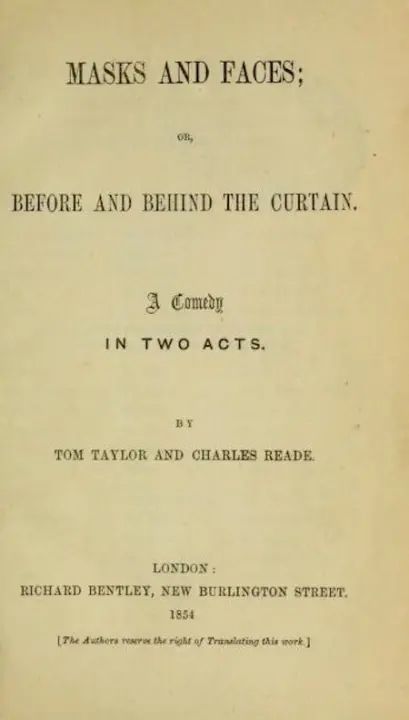
Masks and Faces; or, Before and Behind the Curtain: A Comedy in Two Acts
Tom Taylor & Charles Reade
THE CLASSIC COLLECTION · 1863
"A Simpleton" by Charles Reade is a novel written during the late 19th century. The story centers around a young lady named Rosa Lusignan and her romantic entanglements, particularly with a dedicated physician, Dr. Christopher Staines, and the societal constraints they face. Set against the backdrop of evolving notions of love and marriage, the book explores themes of class, gender roles, and the complexities of human relationships. The beginning of the novel introduces us to Rosa, who is anxiously waiting for Dr. Staines while engaged in an unproductive sewing project. We learn about her beauty and her various skills, but also her dissatisfaction with her current life. The scene shifts when Dr. Staines arrives, highlighting their budding romance filled with youthful hopes and aspirations. However, complications arise when Rosa's father, Mr. Lusignan, disapproves of their relationship due to Dr. Staines' lack of financial security. The unfolding drama captures Rosa's emotional journey, further complicated by health issues and societal expectations, setting the stage for conflicts and dilemmas that will resonate throughout the novel.
Introduction adapted from the source catalogue; source summaries may be automatically generated.
Free to read · English · 130,713 words · No account needed
MAKE TIME FOR A GOOD BOOK
On by default. Untick to stop anonymous reading totals. Each page counts after 10 seconds in view. How this works.
Anonymous counting is on unless you have switched it off.
Mrs. Staines made one or two movements--to stop Lord Tadcaster--with her hand, that expressive feature with which, at such times, a sensitive woman can do all but speak.
When at last he paused for her reply, she said, “Me marry again! Oh! for
shame!”
“Mrs. Staines--Rosa--you will marry again, some day.”
“Never. Me take another husband, after such a man as I have lost! I should be a monster. Oh, Lord Tadcaster, you have been so kind to me; so sympathizing. You made me believe you loved my Christopher, too; and now you have spoiled all. It is too cruel.”
“Oh! Mrs. Staines, do you think me capable of feigning--don't you see my love for you has taken you by surprise? But how could I visit you--look on you--hear you--mingle my regrets with yours; yours were the deepest, of course; but mine were honest.”
“I believe it.” And she gave him her hand. He held it, and kissed it, and cried over it, as the young will, and implored her, on his knees, not to condemn herself to life-long widowhood, and him to despair.
Then she cried, too; but she was firm; and by degrees she made him see that her heart was inaccessible.
Then at last he submitted with tearful eyes, but a valiant heart.
She offered friendship timidly.
But he was too much of a man to fall into that trap. “No,” he said: “I could not, I could not. Love or nothing.”
“You are right,” said she, pityingly. “Forgive me. In my selfishness and my usual folly, I did not see this coming on, or I would have spared you this mortification.”
“Never mind that,” gulped the little earl. “I shall always be proud I knew you, and proud I loved you, and offered you my hand.”
Then the magnanimous little fellow blessed her, and left her, and
discontinued his visits.
Mr. Lusignan found her crying, and got the truth out of her. He was in despair. He remonstrated kindly, but firmly. Truth compels me to say that she politely ignored him. He observed that phenomenon, and said, “Very well then, I shall telegraph for Uncle Philip.”
“Do,” said the rebel. “He is always welcome.”
Philip, telegraphed, came down that evening; likewise his little black bag. He found them in the drawing-room: papa with the Pall Mall Gazette, Rosa seated, sewing, at a lamp. She made little Christie's clothes herself,--fancy that!
Having ascertained that the little boy was well, Philip, adroitly hiding that he had come down torn with anxiety on that head, inquired with a show of contemptuous indifference, whose cat was dead.
Your reading position is saved on this browser. Take it to another device with a library code. Reading pages adapt to text, rather than matching a printed edition.
Tom Taylor & Charles Reade
Charles Reade
Charles Reade
Charles Reade
BEHIND THE BOOK
This eBook is for the use of anyone anywhere in the United States and most other parts of the world at no cost and with almost no restrictions whatsoever. You may copy it, give it away or re-use it under the terms of the Project Gutenberg License included with this eBook or online at www.gutenberg.org. If you are not located in the United States, you will have to check the laws of the country where you are located before using this eBook. Read the source licence.
The original source file, including credits and licence, is retained by this library. Request an original-format copy at no charge. Please include the book title and Project Gutenberg identifier #2301.
KEEP YOUR CURIOSITY GOING
Coulson Kernahan

Maurice Baring
Frances Wright
Cécile Tormay

Frederic Jesup Stimson

W. H. P. (William Henry Pope) Jarvis