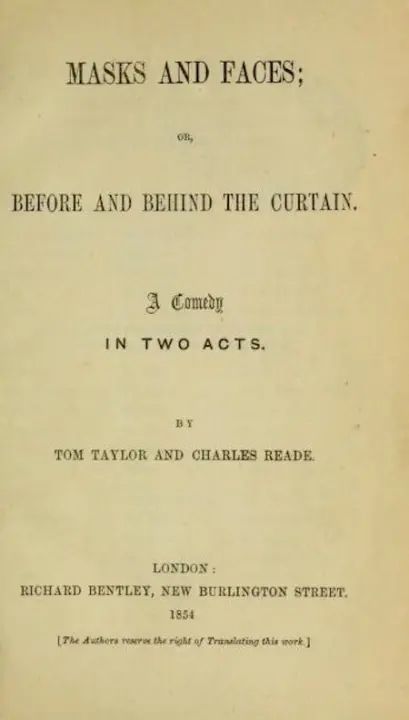
Masks and Faces; or, Before and Behind the Curtain: A Comedy in Two Acts
Tom Taylor & Charles Reade
THE CLASSIC COLLECTION · 1863
"A Simpleton" by Charles Reade is a novel written during the late 19th century. The story centers around a young lady named Rosa Lusignan and her romantic entanglements, particularly with a dedicated physician, Dr. Christopher Staines, and the societal constraints they face. Set against the backdrop of evolving notions of love and marriage, the book explores themes of class, gender roles, and the complexities of human relationships. The beginning of the novel introduces us to Rosa, who is anxiously waiting for Dr. Staines while engaged in an unproductive sewing project. We learn about her beauty and her various skills, but also her dissatisfaction with her current life. The scene shifts when Dr. Staines arrives, highlighting their budding romance filled with youthful hopes and aspirations. However, complications arise when Rosa's father, Mr. Lusignan, disapproves of their relationship due to Dr. Staines' lack of financial security. The unfolding drama captures Rosa's emotional journey, further complicated by health issues and societal expectations, setting the stage for conflicts and dilemmas that will resonate throughout the novel.
Introduction adapted from the source catalogue; source summaries may be automatically generated.
Free to read · English · 130,713 words · No account needed
MAKE TIME FOR A GOOD BOOK
On by default. Untick to stop anonymous reading totals. Each page counts after 10 seconds in view. How this works.
Anonymous counting is on unless you have switched it off.
“Sublata causa tollitur effectus.” The stays being gone, and dissipation moderated, Mrs. Staines bloomed again, and they gave one or two unpretending little dinners at the Bijou. Dr. Staines admitted no false friends to these. They never went beyond eight; five gentlemen, three ladies. By this arrangement the terrible discursiveness of the fair, and man's cruel disposition to work a subject threadbare, were controlled and modified, and a happy balance of conversation established. Lady Cicely Treherne was always invited, and always managed to come; for she said, “They were the most agweeable little paaties in London, and the host and hostess both so intewesting.” In the autumn, Staines worked double tides with the pen, and found a vehicle for medical narratives in a weekly magazine that did not profess medicine.
This new vein put him in heart. His fees, towards the end of the year, were less than last year, because there was no hundred-guinea fee; but there was a marked increase in the small fees, and the unflagging pen had actually earned him two hundred pounds, or nearly. So he was in good spirits.
Not so Mrs. Staines; for some time she had been uneasy, fretful, and like a person with a weight on her mind.
One Sunday she said to him, “Oh, dear, I do feel so dull. Nobody to go to church with, nor yet to the Zoo.”
“I'll go with you,” said Staines.
“You will! To which?”
“To both; in for a penny, in for a pound.”
So to church they went; and Staines, whose motto was “Hoc age,” minded his book. Rosa had intervals of attention to the words, but found plenty of time to study the costumes.
During the Litany in bustled Clara, the housemaid, with a white jacket on so like her mistress's, that Rosa clutched her own convulsively, to see whether she had not been skinned of it by some devilish sleight-of-hand.
No, it was on her back; but Clara's was identical.
In her excitement, Rosa pinched Staines, and with her nose, that went like a water-wagtail, pointed out the malefactor. Then she whispered, “Look! How dare she? My very jacket! Earrings too, and brooches, and dresses her hair like mine.”
“Well, never mind,” whispered Staines. “Sunday is her day. We have got all the week to shine. There, don't look at her--'From all evil speaking, lying, and slandering'”--
“I can't keep my eyes off her.”
“Attend to the Litany. Do you know, this is really a beautiful
composition?”
“I'd rather do the work fifty times over myself.”
“Hush! people will hear you.”
Your reading position is saved on this browser. Take it to another device with a library code. Reading pages adapt to text, rather than matching a printed edition.
Tom Taylor & Charles Reade
Charles Reade
Charles Reade
Charles Reade
BEHIND THE BOOK
This eBook is for the use of anyone anywhere in the United States and most other parts of the world at no cost and with almost no restrictions whatsoever. You may copy it, give it away or re-use it under the terms of the Project Gutenberg License included with this eBook or online at www.gutenberg.org. If you are not located in the United States, you will have to check the laws of the country where you are located before using this eBook. Read the source licence.
The original source file, including credits and licence, is retained by this library. Request an original-format copy at no charge. Please include the book title and Project Gutenberg identifier #2301.
KEEP YOUR CURIOSITY GOING
Coulson Kernahan

Maurice Baring
Frances Wright
Cécile Tormay

Frederic Jesup Stimson

W. H. P. (William Henry Pope) Jarvis