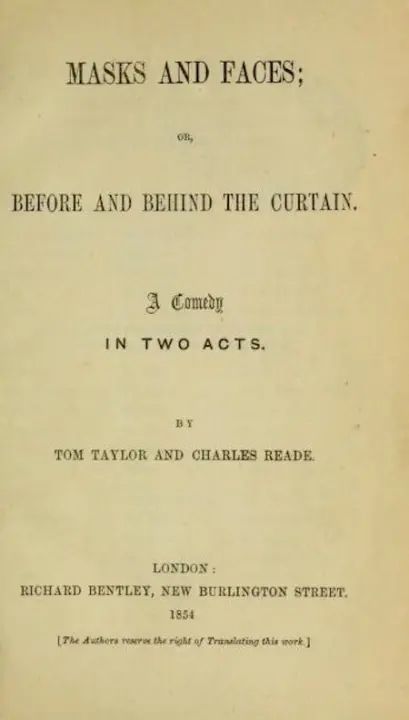
Masks and Faces; or, Before and Behind the Curtain: A Comedy in Two Acts
Tom Taylor & Charles Reade
THE CLASSIC COLLECTION · 1863
"A Simpleton" by Charles Reade is a novel written during the late 19th century. The story centers around a young lady named Rosa Lusignan and her romantic entanglements, particularly with a dedicated physician, Dr. Christopher Staines, and the societal constraints they face. Set against the backdrop of evolving notions of love and marriage, the book explores themes of class, gender roles, and the complexities of human relationships. The beginning of the novel introduces us to Rosa, who is anxiously waiting for Dr. Staines while engaged in an unproductive sewing project. We learn about her beauty and her various skills, but also her dissatisfaction with her current life. The scene shifts when Dr. Staines arrives, highlighting their budding romance filled with youthful hopes and aspirations. However, complications arise when Rosa's father, Mr. Lusignan, disapproves of their relationship due to Dr. Staines' lack of financial security. The unfolding drama captures Rosa's emotional journey, further complicated by health issues and societal expectations, setting the stage for conflicts and dilemmas that will resonate throughout the novel.
Introduction adapted from the source catalogue; source summaries may be automatically generated.
Free to read · English · 130,713 words · No account needed
MAKE TIME FOR A GOOD BOOK
On by default. Untick to stop anonymous reading totals. Each page counts after 10 seconds in view. How this works.
Anonymous counting is on unless you have switched it off.
Then she took down one hand--the left--and gave it him, averting her face tenderly, and still covering it with her right; “For,” said she to herself, “I am such a fright now.” This opportune reflection, and her heaving bosom, proved that she at least felt herself something more than his patient. Her pretty consciousness made his task more difficult; nevertheless, he only allowed himself to press her hand tenderly with both his palms one moment, and then he entered on his functions bravely. “I am here as your physician.”
“Very well,” said she softly.
He gently detained the hand, and put his finger lightly to her pulse; it was palpitating, and a fallacious test. Oh, how that beating pulse, by love's electric current, set his own heart throbbing in a moment!
He put her hand gently, reluctantly down, and said, “Oblige me by turning this way.” She turned, and he winced internally at the change in her; but his face betrayed nothing. He looked at her full; and, after a pause, put her some questions: one was as to the color of the hemorrhage. She said it was bright red.
“Not a tinge of purple?”
“No,” said she hopefully, mistaking him.
He suppressed a sigh.
Then he listened at her shoulder-blade and at her chest, and made her draw her breath while he was listening. The acts were simple, and usual in medicine, but there was a deep, patient, silent intensity about his way of doing them.
Mr. Lusignan crept nearer, and stood with both hands on a table, and his old head bowed, awaiting yet dreading the verdict.
Up to this time, Dr. Staines, instead of tapping and squeezing, and pulling the patient about, had never touched her with his hand, and only grazed her with his ear; but now he said “Allow me,” and put both hands to her waist, more lightly and reverently than I can describe; “Now draw a deep breath, if you please.”
“There!”
“If you could draw a deeper still,” said he, insinuatingly.
“There, then!” said she, a little pettishly.
Dr. Staines's eye kindled.
“Hum!” said he. Then, after a considerable pause, “Are you better or worse after each hemorrhage?”
“La!” said Rosa; “they never asked me that. Why, better.”
“No faintness?”
“Not a bit.”
“Rather a sense of relief, perhaps?”
“Yes; I feel lighter and better.”
The examination was concluded.
Dr. Staines looked at Rosa, and then at her father. The agony in that aged face, and the love that agony implied, won him, and it was to the parent he turned to give his verdict.
“The hemorrhage is from the lungs”--
Lusignan interrupted him: “From the lungs!” cried he, in dismay.
Your reading position is saved on this browser. Take it to another device with a library code. Reading pages adapt to text, rather than matching a printed edition.
Tom Taylor & Charles Reade
Charles Reade
Charles Reade
Charles Reade
BEHIND THE BOOK
This eBook is for the use of anyone anywhere in the United States and most other parts of the world at no cost and with almost no restrictions whatsoever. You may copy it, give it away or re-use it under the terms of the Project Gutenberg License included with this eBook or online at www.gutenberg.org. If you are not located in the United States, you will have to check the laws of the country where you are located before using this eBook. Read the source licence.
The original source file, including credits and licence, is retained by this library. Request an original-format copy at no charge. Please include the book title and Project Gutenberg identifier #2301.
KEEP YOUR CURIOSITY GOING
Coulson Kernahan

Maurice Baring
Frances Wright
Cécile Tormay

Frederic Jesup Stimson

W. H. P. (William Henry Pope) Jarvis