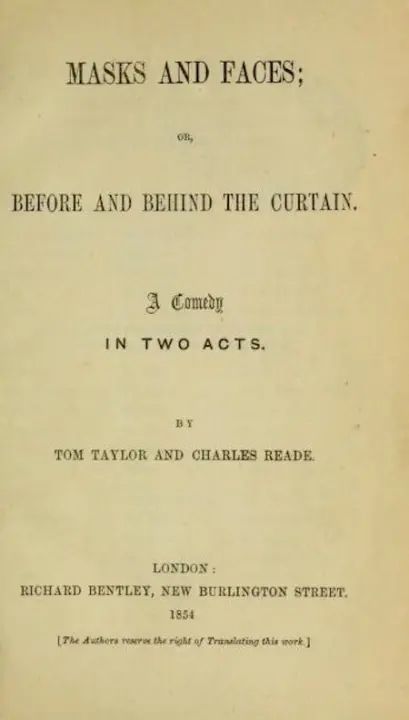
Masks and Faces; or, Before and Behind the Curtain: A Comedy in Two Acts
Tom Taylor & Charles Reade
THE CLASSIC COLLECTION · 1863
"A Simpleton" by Charles Reade is a novel written during the late 19th century. The story centers around a young lady named Rosa Lusignan and her romantic entanglements, particularly with a dedicated physician, Dr. Christopher Staines, and the societal constraints they face. Set against the backdrop of evolving notions of love and marriage, the book explores themes of class, gender roles, and the complexities of human relationships. The beginning of the novel introduces us to Rosa, who is anxiously waiting for Dr. Staines while engaged in an unproductive sewing project. We learn about her beauty and her various skills, but also her dissatisfaction with her current life. The scene shifts when Dr. Staines arrives, highlighting their budding romance filled with youthful hopes and aspirations. However, complications arise when Rosa's father, Mr. Lusignan, disapproves of their relationship due to Dr. Staines' lack of financial security. The unfolding drama captures Rosa's emotional journey, further complicated by health issues and societal expectations, setting the stage for conflicts and dilemmas that will resonate throughout the novel.
Introduction adapted from the source catalogue; source summaries may be automatically generated.
Free to read · English · 130,713 words · No account needed
MAKE TIME FOR A GOOD BOOK
On by default. Untick to stop anonymous reading totals. Each page counts after 10 seconds in view. How this works.
Anonymous counting is on unless you have switched it off.
But the moment he got her alone he kissed her paternally, and said, “Rosa, it is not lost on me, your fidelity to the dead. As years roll on, and your deep wound first closes, then skins, then heals--”
“Ah, let me die first--”
“Time and nature will absolve you from that vow; but bless you for thinking this can never be. Rosa, your folly of this day has made you my heir; so never let money tempt you, for you have enough, and will have more than enough when I go.”
He was as good as his word; altered his will next day, and made Rosa his residuary legatee. When he had done this, foreseeing no fresh occasion for his services, he prepared for a long visit to Italy. He was packing up his things to go there, when he received a line from Lady Cicely Treherne, asking him to call on her professionally. As the lady's servant brought it, he sent back a line to say he no longer practised medicine, but would call on her as a friend in an hour's time.
He found her reclining, the picture of lassitude. “How good of you to
come,” she drawled.
“What's the matter?” said he brusquely.
“I wish to cawnsult you about myself. I think if anybody can brighten me up, it is you. I feel such a languaw--such a want of spirit; and I get palaa, and that is not desiwable.”
He examined her tongue and the white of her eye, and told her, in his blunt way, she ate and drank too much.
“Excuse me, sir,” said she stiffly.
“I mean too often. Now, let's see. Cup of tea in bed, of a morning?”
“Yaas.”
“Dinner at two?”
“We call it luncheon.”
“Are you a ventriloquist?”
“No.”
“Then it is only your lips call it luncheon. Your poor stomach, could it speak, would call it dinner. Afternoon tea?”
“Yaas.”
“At seven-thirty another dinner. Tea after that. Your afflicted stomach gets no rest. You eat pastry?”
“I confess it.”
“And sugar in a dozen forms?”
She nodded.
“Well, sugar is poison to your temperament. Now I'll set you up, if you can obey. Give up your morning dram.”
“What dwam?”
“Tea in bed, before eating. Can't you see that is a dram? Animal food twice a day. No wine but a little claret and water; no pastry, no sweets, and play battledore with one of your male subjects.”
“Battledaw! won't a lady do for that?”
“No: you would get talking, and not play ad sudorem.”
“Ad sudawem! what is that?”
“In earnest.”
“And will sudawem and the west put me in better spiwits, and give me a
tinge?”
Your reading position is saved on this browser. Take it to another device with a library code. Reading pages adapt to text, rather than matching a printed edition.
Tom Taylor & Charles Reade
Charles Reade
Charles Reade
Charles Reade
BEHIND THE BOOK
This eBook is for the use of anyone anywhere in the United States and most other parts of the world at no cost and with almost no restrictions whatsoever. You may copy it, give it away or re-use it under the terms of the Project Gutenberg License included with this eBook or online at www.gutenberg.org. If you are not located in the United States, you will have to check the laws of the country where you are located before using this eBook. Read the source licence.
The original source file, including credits and licence, is retained by this library. Request an original-format copy at no charge. Please include the book title and Project Gutenberg identifier #2301.
KEEP YOUR CURIOSITY GOING
Coulson Kernahan

Maurice Baring
Frances Wright
Cécile Tormay

Frederic Jesup Stimson

W. H. P. (William Henry Pope) Jarvis